

Walk through the packaging decisions of almost any Australian eCommerce business, retail operator, or food service supplier, and sooner or later the conversation will turn to corrugated board. The specific grade of corrugated you choose has a direct impact on product protection, presentation, storage efficiency, and freight performance. Yet for many businesses, the choice between flute types is made without a solid understanding of what each one actually delivers.
E-flute corrugated sits in a particularly useful position across the packaging spectrum. It is thin enough to store and ship efficiently, smooth enough to carry high-quality print, and structurally capable enough to protect a wide range of products across retail, eCommerce, and commercial applications. At Premium Packaging, we supply E-flute corrugated solutions to businesses across Australia, and this guide covers everything procurement managers, warehouse supervisors, and operations teams need to know before making a decision.
Before focusing specifically on E-flute, it helps to understand what corrugated fluting actually is and what role it plays in packaging performance.
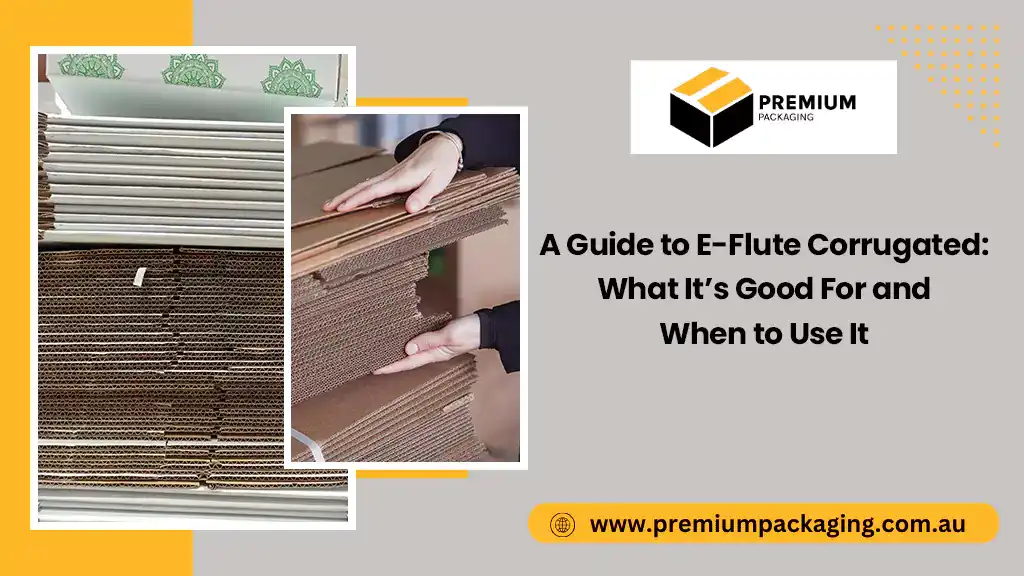
Corrugated board is made up of three layers. Two flat outer sheets, known as liners, sandwich a middle layer of wavy, arch-shaped paper. That middle layer is the fluting. The fluting is what gives corrugated board its strength, cushioning capability, and structural rigidity. Without it, you would simply have two flat sheets of paper pressed together.
The flute profile, which refers to the height and density of those arches, determines almost everything about how a corrugated sheet performs. A taller, larger arch provides more cushioning and compression strength. A shorter, denser arch creates a smoother surface, allows for tighter structural tolerances, and reduces overall board thickness.
Flute types are designated by letter, and those letters reflect the order in which each profile was developed, not their size ranking. The profiles in common commercial use include A, B, C, E, and F. Each has a defined role in packaging design, and no single profile is universally superior. The right choice depends on what you are packaging, how it is being transported, and what you need the packaging to communicate.
E-flute sits towards the thinner end of the corrugated spectrum. It measures approximately 1.5 to 2.0 millimetres in thickness and contains around 90 flutes per linear foot. That high flute density is the key to its performance.
Because the arches are smaller and more tightly spaced, the outer surface of E-flute board is noticeably smoother than thicker profiles like B or C flute. That smoothness is not incidental. It is what makes E-flute the preferred substrate when print quality is a priority.
For businesses where the packaging is part of the product experience, whether that is a branded mailer box for an eCommerce order or a retail shelf carton that needs to carry sharp graphics and clear colour, E-flute provides a surface that supports those outcomes in a way that bulkier corrugated profiles simply cannot match.
Beyond print performance, E-flute offers several other operational advantages that make it well-suited to specific commercial contexts.
The density of flutes per foot in E-flute board creates a surface that is close to flat, giving it print characteristics that approach those of solid board. Litho printing, flexographic printing, and digital printing all perform at a higher standard on E-flute than on coarser profiles. Colour reproduction is more accurate, fine text is cleaner, and logo placement holds precision. For retail-facing packaging, this matters considerably.
At roughly 1.5 to 2.0 millimetres, E-flute takes up significantly less space than B-flute (approximately 2.5 to 3.5mm) or C-flute (approximately 3.7 to 4.0mm). In practical terms, this means flatpacked E-flute cartons store more densely in your packaging room or warehouse, and the outer dimensions of finished boxes are smaller relative to the interior volume. For businesses managing freight costs on a per-cubic-metre basis, this reduction in board thickness translates to genuine savings over time.
E-flute is not a flimsy material. With around 90 flutes per foot, the dense arch structure provides solid crush resistance that is more than adequate for lighter to medium weight goods. It holds its shape under reasonable stacking pressure and protects contents from lateral impact effectively. The limitation comes at heavier load weights and larger box sizes, where thicker profiles begin to perform more reliably.
E-flute board is lighter than the thicker corrugated profiles. For businesses calculating freight costs where weight is a billing factor, packaging made from E-flute contributes less to total shipment weight. Across large order volumes, the cumulative difference is worth accounting for in procurement decisions.
E-flute corrugated is fully recyclable and is available in grades produced from recycled fibre content. For businesses working toward sustainability targets or carrying formal environmental commitments, E-flute sourced from responsibly managed material streams supports those goals without compromising packaging performance.
Understanding where E-flute excels means looking at the specific commercial applications where its properties align with operational requirements.
For eCommerce businesses, E-flute is one of the most practical corrugated options available. The combination of smooth printability, compact thickness, and adequate crush resistance makes it well-suited for branded mailer boxes, subscription boxes, and product-specific shipping cartons.
The reduced board thickness means a mailer box built from E-flute takes up less space in your dispatch area when stored flat, and the finished box dimensions remain tight around the product, reducing void space and the need for excessive protective fill.
For businesses focused on unboxing experience, E-flute provides the surface quality needed to carry brand graphics without the cardboard texture bleeding through the print. That attention to presentation at point of opening reflects positively on the brand and supports repeat purchase.
Retail-facing packaging needs to look sharp at close range. Shoppers interact with shelf packaging directly, reading product information, examining graphics, and making judgements based on visual quality. E-flute delivers the print fidelity needed to support this application in a way that heavier corrugated board does not.
Retail cartons for cosmetics, personal care products, food accessories, household goods, and specialty items are all categories where E-flute is the preferred corrugated choice. The board is rigid enough to hold shape on shelf while remaining light enough that overall packaging weight does not add unnecessarily to freight or handling costs.
For point of sale display units, E-flute provides sufficient structural integrity for floor-standing or counter-top configurations while keeping the total weight of the assembled display manageable.
Products in the low to medium weight range, such as clothing, accessories, small homewares, stationery, personal care items, and packaged food accessories, are well served by E-flute corrugated cartons. The board protects adequately through standard courier handling and the reduced thickness keeps outer box dimensions as small as possible relative to the goods inside.
For businesses paying freight costs per cubic metre or per kilogram, the efficiencies that come with E-flute packaging are real and worth factoring into your packaging specification decisions.
E-flute corrugated is used across food packaging applications where a smooth, clean surface and structural integrity are required. Cartons for packaged food products, gift food hampers, specialty retail food items, and gourmet product ranges benefit from E-flute’s print capability and food-safe material options.
Where food contact compliance requirements apply, it is important to specify board grades produced with food-safe liners and adhesives. Premium Packaging can advise on the appropriate specifications for your application.
E-flute corrugated handles die-cutting and folding with greater precision than thicker profiles. This makes it suitable for custom structural packaging formats, including boxes with complex folds, internal inserts, tray and sleeve configurations, and self-locking bases. Businesses requiring packaging that follows the exact contours of a product, or that incorporates structural features to eliminate the need for loose fill, will find E-flute easier to work with from a conversion standpoint.
Being clear about the limitations of E-flute is just as useful as understanding its strengths.
E-flute is not the appropriate specification for heavy or dense products. Once load weights move into the upper range or box sizes become large, the thinner profile begins to show limitations in stacking strength and compression resistance. For heavier goods, or for applications involving palletised stacking under significant load, B-flute or double-wall EB-flute are the more suitable specifications.
E-flute also has a lower tolerance for external moisture compared to thicker profiles. In warehouse or logistics environments where humidity exposure is a factor, board treatment or lamination may be required, or a more robust profile selected.
For very large outer shipping cartons carrying multiple units or heavy components, E-flute alone will generally not provide the structural performance required. In these cases, a double-wall combination such as EB-flute, which pairs the smooth outer surface of E-flute with the stacking strength of B-flute, is worth considering.
Learn more: https://premiumpackaging.com.au/blog/e-flute-corrugated-uses-guide/

© 2025 Crivva - Hosted by Airy Hosting Managed Website Hosting.