

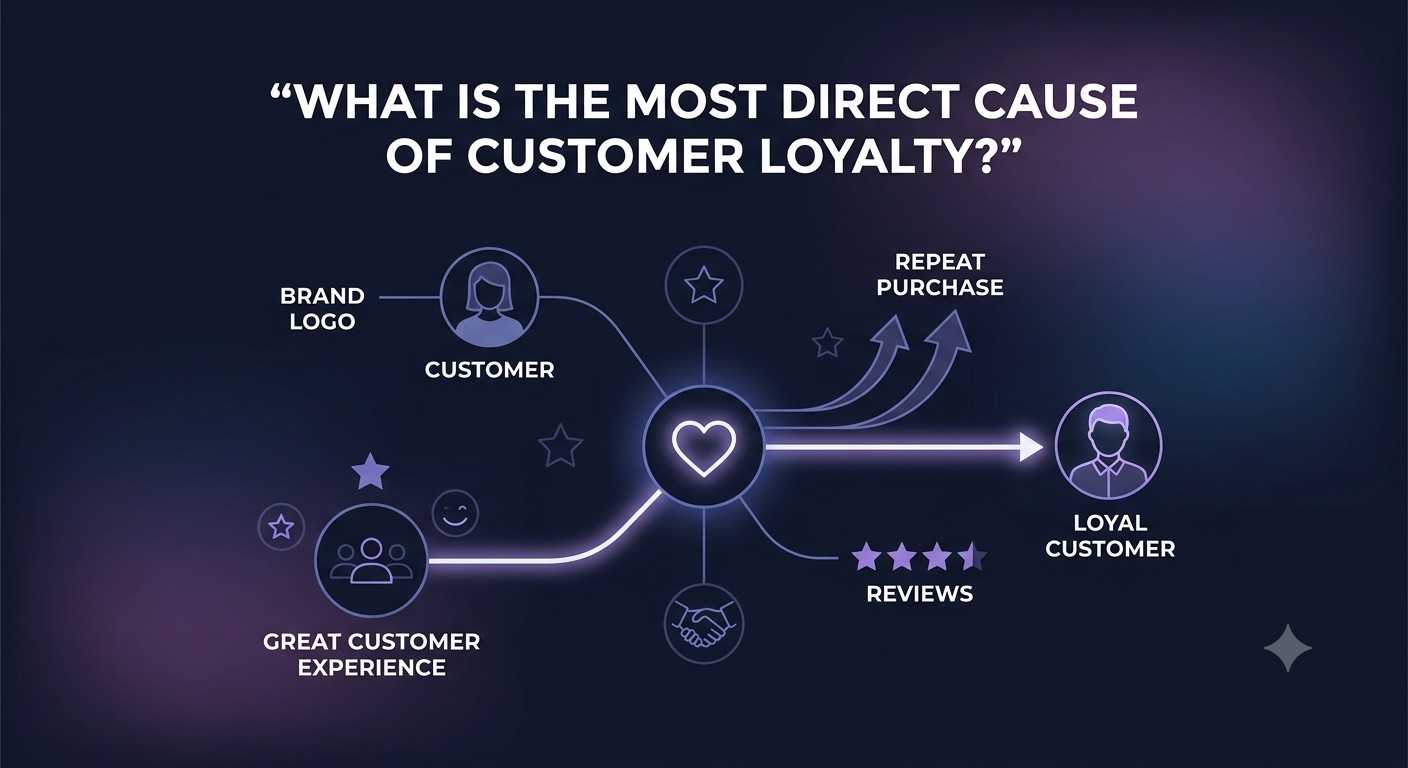
The most direct cause of customer loyalty is a consistent, positive customer experience, specifically the repeated pattern of a brand delivering on its promises with minimal friction. When customers trust that a brand will meet their expectations every single time, they stop shopping around. According to research from 2025, customer experience now accounts for up to 55% of brand loyalty in key sectors, outpacing price, rewards, and even product quality as a standalone driver.
You probably know the feeling. You’ve tried a brand once, liked it, and then without ever consciously deciding to, you keep going back. Not because of a coupon. Not because their app pinged you. Just because they made it easy, they got it right, and over time, you stopped second-guessing them. That’s loyalty. And it turns out that the pattern of expectations being met repeatedly is the single most direct cause of it.
The debate between “is it price?” and “is it experience?” has been running for years. In 2025, the data settled it more clearly than ever.
Forrester’s ongoing research found that for banks, customer experience accounts for 55% of loyalty. For retailers, it drives 46.5%, and critically, adding price-value data into the equation only bumped those numbers by about one percentage point. What that tells us is that price doesn’t stack on top of experience; it plays a secondary role entirely.
Meanwhile, Adobe’s 2025 consumer survey of 1,003 US shoppers found that the top drivers of repeat purchase were fair pricing (69%), high product quality (66%), and positive experience (61%). Notice that “experience” is only slightly behind price, and unlike pricing, it compounds over time. A good experience today makes the next purchase easier. A bad one ends the relationship.
Here’s what makes “consistent experience” more than just a vague buzzword: it works through a psychological mechanism called reduced perceived risk. Every time a customer buys from you, they’re placing a small bet. Will this arrive on time? Will it match what I saw online? Will someone help me if something goes wrong?
When you answer those bets correctly every time, you’re not just satisfying a customer. You’re eliminating the friction that makes them consider an alternative. That’s the most direct cause of customer loyalty: not the reward points, not the birthday email, but the absence of a reason to leave.
Loyalty isn’t bought with discounts anymore. It’s built through consistent, trustworthy experiences and lost the moment that trust cracks.
Nector.io What Drives Customer Loyalty, 2025
PwC’s 2025 Customer Experience Survey puts it bluntly: loyalty now begins long before a purchase. It’s seeded in Reddit threads, friend recommendations, and product reviews, a multi-touch process where consistency at every stage is the price of admission. One broken link breaks the chain.
Price matters; nobody’s arguing otherwise. SAP Emarsys found in 2025 that more than half of consumers see lower prices as part of what loyalty looks like. But here’s the problem with building a strategy around it: price is the easiest thing for a competitor to match overnight. A customer who’s with you purely on price is one sale away from being someone else’s customer.
The data on what breaks loyalty is even more telling. According to SAP Emarsys’s 2025 research, more than half of consumers would abandon a brand if product quality slipped. Nearly half say price increases make them reconsider. But almost half also say poor customer service is a direct trigger for leaving, and that’s a factor you have complete control over.
The most important number you’re probably not tracking: 72% of customers would walk away from a brand after rude or unhelpful service (Adobe 2025). That’s not a pricing problem. That’s a people-and-process problem, and it’s fixable.
WiserReview’s 2026 data shows that for the first time, quality and experience have surpassed price as the leading drivers of brand commitment. A full 59% of consumers cite high-quality products as their top driver of loyalty. Quality isn’t the differentiator anymore; it’s the table stakes. Slip on it even once, and you’ve opened the door for a competitor to walk through.
Customers who trust a brand are 88% more likely to make repeat purchases. Trust isn’t a feeling; it’s a track record. It’s built through accurate product descriptions, on-time delivery, clear communication when something goes wrong, and honest advertising. SAP Emarsys notes that over a third of consumers in 2025 say they’ll withdraw loyalty if brands misuse their personal data, up from 30% the year before. Trust is fragile, and once broken, it rarely fully recovers.
PwC’s 2025 survey found that over a quarter of consumers cite friction-free interactions across all touchpoints as a key reason to stay loyal. This is the operational side of loyalty: how easy is your checkout? How fast is your support response? How clear is your returns process? Ease of doing business compounds on top of trust and quality to create the kind of loyalty that doesn’t need to be earned back every cycle.
PwC’s customer loyalty research found that executives consistently overestimate by 10 to 18 percentage points how much consumers value secondary drivers such as personalization. Only 8% of consumers say they stay loyal because of personalized experiences, but 26% of executives believe that’s a key driver. Meanwhile, the basics of reliable quality, service, and consistent value are underinvested.
The most direct cause of customer loyalty is hiding in plain sight. It’s not a loyalty app. It’s not the point. It’s whether your customer, after every single interaction, walks away thinking: “That was exactly what I expected. I’ll be back.”
The most direct cause of customer loyalty is a consistent, positive customer experience built on trust, quality, and low friction. Price and rewards programs influence loyalty, but they don’t create it. What creates it is a consistent pattern of delivering on your promises, making it easy, and handling problems honestly. Customers who experience this stop looking for alternatives, not because they can’t find any, but because they no longer feel the need to look.
The most direct cause of customer loyalty is a consistent positive customer experience, specifically, a brand repeatedly delivering on its promises with minimal friction. When customers trust that expectations will be met every time, they stop considering alternatives. Forrester research found that CX alone accounts for up to 55% of loyalty in key sectors, outpacing price as a standalone driver.
Customer experience is more important for long-term loyalty. While pricing influences purchase decisions, Forrester found that adding price-value data on top of CX data only marginally improves loyalty outcomes. Price attracts customers; experience keeps them. Brands that compete on price alone are vulnerable to any competitor willing to go lower.
According to 2025 research from Adobe, Deloitte, and SAP Emarsys, the top drivers are: (1) consistent product quality cited by 59% of consumers, (2) competitive pricing, (3) positive experience, (4) excellent customer service, and (5) brand trust. For the first time, quality and experience have collectively surpassed price as the leading combined driver of loyalty.
The fastest loyalty-killers in 2025 are: poor customer service (cited by nearly half of consumers), a perceived drop in product quality (cited by over half), price increases, misleading advertising, and misuse of personal data. A single bad experience is enough to make 76% of customers switch brands, even those who were previously satisfied (Salesforce 2025).
Loyalty programs support retention but don’t create genuine loyalty on their own. Deloitte’s 2025 Consumer Loyalty Program Survey found that while price, value, and quality remain the top loyalty drivers, well-designed programs come close behind. Programs work best when they reinforce an already-positive experience; they reward loyalty that exists, but rarely manufacture it from scratch.

© 2025 Crivva - Hosted by Airy Hosting Managed Website Hosting.