

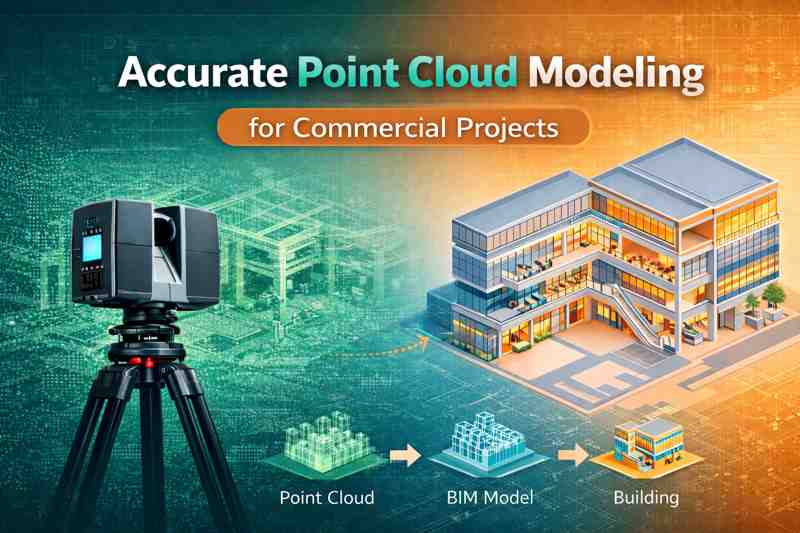
The initiation of design, planning, and MEP integration for commercial construction and renovation projects relies on precise as-built data from office towers, retail complexes, industrial facilities, and large-scale retrofit projects. Point cloud modeling (Scan to BIM) leverages 3D laser scanners and UAV/drone-based LiDAR scanning to generate detailed digital twins from millions of spatial data points. These high-fidelity models eliminate traditional surveying limitations, reduce costly errors during early project phases, and provide a centralized BIM database accessible to architects, engineers, contractors, and owners.
Incorrect or low-accuracy modeling introduces deviations from actual structures, resulting in extended timelines, rework, and increased project costs.
Point cloud modeling encompasses several key service categories:
This foundational service converts raw point cloud data into information-rich BIM models using platforms such as Autodesk Revit, Leica CloudWorx, or equivalent tools. TrueCADD provides Scan to BIM solutions across architectural, structural, and MEP domains, producing precise models for construction coordination and documentation.
BIM model development involves geometric data capture, enriched with metadata, spatial relationships, and discipline-specific details for construction documentation, coordination, and facility management. Deliverables include 3D BIM models, 2D plans, elevations, and sections, and as-built documentation derived from point cloud datasets.
Clash detection workflows identify interferences between structural, architectural, and MEP systems, preventing onsite conflicts and reducing rework in commercial and complex facility projects.
Selecting a commercial point cloud modeling services provider requires rigorous technical scrutiny. Critical performance indicators include:
BIM models must match the physical building geometry with millimeter-level precision. Accuracy depends on scanner type, scan registration quality, and model verification protocols.
LOD 300 or higher is often required for commercial coordination, where the geometry is sufficient for construction planning and documentation. TrueCADD delivers models aligned with project-specific LOD standards.
Providers must operate within a robust BIM software ecosystem. Core tools include Autodesk Revit for BIM authoring and Recap/CloudWorx for point cloud processing, ensuring compatibility with client systems.
Commercial projects may involve hundreds of point cloud scans. Fast delivery requires optimized processing workflows, scalable design teams, and standardized Revit layer conventions.
When comparing point cloud modeling providers, consider the following technical criteria:
|
Criteria |
Technical Requirement |
Ideal Provider |
|
Accuracy |
Millimeter-level BIM alignment |
Sub-centimeter precision verified through QC |
|
Software & Tools |
Industry-standard platforms |
Autodesk Revit, Recap, CloudWorx |
|
Deliverables |
BIM models + construction documentation |
3D BIM & extracted 2D plans |
|
Project Expertise |
Commercial, heritage, retrofit |
Proven experience across sectors |
TrueCADD supports multi-disciplinary collaboration, enabling architects, engineers, and MEP teams to merge models into a unified BIM environment. Differences among providers typically stem from execution methods, operational systems, and quality control protocols.
Machine learning and AI enable automatic object recognition, segmentation, and semantic classification of point cloud datasets, accelerating modeling and improving accuracy.
Cloud BIM solutions allow distributed teams to handle large point cloud datasets, improving coordination in commercial projects with multiple stakeholders.
Handheld LiDAR and drone scanning facilitate data capture in inaccessible areas, enabling precise spatial modeling across complex facilities.
A European topographic services firm engaged TrueCADD to model a 111,000 m² commercial building using 133 point cloud scans. Outcomes included:
Before hiring a point cloud modeling provider, confirm:
For complex commercial projects, organizations must prioritize precision, workflow transparency, and sector expertise. TrueCADD demonstrates:
Selecting a provider with both technical expertise and a track record of successful project delivery ensures the creation of high-fidelity BIM assets from point cloud datasets, enabling accurate, efficient, and coordinated commercial construction workflows.
1. What is commercial point cloud modeling?
Commercial point cloud modeling is the process of turning laser-scanned data into accurate 3D BIM models of real buildings. It shows the exact shape, size, and layout of a commercial space.
2. Why is point cloud modeling important for commercial buildings?
It helps teams work with correct building data. This reduces errors, avoids guesswork, and improves planning for renovations, MEP upgrades, and new construction.
3. What types of buildings use point cloud modeling?
It is used for offices, malls, hospitals, factories, warehouses, and large retrofit projects.
4. What is LOD in BIM?
LOD stands for Level of Development. It shows how detailed a BIM model is. Commercial projects usually need LOD 300 or higher.
5. What software is used for point cloud modeling?
Common tools include Autodesk Revit, ReCap, and CloudWorx. These tools help create accurate and usable BIM models.
6. What deliverables do Scan to BIM services provide?
You receive 3D BIM models, floor plans, elevations, sections, and sometimes clash reports.
6. How does AI help in point cloud modeling?
AI helps recognize objects and shapes automatically, making modeling faster and more accurate.
7. What are UAV or drone scans used for?
Drones capture hard-to-reach areas like roofs and tall structures for complete building data.
8. How do I know if a provider is reliable?
A good provider follows accuracy checks, uses industry software, and has experience with commercial projects.
9. Why choose a company like TrueCADD?
TrueCADD offers accurate Scan to BIM services, supports large commercial projects, and provides LOD-based BIM models for smooth coordination.

© 2025 Crivva - Hosted by Airy Hosting Managed Website Hosting.