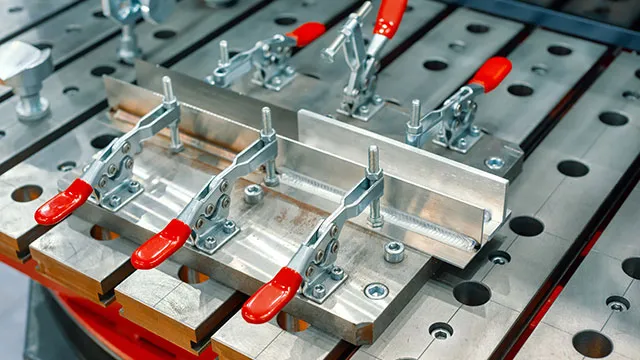
In CNC machining, achieving consistent quality depends on how parts are positioned, supported, and held during every operation. Even with advanced machines, inaccurate or unstable workholding can lead to costly errors and wasted material. Jigs and fixtures tooling plays a pivotal role in ensuring workpieces are aligned precisely, secured effectively, and machined with repeatable accuracy. Proper workholding reduces variability, speeds up setups, and enhances overall production efficiency, allowing manufacturers to deliver high-quality parts reliably.
Modern CNC manufacturers face increasing demands for complex geometries, tighter tolerances, and faster production cycles. Using high-quality jigs and fixtures tooling enables shops to address these challenges by providing stable setups that support repeatable machining operations. Workholding solutions improve dimensional control, protect cutting tools, and streamline processes to help businesses stay competitive in industrial markets.
The Critical Role of Jigs and Fixtures Tooling in CNC
Accurate Workpiece Location
Precise part placement is the foundation of CNC machining success. Jigs and fixtures locating systems establish stable reference points that align the workpiece with the machine coordinate system. This ensures each operation begins from the same datum, eliminating operator-dependent variation. Maintaining exact location helps achieve consistent dimensional accuracy across multiple production cycles.
Accurate locating also improves communication between design and production teams. A well-defined reference system makes CNC programs more reliable, reduces errors, and simplifies machine-to-machine replication, which ultimately strengthens production predictability.
Ensuring Consistent Manufacturing Output
Repeatability is vital for scalable CNC production. Once a fixture is verified, it allows operators to load and unload parts consistently without re-alignment. This repeatable workflow ensures each part experiences identical machining conditions, producing uniform quality and reducing defects.
Consistency also simplifies quality monitoring and supports statistical process control. Reliable jigs and fixtures tooling minimizes rework, scrap, and downtime, contributing to lower per-unit production costs and improved operational efficiency.
Key Principles of Jig and Fixture Design
Locating Surfaces and Part Constraint
Effective jigs and fixtures tooling controls part movement while avoiding over-constraint that can induce stress or distortion. Locating surfaces are chosen based on functional requirements rather than appearance, ensuring parts are aligned for machining accuracy.
Important considerations for design include:
-
Defining primary, secondary, and tertiary datums
-
Minimizing contact points while controlling all degrees of freedom
-
Using durable materials for long-term accuracy
Proper locating surfaces provide stable references that reduce setup errors and enhance machining performance.
Clamping Design and Force Management
Clamping secures the part against locating surfaces during machining. Balanced clamping applies enough pressure to resist cutting forces without causing distortion. Designers evaluate material properties, geometry, and cutting loads when determining clamp locations and force levels.
Effective clamping improves surface finish, reduces vibration, and protects both parts and cutting tools. Proper force distribution supports heavy cuts while maintaining part integrity and tooling life.
Operational Benefits of Using Jigs and Fixtures Tooling
Reducing Setup Time
Setup is a major contributor to CNC downtime. Jigs and fixtures tooling streamlines this process by integrating alignment and clamping into the fixture itself. Operators can position parts quickly and reliably, minimizing machine idle time between production runs.
Faster setups also reduce human error. When alignment is built into the fixture design, consistency is achieved regardless of operator skill, improving efficiency and supporting higher throughput.
Enhancing Workflow Efficiency
Well-designed fixtures improve shop floor workflow. Clear part orientation and accessible clamping points allow operators to handle components efficiently and safely. Simplified handling reduces errors, accelerates production, and supports smooth operations.
Higher workflow efficiency increases machine utilization, reduces bottlenecks, and ensures predictable production schedules, benefiting overall business performance.
Integration with Modern CNC Technology
Enabling Multi-Axis Machining
Multi-axis CNC machines require fixtures that provide rigid support while allowing tool access from multiple directions. Advanced jigs and fixtures tooling accounts for tool paths, machine motion, and clearance to avoid interference and maintain accuracy.
By minimizing setups, these fixtures reduce repositioning errors and maintain precise alignment, resulting in improved dimensional control, shorter cycle times, and superior part quality.
Supporting Automation and Scalable Production
Automation depends on consistent positioning. Fixtures must accommodate robotic loading and unloading with minimal variation. Even minor inconsistencies can disrupt automated workflows and reduce productivity.
Automation-ready jigs and fixtures tooling often incorporates self-locating features and standardized mounting interfaces. These designs enable reliable, unattended operation and scalable production without proportional increases in labor.
Application-Focused Jig and Fixture Design Devices
Precision-Critical Manufacturing Needs
Industries like aerospace, medical, and industrial equipment require stringent tolerances. Jig and fixture design devices for these applications must consider thermal expansion, vibration, and long machining cycles. Rigid materials and precision-machined surfaces help maintain stability under demanding conditions.
High-quality fixtures enhance machine capability, minimize variation, and support compliance with strict industry standards, enabling manufacturers to deliver consistent, high-quality components.
Handling Complex Component Geometries
Complex parts with thin walls, curved surfaces, or asymmetrical shapes often need custom workholding solutions. Standard fixtures may not provide adequate support. Custom-designed devices conform to part geometry, distribute forces evenly, and reduce deformation.
This tailored support minimizes chatter and vibration, allowing challenging components to be machined accurately and efficiently. Manufacturers can expand their production capabilities without increasing risk or scrap.
Long-Term Business Value of Jigs and Fixtures Tooling
Cost Efficiency Across Production Life
Custom jigs and fixtures tooling requires an initial investment but delivers long-term savings. Reduced scrap, fewer rejected parts, and shorter cycle times lower cost per unit. Over the lifecycle of a product, these savings often surpass the upfront cost of tooling.
Custom fixtures also protect cutting tools by reducing vibration and uneven loading. Extended tool life further decreases operating costs and ensures consistent production.
Process Stability and Quality Assurance
Stable, repeatable processes are easier to manage and improve. Custom jig and fixture design ensures each part is machined under controlled conditions. This consistency simplifies inspection, supports data-driven quality control, and reduces rework.
For B2B manufacturers, reliable quality strengthens client trust, reduces warranty claims, and improves reputation. Predictable processes also enable continuous optimization and efficiency gains.
Future Trends in Jigs and Fixtures Tooling
Digital Design and Simulation
CAD and simulation tools are revolutionizing fixture development. Designers can validate concepts digitally before physical production, reducing errors and shortening lead times.
Simulation allows optimization of locating and clamping strategies without extensive physical testing. The result is more efficient, reliable fixtures ready for immediate production.
Modular Fixtures and Flexible Workholding
Manufacturing environments increasingly require flexibility. Modular jigs and fixtures tooling allows components to be reconfigured for different parts while maintaining precision. This adaptability supports high-mix, low-volume production. Modular systems reduce setup time, enable rapid response to customer orders, and maintain accuracy, helping manufacturers stay competitive and responsive in dynamic markets.
By integrating advanced jigs and fixtures tooling into CNC production, manufacturers achieve higher accuracy, repeatability, and efficiency. Thoughtful fixture design transforms workholding into a strategic advantage that drives quality, productivity, and long-term operational success.