


Every year, thousands of children are injured in road traffic accidents across the United States. Many of those injuries are preventable. The single most effective tool available to parents and caregivers for protecting young passengers is not speed limits, not road design, and not vehicle safety ratings — it is the correct use of an age-appropriate, properly installed child restraint system.
Yet despite decades of public safety campaigns, misuse of child car seats remains alarmingly common. Harness straps set too loosely, children moved to the next seat stage too early, booster seats used in vehicles without proper seat belts, and winter coats left on during travel — these are mistakes that happen in well-meaning families every day, and they can have life-altering consequences in the event of a crash.
This article explores the broader landscape of child passenger safety in America — how the regulatory framework works, why seat requirements change as children grow, what parents consistently get wrong, and how staying informed through reliable resources like Global Transport News can help families make better, safer decisions every time they put a child in a vehicle.
The United States does not have a single national child car seat law. Instead, each state sets its own requirements governing which restraint systems must be used, at what ages, and under what circumstances. This creates a patchwork of regulations that can be confusing for families who travel across state lines, relocate frequently, or simply assume that what applies in one state applies everywhere.
Despite the variation in specific details, all state laws share the same underlying philosophy: children must be protected by restraint systems that match their physical development. A standard adult seat belt is designed for a body that is at least 4 feet 9 inches tall and weighs at least 80 pounds. Using one on a young child before they reach those thresholds can cause severe internal injuries — particularly to the abdomen and neck — in a collision, even at relatively low speeds.
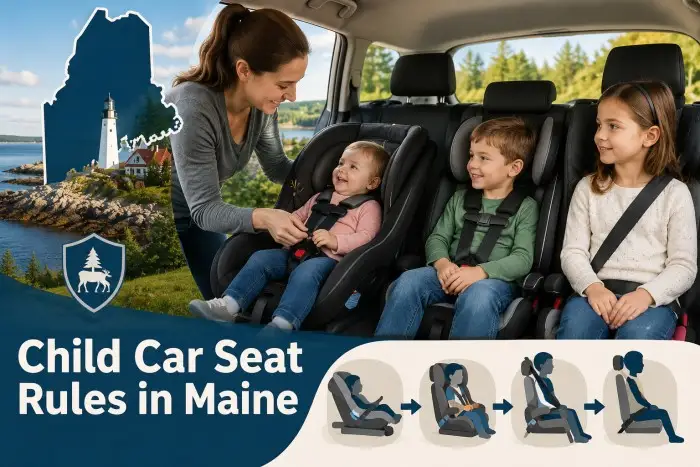
Most state laws and pediatric safety guidelines organize child restraint requirements into four broad developmental stages, each corresponding to a different type of seat.
Stage One — Rear-Facing Infant Seats: For newborns and infants, rear-facing car seats are the safest option available. In this position, the seat cradles and moves with the child during a crash, distributing the forces of impact across the entire back, shoulders, and head rather than concentrating them on a single point. Pediatric safety experts consistently recommend keeping children rear-facing for as long as the seat manufacturer’s height and weight limits allow — not just until the legal minimum age.
Stage Two — Forward-Facing Seats With Harness: Once a child has genuinely outgrown their rear-facing seat, a forward-facing seat with a five-point harness system becomes appropriate. The harness spreads crash forces across the stronger bony structures of the chest, shoulders, and hips, providing significantly better protection than a seat belt alone for children in this weight range.
Stage Three — Booster Seats: Booster seats serve a critical transitional purpose. They elevate the child so that the vehicle’s standard seat belt fits correctly — the lap portion across the upper thighs rather than the soft abdomen, and the shoulder belt across the chest and collarbone rather than the neck. Without a booster, children who are too small for adult seat belts are at serious risk of what safety researchers call “seat belt syndrome” — internal injuries caused by a belt that was never designed for their body.
Stage Four — Seat Belt Only: Children are ready for a standard seat belt when they can sit with their back flat against the seat, their knees bent naturally at the edge of the cushion, and the seat belt fitting correctly across both the lap and shoulder simultaneously. For most children, this does not happen until they are between 8 and 12 years old.
Because child car seat requirements vary by state, parents and caregivers who move between states or travel regularly need to actively check local regulations rather than assuming consistency. Some states set minimum age thresholds, others focus on height and weight, and many use a combination of all three.
For example, detailed state-specific guides such as the one covering Child Seat Laws in Maine illustrate how individual states structure their requirements across each developmental stage — from rear-facing rules for children under two, through booster seat requirements for children under eight or shorter than 57 inches, to recommendations about back seat positioning for children under thirteen.
Understanding your specific state’s laws is the starting point, but safety experts universally recommend going beyond the legal minimum. Laws set a floor, not a ceiling — the safest choice for your child may exceed what the law requires.
Studies conducted by child passenger safety organizations consistently find that the majority of car seats in use are either incorrectly installed, incorrectly used, or both. This is not primarily a matter of carelessness — it reflects the genuine complexity of car seat installation and the gap between what parents read in manuals and what they confidently execute in practice.
The harness should be snug enough that you cannot pinch any excess webbing between your fingers at the child’s collarbone. A loose harness allows the child to move forward during a crash, dramatically reducing the seat’s protective value. Conversely, twisted straps concentrate forces on narrow points rather than distributing them evenly.
Rear-facing seats for infants must be positioned at the correct recline angle to prevent the baby’s head from falling forward and obstructing their airway. Most modern seats include angle indicators, but parents frequently overlook this detail or allow the angle to shift over time as the vehicle seat compresses.
One of the most consequential mistakes parents make is moving children to the next seat stage before they have genuinely outgrown the current one. Rear-facing seats feel restrictive to active toddlers, and children often resist them — but the protection they offer is substantially superior to forward-facing seats for children who still fit within the weight and height limits. Transition decisions should be driven by the child’s measurements, not their age or their preferences.
In cold climates, parents routinely leave children in puffy winter coats while buckling them into their seats. This is a significant safety risk. The compressed thickness of a winter coat creates slack in the harness that is invisible to the eye but substantial in a crash. The correct approach is to buckle the child in their normal clothing and then place blankets or the coat over the harness rather than under it.
The proliferation of rideshare services has created a genuine grey area in child passenger safety. While many jurisdictions provide legal exemptions for taxis and rideshares, legal exemptions are not safety exemptions. A crash does not adjust its severity based on the type of vehicle involved.
Families using rideshare services with young children should carry a portable booster seat, confirm that functioning seat belts are available before starting the journey, and never hold a child on their lap as a substitute for a restraint system. For air travel, FAA-approved car seats used in aircraft seats provide substantially better protection during turbulence and emergency situations than lap belt seating alone.
With hundreds of car seat models available at a wide range of price points, selection can feel overwhelming. The most important principle is straightforward: the best car seat is the one that fits your child’s current measurements, fits correctly in your specific vehicle, and can be installed and used correctly every single time.
Price is not a reliable indicator of safety. What matters is whether the seat has been certified to meet federal safety standards, whether it is compatible with your vehicle’s seating geometry, and whether you can install it securely and operate the harness consistently. Parents are strongly encouraged to have their installation checked by a certified child passenger safety technician — a free service available at many fire stations, hospitals, and community health events across the country.
Car seats also have expiration dates, typically printed on a sticker on the base of the seat. Materials degrade over time, and older seats may not meet current safety standards. Purchasing secondhand seats should only be considered when the full crash history is known and the seat is confirmed to be unexpired and unrecalled.
Child passenger safety is not a static field. Research continues to refine understanding of how crash forces affect children of different sizes and ages, and both laws and manufacturer guidelines are updated accordingly. Parents who stay current with reliable transportation and safety news are better positioned to make informed decisions as their children grow and as their family’s circumstances change.
For families and caregivers who want to stay ahead of regulatory updates, safety recalls, and evidence-based guidance, following dedicated transport and road safety platforms provides a practical and accessible way to remain informed without having to monitor dozens of individual state agencies.
Child passenger safety is one of the clearest examples of an area where knowledge directly translates to lives saved. The technology exists, the regulations exist, and the guidance from pediatric and safety experts is consistent and well-established. What bridges the gap between policy and protection is informed, attentive parenting — understanding not just what the law requires, but why each requirement exists and what happens when it is not followed.
Every car journey with a child is an opportunity to get it right. The few extra minutes it takes to check the harness, verify the recline angle, and ensure the seat belt fits correctly are among the most consequential minutes any parent or caregiver can spend.

© 2025 Crivva - Hosted by Airy Hosting Managed Website Hosting.