

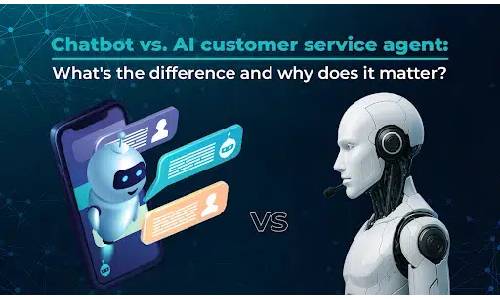
The difference between a chatbot and an AI customer service agent comes down to capability, context, and business impact. A chatbot follows predefined rules and scripts. An AI customer service agent understands intent, adapts to complex conversations, and takes action across systems. That distinction matters because customer expectations have shifted from basic automation to fast, accurate, human-like support at scale.
This guide breaks down how chatbots and AI agents differ, where each fits, and why many organisations are moving toward virtual customer service agents to handle modern support demands.
A chatbot is a conversational interface designed to respond to specific inputs using rules, decision trees, or scripted flows.
Typical chatbot characteristics
Chatbots are effective for:
They reduce frontline workload, but their value plateaus once conversations become nuanced.
An AI customer service agent (also called an AI agent or virtual customer service agent) uses machine learning, natural language understanding, and system integrations to handle conversations dynamically.
Instead of matching keywords, an AI agent interprets intent, remembers context, and decides what action to take.
Core capabilities
This moves customer support from automation to autonomous resolution.
|
Feature |
Chatbot |
AI customer service agent |
|
Conversation logic |
Rules and scripts |
Intent-driven and adaptive |
|
Context awareness |
Minimal |
High (remembers prior messages) |
|
Ability to learn |
No |
Yes |
|
Handles complex issues |
Rarely |
Frequently |
|
System integration |
Limited |
Deep and flexible |
|
Customer experience |
Transactional |
Human-like and personalised |
This difference between chatbot and AI agent directly affects resolution time, customer satisfaction, and operational cost.
Customers expect support that feels immediate, relevant, and accurate. Repeating information or navigating rigid menus creates friction. AI agents reduce that friction by understanding intent the first time.
As digital channels expand, support teams face higher ticket volumes. Chatbots deflect simple queries, but AI customer service agents resolve a broader range of issues without increasing headcount.
Unlike traditional automation, AI agents don’t trade quality for scale. They improve first-contact resolution while keeping costs predictable.
AI agents deliver consistent answers across voice, chat, and messaging platforms, reducing errors and compliance risk.
Chatbots still have a place when:
For many organisations, chatbots act as a stepping stone toward more capable AI solutions.
An AI agent is a stronger fit when:
In these scenarios, chatbots often create bottlenecks rather than removing them.
A growing service business might start with a chatbot answering opening hours and booking links. As demand grows, customers begin asking:
A chatbot fails here. An AI customer service agent can:
That shift directly improves retention and reduces support backlog.
The move from chatbot to AI agent delivers tangible advantages:
These benefits compound over time as the AI agent learns from real interactions.
Modern customer service requires more than scripted automation. Platforms like Tricall are built around AI agents that handle real conversations, not just predefined flows.
Tricall enables businesses to:
Rather than replacing teams, Tricall’s approach augments them—freeing human agents to focus on edge cases and high-value interactions.
Ask these questions before deciding:
If you answer “yes” to the latter two, an AI customer service agent is likely the better long-term investment.
Understanding the chatbot vs AI assistant for customer service distinction helps businesses avoid underpowered automation. Chatbots answer questions. AI customer service agents solve problems.
If your goal is scalable, consistent, and customer-friendly support, investing in an AI agent approach delivers measurable advantages. Platforms like Tricall make that transition practical by combining conversational intelligence with real operational capability—without adding unnecessary complexity.
A chatbot follows fixed rules, while an AI agent understands intent, adapts responses, and completes actions across systems.
They’re related, but a virtual customer service agent is purpose-built for support, resolution, and system interaction rather than general assistance.
No. They handle routine and complex requests efficiently, allowing human agents to focus on exceptions, empathy-driven cases, and strategic work.
Costs depend on scope, but modern platforms reduce setup time and deliver ROI through reduced ticket volume and faster resolution.
Yes. Many organisations use chatbots for simple deflection and AI agents for full resolution, creating a layered support strategy.
Know more https://tricall.ai/chatbot-vs-ai-customer-service-agent/

© 2025 Crivva - Hosted by Airy Hosting Managed Website Hosting.