


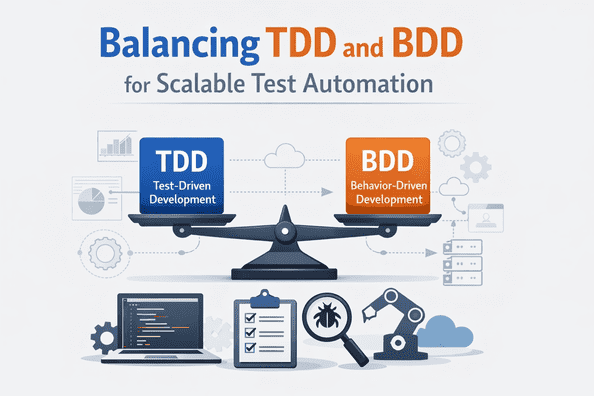
In modern software development, teams are under pressure to release features quickly without sacrificing quality. Test-driven development (TDD) and behavior-driven development (BDD) are two proven approaches to automated testing, but relying solely on one can leave gaps. The key to effective, scalable test automation is understanding how to balance TDD and BDD in your workflow.
This article explores strategies for integrating these approaches, metrics to measure their impact, and practical considerations for scaling automated testing in fast-paced development environments.
Instead of viewing TDD and BDD as competing methodologies, it helps to see them as complementary tools:
TDD focuses on ensuring that individual units of code work as intended. Developers write tests for small components, verify their behavior, and use these tests as a safety net during refactoring.
BDD ensures that the application behaves as expected from the user’s perspective. Scenarios are written in plain language, which encourages collaboration between developers, QA, and business stakeholders.
By leveraging TDD for technical correctness and BDD for validating business logic, teams can achieve thorough coverage from code level to end-to-end workflows.
As projects grow, maintaining test automation becomes increasingly difficult:
Test suite bloat: Running a large number of unit and acceptance tests can slow down CI/CD pipelines.
Duplicated effort: Without coordination, BDD scenarios may duplicate TDD coverage, wasting resources.
Complex refactoring: Large modules with intertwined functionality can break multiple tests if not properly designed.
Balancing TDD vs BDD addresses these challenges by providing layered testing and reducing redundancy.
1. Layered Testing Approach
Unit-Level with TDD: Test each module in isolation to ensure code correctness.
Integration & Acceptance with BDD: Focus on user workflows and business-critical paths.
This layered strategy ensures that defects are caught early, while high-level tests validate real-world usage.
2. Risk-Based Test Planning
Not all parts of the application carry the same risk. Complex algorithms or frequently modified modules benefit from intensive TDD. Core user flows, critical integrations, and business rules are best captured with BDD scenarios.
3. CI/CD Integration
Integrate TDD and BDD tests into pipelines differently:
TDD tests run frequently, providing rapid feedback on code changes.
BDD scenarios run periodically or in parallel, ensuring behavior validation without slowing down releases.
4. Maintainable Test Suites
TDD tests should remain modular and independent.
BDD scenarios should be concise and easy to update as business rules evolve.
This reduces maintenance overhead, allowing test automation to scale with the application.
5. Collaborative Workflow
Encourage developers, QA, and stakeholders to jointly define BDD scenarios. TDD tests ensure implementation correctness, while BDD ensures features meet user expectations. This alignment minimizes miscommunication and reduces rework.
Even experienced teams can struggle with integrating both approaches. Some common pitfalls include:
Overlapping coverage: Writing both unit tests and BDD scenarios for the same functionality can lead to duplication. Solution: Define clear testing boundaries and use TDD for low-level logic and BDD for behavior.
Flaky tests in CI/CD: Poorly written BDD scenarios can fail intermittently due to environment dependencies. Solution: Mock external services or use realistic test environments.
Neglecting TDD during high-velocity releases: Rushing features without unit-level tests increases technical debt. Solution: Enforce TDD as part of the development workflow.
Ignoring metrics: Without tracking coverage, regression detection, or execution speed, it’s impossible to know if the balance is effective. Solution: Regularly review metrics and adjust strategy.
Monitoring the effectiveness of your combined TDD and BDD approach ensures scalable testing:
Test coverage: Verify that both code paths (TDD) and user scenarios (BDD) are sufficiently covered.
Regression detection: Track how often tests catch regressions in frequent releases.
Execution speed: Optimize test suites so that CI/CD feedback remains fast, even with large test volumes.
Defect distribution: Compare defects caught at unit versus feature levels to identify coverage gaps.
Test flakiness: Monitor and reduce flaky tests, particularly in BDD scenarios, to maintain release confidence.
Tools like Keploy can help capture real application behavior and automatically generate tests, improving both TDD and BDD workflows without manual duplication. This not only accelerates testing but also ensures that coverage scales as the codebase grows.
Adopt a hybrid mindset: Combine TDD and BDD strategically, leveraging the strengths of each.
Automate early: Write TDD tests during development and define BDD scenarios alongside feature specifications.
Refactor tests routinely: Regularly review both unit and scenario tests to maintain clarity and reliability.
Focus on high-value paths: Prioritize testing for modules and features critical to business or user workflows.
Leverage automation tools: Use frameworks and tools that integrate smoothly into CI/CD pipelines for both unit and behavior testing.
Document scenario intent: BDD scenarios should clearly describe the purpose and expected outcome, reducing ambiguity for new team members.
Regular feedback loops: Share metrics and test results with the team to continuously improve the balance of TDD and BDD.
Consider a SaaS platform releasing new features weekly:
TDD tests verify the correctness of new data-processing algorithms.
BDD scenarios validate end-to-end workflows, such as user onboarding or subscription management.
By balancing both approaches, developers can confidently refactor internal logic while ensuring that critical user experiences remain intact. With tools like Keploy, teams can even capture live behavior and generate automated tests for both unit and behavior-level scenarios, reducing manual effort and improving reliability.
Balancing tdd vs bdd is crucial for scalable test automation, especially in high-velocity release environments. TDD ensures unit-level correctness, providing confidence during refactoring, while BDD validates user behavior and business outcomes. Combining both approaches strategically allows teams to maintain comprehensive coverage, reduce defects, and scale their automation efforts efficiently.
Integrating layered testing, risk-based prioritization, collaborative scenario definition, and automation tools like Keploy enables development teams to deliver reliable, maintainable, and fast test automation. By understanding the strengths and limitations of each approach, teams can optimize workflows, improve developer productivity, achieve higher release confidence, and ensure that both technical quality and user experience are consistently maintained across every release, while fostering stronger collaboration across development, QA, and business teams.

© 2025 Crivva - Hosted by Airy Hosting Managed Website Hosting.