Ever wondered why some businesses sell to companies while others sell directly to you?
If you’ve tried to understand how businesses operate, whether you’re starting your own venture, working in marketing, or just curious, you’ve likely come across the terms B2B and B2C. At first glance, they seem simple. But when you look closer, the differences affect everything from pricing and sales strategies to customer relationships and marketing tactics.
So, what do these terms really mean? And more importantly, how do they influence how businesses grow and succeed?
Let’s break it down in a way that makes sense.
What is B2B (Business-to-Business)?
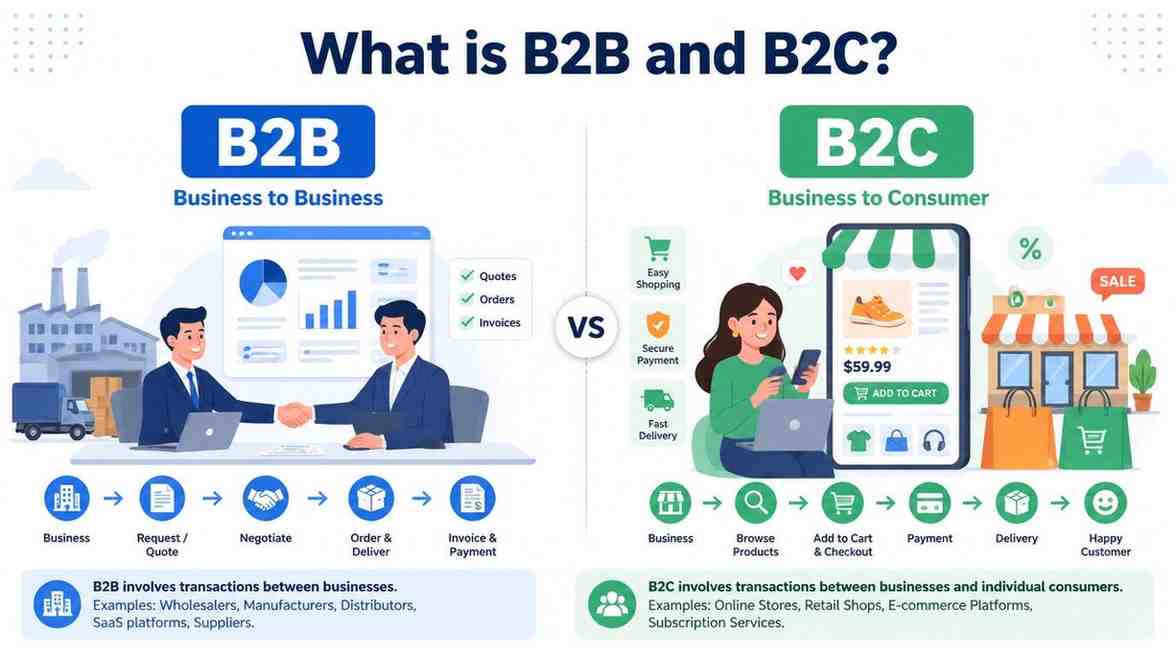
B2B (Business-to-Business) refers to transactions where one business sells products or services to another business instead of individual consumers. These relationships focus on long-term value, efficiency, and mutual growth.
Simple Examples:
- A software company selling CRM tools to a corporate firm
- A manufacturer supplying raw materials to a factory
- A wholesaler selling goods to retailers
Key Characteristics of B2B:
- Longer sales cycles – Decisions involve multiple stakeholders and approvals
- Higher transaction value – Deals are often large, bulk-based, and recurring
- Relationship-driven – Trust and long-term partnerships are essential
- Custom pricing – Negotiations and tailored pricing models are common
- Rational decision-making – Buyers focus on ROI, efficiency, and business outcomes
In B2B, decisions are based on logic, data, and long-term value, not impulse.
What is B2C (Business-to-Consumer)?
B2C (Business-to-Consumer) refers to businesses that sell products or services directly to individual customers for personal use. This is the most common model people encounter in their daily lives.
Simple Examples:
- An online store selling clothes
- A streaming service offering subscriptions
- A restaurant serving customers
Key Characteristics of B2C:
- Shorter sales cycles – Purchase decisions are quick and often spontaneous
- Lower transaction value – Individual purchases are smaller in size
- Emotion-driven marketing – Branding, storytelling, and experience matter
- Fixed pricing – Prices are usually set with little to no negotiation
- Mass audience targeting – Businesses aim to reach a broad customer base
In B2C, the aim is to grab attention, create desire, and convert quickly.
B2B vs B2C: Key Differences Explained
Let’s compare them side by side to make things clear. This is especially important if you plan to work with a
B2B ecommerce development agency or build a customer-focused platform.
| Target Audience |
Businesses |
Individual consumers |
| Decision Process |
Logical, multi-step |
Emotional, quick |
| Sales Cycle |
Long |
Short |
| Pricing |
Negotiable |
Fixed |
| Marketing Focus |
Value, ROI, efficiency |
Emotion, brand, experience |
| Customer Relationship |
Long-term partnerships |
Transaction-based (but can build loyalty) |
| Purchase Volume |
Bulk or large contracts |
Small, individual purchases |
Real-Life Scenario to Understand Better
Imagine you run a coffee brand:
- If you sell coffee beans in bulk to cafes → That’s B2B
- If you sell packaged coffee directly to customers online → That’s B2C
It’s the same product but a different audience and a completely different strategy.
Marketing Strategies: B2B vs B2C
Marketing strategies differ a lot between B2B and B2C because the audience, decision-making process, and goals are not the same.
B2B Marketing
B2B marketing focuses on building trust, educating prospects, and showing value over time. Since decisions involve many stakeholders, the strategy emphasizes logic and long-term benefits.
- Focuses on education and trust – It provides detailed information to guide decision-making.
- Content-driven approach – It uses whitepapers, case studies, webinars, and reports.
- Channels used – Primarily LinkedIn, email marketing, and industry-specific platforms.
- Data-focused messaging – It highlights ROI, efficiency, and measurable outcomes.
- Long-term nurturing – It builds relationships through consistent engagement.
In B2B, marketing success comes from demonstrating value and building credibility over time.
B2C Marketing
B2C marketing centers on capturing attention fast and driving immediate action. It appeals more to emotions and personal preferences.
- Focuses on engagement and emotions – It creates connections through relatable messaging.
- Content style – It uses social media content, ads, videos, and influencer collaborations.
- Channels used – Instagram, Facebook, YouTube, and other mass platforms.
- Visual storytelling – There is a strong emphasis on branding, design, and user experience.
- Quick conversions – It encourages fast purchasing decisions with offers and urgency.
In B2C, marketing works best when it grabs attention, sparks desire, and converts instantly.
Sales Approach: How They Differ
The sales process in B2B and B2C models differs greatly because of variations in customer behavior, decision complexity, and purchase value. Each method is tailored to fit how buyers think and make decisions.
In B2B Sales
B2B sales are usually structured, consultative, and focused on relationships. They involve several interactions before closing a deal.
- Sales teams are heavily involved – Representatives guide prospects through each stage of the buying journey.
- Detailed sales process – Includes demos, proposals, presentations, and negotiations
- Multiple decision-makers – Managers, finance teams, and executives all play a role in the final decision.
- Longer sales cycles – Time is needed for evaluation, approvals, and risk assessment
In B2B, the aim is to build trust, meet specific business needs, and form long-term partnerships.
In B2C Sales
B2C sales are quick, straightforward, and focus on customers, emphasizing convenience and fast decision-making.
- Self-service experience – They browse and buy independently, like in online shopping.
- Minimal interaction – Little to no involvement from sales representatives
- Individual decision-making – Purchases depend on personal preferences and immediate needs.
- Short sales cycles – Transactions often happen in just minutes.
In B2C, success relies on making the buying process smooth, fast, and engaging.
Which Model is Better?
Here’s the truth: neither B2B nor B2C is inherently better. The right choice depends on your business goals, resources, and target audience.
Choose B2B if:
- You prefer fewer clients with higher revenue per deal
- You’re okay with longer sales cycles
- You can build strong professional relationships
Choose B2C if:
- You want faster sales and wider reach
- You enjoy branding and creative marketing
- You’re targeting everyday consumers
Many modern businesses actually combine both models. This is called B2B2C (Business-to-Business-to-Consumer).
Common Challenges in B2B and B2C
While both B2B and B2C models offer strong growth opportunities, each comes with its own unique challenges. Understanding these can help businesses plan better strategies and stay competitive.
B2B Challenges:
- Long decision timelines
- Complex customer needs
- High competition in niche markets
B2C Challenges:
- Customer loyalty is harder to maintain
- High marketing costs
- Constant need for innovation and engagement
Why Understanding B2B and B2C Matters
Whether you’re building a startup, writing a business plan, or working in marketing, understanding these models helps you.
- Target the right audience
- Create effective marketing strategies
- Improve sales performance
- Build stronger customer relationships
Simply put, it helps you avoid wasting time and money on the wrong approach.
The Future: Blurring Lines Between B2B and B2C
The traditional boundaries between B2B and B2C are quickly fading. Today, businesses are using strategies from both models to meet changing customer expectations.
- B2B companies are adopting B2C-like user experiences
- B2C brands are using data-driven strategies like B2B
- Personalization is becoming key in both
Modern customers, whether businesses or individuals, expect speed, convenience, and value.
Conclusion
Understanding the difference between B2B and B2C goes beyond just learning business terms. It’s about knowing how to communicate, sell, and build relationships effectively.
- B2B is about logic, relationships, and long-term value
- B2C is about emotions, speed, and customer experience
Once you recognize these key differences, you can adjust your strategy, connect with your audience better, and achieve real results, no matter which model you choose.
FAQs
1. What is the main difference between B2B and B2C?
The main difference is the target audience. B2B sells to businesses, while B2C sells directly to individual consumers.
2. Which is more profitable: B2B or B2C?
Both can be profitable. B2B often has a higher deal value, while B2C benefits from higher sales volume.
3. Can a company be both B2B and B2C?
Yes, many companies operate in both models. This is often called a hybrid or B2B2C model.
4. Why is the B2B sales cycle longer than B2C?
Because B2B purchases involve multiple decision-makers, approvals, and larger investments.
5. Is marketing different for B2B and B2C?
Yes. B2B marketing focuses on logic and ROI, while B2C marketing focuses on emotions and quick engagement.