

You’ve spent months (maybe years) building relationships with your business clients, only to watch a competitor swoop in with a slightly better discount and walk away with an account you thought was locked in. Sound familiar? If acquiring new B2B customers feels like running on a treadmill while existing ones quietly drift toward your competitors, you’re not alone, and you’re not doing anything “wrong.” You’re just missing a structure that makes loyalty worth their while. That’s where B2B loyalty programs come in, and once you understand how they actually work (spoiler: they’re nothing like the punch cards from your local coffee shop), you’ll see why they’ve become one of the most underused growth levers in business-to-business relationships.
Let’s clear up a common misconception first. When people hear “loyalty program,” they picture points for a free sandwich or a birthday discount code. That model works fine for individual consumers making impulse decisions. But B2B purchasing is a completely different animal.
In B2B, you’re not dealing with one person making a quick decision; you’re dealing with procurement teams, decision-makers, end users, and sometimes finance departments, all of whom have different priorities. Purchases are larger, sales cycles are longer, and the relationship often spans years, not minutes. A B2B buyer isn’t looking for a free coffee; they’re looking for value, reliability, and a partner who understands their business goals.
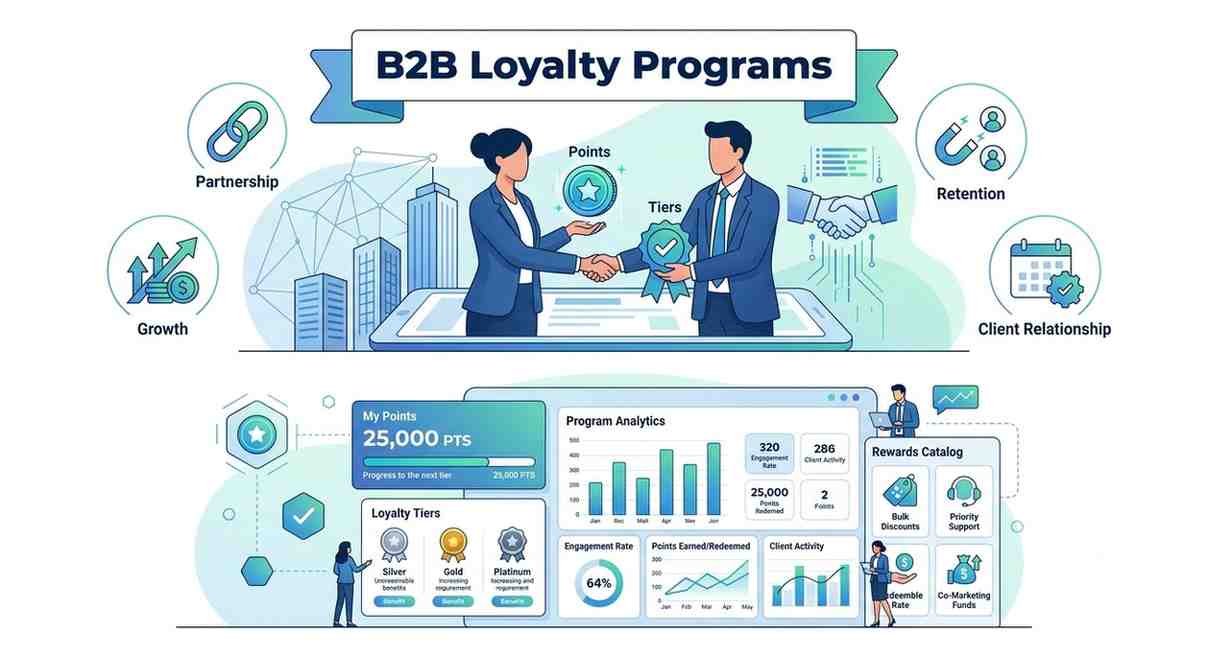
This is exactly why B2B loyalty programs need to be built differently. Instead of simple point-for-purchase systems, successful programs focus on tiered benefits, exclusive access, personalized account support, training resources, and rewards that genuinely impact a business’s bottom line, things like volume discounts, priority service, co-marketing opportunities, or early access to new products.
Here’s something most businesses don’t realize until it’s too late: B2B churn rarely happens overnight. It’s not usually a dramatic breakup. Instead, it’s a slow fade: fewer reorders, smaller order sizes, less engagement with your team, and eventually, a quiet switch to a competitor.
By the time you notice the warning signs, the client has often already mentally checked out. This is the silent killer of B2B revenue, and it’s also exactly why retention-focused strategies matter so much more than most companies give them credit for.
Acquiring a new B2B client typically costs significantly more than retaining an existing one. Beyond the direct cost, there’s also the lost opportunity: every dollar spent chasing a new logo is a dollar not spent deepening a relationship with a client who already trusts you, already knows your product, and already has a reason to keep buying.
A well-structured loyalty program addresses this head-on. It gives your clients ongoing reasons to stay engaged, rewards consistency, and, just as importantly, gives your team visibility into how engaged (or disengaged) a client actually is.
Not all loyalty programs are created equal. Some feel like an afterthought, a generic discount slapped onto an invoice. Others become a genuine part of how a client experiences your brand. Here’s what separates the two.
Rather than treating every client the same, tiered programs recognize that a client spending $500,000 annually has different needs (and deserves different recognition) than one spending $50,000. Tiers can unlock things like dedicated account managers, faster support response times, custom pricing, or invitation-only events. The key is making sure each tier feels earned and meaningful, not arbitrary.
Forget generic swag. The most effective B2B loyalty programs offer rewards that directly help a client’s business, things like extended payment terms, free training sessions for their team, access to beta features, or marketing co-op funds. These aren’t just “nice-to-haves “; they make your client’s job easier, which strengthens the relationship in a way a branded mug never could.
B2B relationships thrive on understanding. When you know a client’s purchasing patterns, pain points, and goals, you can tailor your loyalty program to match. This might mean proactively offering a relevant upgrade before they ask, or recognizing a milestone, such as their five-year anniversary as a customer. Personalization shows clients they’re more than just a line item on your revenue report.
One of the fastest ways to undermine a loyalty program is to make it confusing or to make it feel like a “gotcha.” B2B buyers are sophisticated; they’ll see through vague terms or rewards that are nearly impossible to redeem. Clear communication about how the program works, what’s expected, and what clients will receive builds the kind of trust that keeps relationships strong for years.
The strongest programs aren’t just about giving clients things; they’re about creating a relationship where both sides benefit. Maybe loyal clients provide testimonials, case studies, or referrals in exchange for added perks. This turns your most loyal customers into advocates, which fuels organic growth without additional marketing spend.
It’s easy to think of loyalty programs purely as a retention tool, but their impact on growth is just as significant; it just shows up in different ways.
When clients feel valued, they’re more likely to expand their relationship with you. This could mean purchasing additional products, upgrading to higher service tiers, or bringing other departments within their organization on board. This kind of organic account expansion is often far more cost-effective than acquiring entirely new clients.
Loyal clients also become your best source of referrals. In B2B, word-of-mouth and peer recommendations carry enormous weight; decision-makers trust other decision-makers far more than they trust marketing materials. A client who feels genuinely supported by your loyalty program is far more likely to recommend you when a colleague asks for a vendor recommendation.
Finally, loyalty programs give you a feedback loop. Engaged clients are more willing to share what’s working, what’s not, and what they need next. This insight can directly shape your product roadmap, service offerings, and overall strategy, turning your loyalty program into a built-in research tool.
If you’re feeling overwhelmed at the thought of building a full-scale loyalty program from scratch, take a breath. You don’t need to launch something massive on day one. Start by identifying your most valuable and most at-risk accounts. Talk to them. Ask what would genuinely make a difference in their experience working with you.
From there, pilot a simple program with a small group of clients. Track engagement, gather feedback, and refine before rolling it out more broadly. The goal isn’t perfection from day one; it’s building something that evolves alongside your clients’ needs.
At the end of the day, B2B loyalty programs aren’t about gimmicks or flashy rewards; they’re about recognizing that your best clients deserve to feel like partners, not just accounts. When you build a program that genuinely adds value to their business, you’re not just reducing churn; you’re creating a foundation for sustainable, long-term growth. And in a landscape where switching costs are often low and competitors are always circling, that kind of loyalty isn’t just nice to have; it’s a competitive advantage.
A B2B loyalty program is a structured strategy designed to reward and retain business clients through benefits such as tiered pricing, exclusive support, or co-marketing opportunities rather than the simple point-based rewards typically seen in consumer loyalty programs.
They keep clients engaged through ongoing value, personalized attention, and meaningful incentives, which helps identify disengagement early and gives clients consistent reasons to continue the relationship rather than switch providers.
Rewards that solve real business problems tend to work best, things like extended payment terms, dedicated support, training resources, exclusive access to new features, or marketing collaboration opportunities.
No. Businesses of any size can benefit from a loyalty program, as long as it’s scaled appropriately. Even a small, well-thought-out program can significantly improve retention and client satisfaction.
Results vary by industry and program design, but many businesses begin to notice improvements in engagement and retention within a few months, with stronger growth effects (such as referrals and account expansion) building over time.

© 2025 Crivva - Hosted by Airy Hosting Managed Website Hosting.