

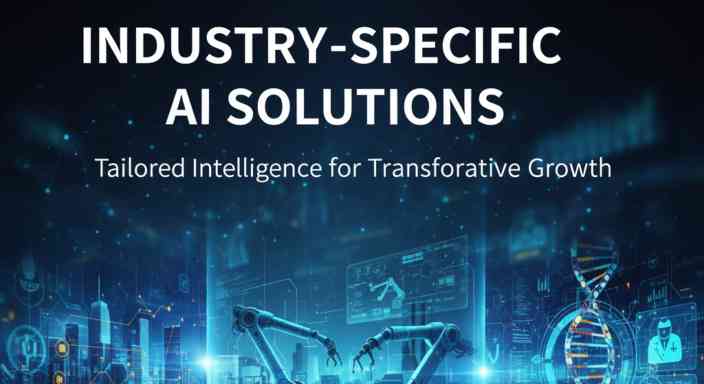
Artificial intelligence has moved far beyond being a buzzword. What was once seen as experimental or reserved for large technology companies is now becoming part of everyday business operations. However, the most meaningful shift is not simply the adoption of AI itself — it’s the move towards Industry-Specific AI Solutions.
Rather than using generic tools that only partially address business challenges, organisations are increasingly turning to AI systems designed with a deep understanding of their industry. These tailored solutions are helping businesses operate more efficiently, make better decisions, and improve customer experiences without losing the human touch.
In the early stages of AI adoption, many businesses relied on broad, general-purpose tools. While helpful, these systems often lacked context. They struggled to understand industry-specific language, regulations, workflows, and customer expectations.
Industry-Specific AI Solutions address this gap by focusing on the realities of individual sectors. Whether it’s healthcare compliance, insurance risk modelling, or real estate market trends, specialised AI systems are built to operate within real-world constraints.
This shift matters because:
Industries face unique challenges that generic AI cannot fully address
Accuracy and compliance are critical in regulated sectors
Custom workflows require flexible, adaptable systems
By aligning AI capabilities with industry needs, businesses gain solutions that feel practical rather than experimental.
At the heart of modern AI systems are AI Agents. These are intelligent programs designed to perform tasks, make decisions, and interact with users autonomously or semi-autonomously.
Unlike traditional automation, AI agents can:
Learn from data and interactions
Adapt to changing conditions
Handle complex decision-making
Communicate naturally with users
When trained for specific industries, AI agents become powerful digital assistants that support teams rather than replace them.
Businesses across sectors are adopting AI agents because they solve real, everyday problems. These agents can work continuously, handle large volumes of information, and provide consistent support without fatigue.
Some common advantages include:
Reduced operational workload
Faster response times
Improved data accuracy
Better customer engagement
When deployed correctly, AI agents free professionals from repetitive tasks, allowing them to focus on strategic thinking and relationship-building.
Sales teams face increasing pressure to personalise communication while managing high volumes of leads. AI Sales Agents are designed to support this balance.
Rather than replacing human sales professionals, AI sales agents assist with tasks such as:
Analysing customer behaviour and intent
Prioritising high-quality leads
Suggesting optimal follow-up timing
Generating personalised outreach content
By handling data-heavy processes, AI sales agents allow sales teams to focus on meaningful conversations and closing opportunities. This leads to more efficient pipelines and better customer experiences.
Healthcare is one of the most demanding environments for AI adoption. It requires accuracy, compliance, empathy, and security. AI Agents for Healthcare are developed with these requirements in mind.
Healthcare-focused AI agents can assist with:
Appointment booking and reminders
Managing patient enquiries
Supporting medical documentation
Analysing patient data for early risk indicators
Importantly, these systems are designed to support clinicians rather than replace them. By reducing administrative workload, healthcare professionals gain more time to focus on patient care, improving outcomes and satisfaction.
Insurance is an industry built on information, analysis, and trust. AI for Insurance Agents helps manage complex data while improving service quality.
Insurance-focused AI solutions can:
Compare policies and coverage options
Assist with claims processing
Respond to routine customer queries
Identify potential fraud patterns
With AI handling repetitive and data-driven tasks, insurance agents can focus on advisory roles, helping clients understand their options and make informed decisions.
The real estate industry relies heavily on timing, location, and communication. AI Agents for Real Estate are transforming how agents interact with buyers and sellers.
These AI agents can:
Instantly respond to property enquiries
Match buyers with suitable listings
Schedule viewings automatically
Analyse local market data and trends
For clients, this means faster responses and more relevant information. For agents, it means less time spent on admin and more time spent closing deals.
Location plays a crucial role in many industries, from property and retail to healthcare and logistics. Location-Based AI Services enhance AI systems by adding geographical context to decision-making.
These services allow businesses to:
Tailor communication based on regional preferences
Optimise pricing strategies by location
Support region-specific regulations
Improve delivery and service planning
By understanding local behaviour and conditions, location-based AI delivers insights that are far more actionable than generic data analysis.
Successful AI implementation depends on thoughtful design and development. AI Agent Development Services focus on building solutions that align with real business needs rather than forcing businesses to adapt to technology.
Effective AI agent development involves:
Understanding industry workflows
Training models on relevant data
Ensuring security and compliance
Designing user-friendly interfaces
Custom development ensures AI agents integrate smoothly into existing systems and are adopted confidently by teams.
Organisations such as Skale Marketing Group often highlight the importance of this tailored approach, recognising that AI success depends on usability, relevance, and long-term strategy rather than quick deployment.
Despite its benefits, AI adoption is not without challenges. Businesses often hesitate due to concerns about complexity, cost, or workforce impact.
Common concerns include:
Fear of replacing human jobs
Data security and privacy issues
Integration with legacy systems
Staff resistance to change
Industry-specific AI helps address many of these concerns by offering targeted, practical solutions that complement existing roles rather than disrupt them.
One of the most important points to understand about Industry-Specific AI Solutions is that they are not designed to eliminate human involvement. Instead, they aim to enhance it.
AI agents excel at:
Processing large volumes of data
Identifying patterns
Automating repetitive tasks
Humans excel at:
Critical thinking
Empathy and relationship-building
Ethical judgement
Creative problem-solving
When combined, this collaboration leads to better outcomes than either could achieve alone.
Before adopting AI solutions, businesses should take a strategic approach. Key considerations include:
Identifying specific pain points
Choosing industry-trained AI over generic tools
Planning system integration
Providing training and support for staff
Clear goals and preparation ensure AI delivers long-term value rather than becoming an underused tool.
As AI technology continues to evolve, its role in business will only grow. Industry-specific solutions are likely to become standard rather than optional, particularly in data-driven and customer-focused sectors.
Businesses that adopt AI thoughtfully will benefit from:
Greater efficiency
Improved customer experiences
Better decision-making
Increased competitiveness
Those who delay risk falling behind as AI-enhanced competitors raise expectations across industries.
Industry-Specific AI Solutions represent a practical, responsible evolution of artificial intelligence. By focusing on real-world needs, regulations, and workflows, these systems offer genuine value without sacrificing human expertise.
From AI Sales Agents and AI Agents for Healthcare to AI for Insurance Agents and AI Agents for Real Estate, specialised AI is quietly transforming how businesses operate. Supported by strong AI Agent Development Services and enhanced through Location-Based AI Services, the future of AI is not just smarter — it’s more relevant, more ethical, and more human-focused.
For businesses willing to embrace this shift thoughtfully, the opportunity is clear: smarter operations, stronger relationships, and sustainable growth in an increasingly intelligent world.

© 2025 Crivva - Hosted by Airy Hosting Managed Website Hosting.