

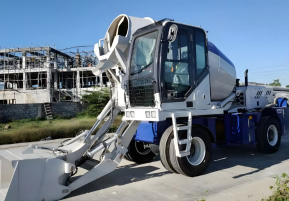
The Ghanaian construction landscape is a testament to ambition, characterized by a relentless drive to develop infrastructure, housing, and commercial spaces that fuel national growth. Yet, this ambition persistently collides with a stark operational reality: the debilitating cycle of cost overruns, logistical paralysis, and quality inconsistencies that plague projects of all scales. The conventional reliance on disjointed methods—stationary batching plants, fleets of transit mixers, and separate pumping crews—has created a productivity paradox where effort and expenditure soar while controllable outcomes diminish. It is within this context that the integrated self loading concrete mixer in Ghana emerges not as a simple tool, but as a compelling, cost-effective philosophy of construction. This argument posits that for Ghanaian contractors to transcend current constraints and secure a profitable future, the adoption of this technology is not a luxury, but a strategic imperative.
A superficial critique often begins and ends with the machine’s initial purchase price, dismissing it as prohibitively expensive. This myopic view ignores the fundamental calculus of total cost of ownership (TCO). The traditional model is a masterclass in fragmented expenditure. One must account for the capital and operational costs of a batching plant, the fuel, maintenance, and driver wages for a fleet of transit trucks, and the hefty rental fees for a separate concrete pump and operator. Each element represents a recurring cost center vulnerable to inflation, fuel price volatility, and mechanical failure. The self-loading mixer with pump consolidates these three major cost vectors into a single, depreciating asset. It obliterates the line item for haulage. It nullifies the daily rental fee for pumping equipment. It provides batching autonomy. The true economic advantage, however, is unlocked in the operational granularity. Material waste—a catastrophic sinkhole for profitability—plummets due to on-demand, precise batching. Project timelines compress dramatically, reducing site overheads, management costs, and exposure to weather-related delays. The machine’s value is not in its invoice price, but in its systematic elimination of the myriad hidden costs that silently erode project margins.
Ghana’s unique operational environment, with its blend of bustling urban centers and remote project sites, demands machinery that offers radical autonomy and resilience. The self-loading mixer is uniquely engineered for this challenge. Consider the pervasive issue of site access. Many promising projects are situated down unpaved roads, across weak bridges, or on confined urban plots utterly inaccessible to large transit mixers and truck-mounted pumps. This machine, often built on a robust 4×4 or articulated chassis, mobilizes to these sites directly, turning previously untenable locations into viable projects. Furthermore, it insulates contractors from the fragility of external supply chains. No longer is the critical path of a project held hostage by the breakdown of a third-party mixer truck or the scheduling conflicts of a pump hire company. The operator gains complete control over the production and placement schedule. This autonomy extends to material handling. By loading raw aggregates, sand, and cement directly from stockpiles, the machine ensures mix integrity from source to point of placement, a critical defense against the quality variability that can occur in pre-mixed concrete during extended transit times in tropical heat.
To realize the full return on investment, deployment must be strategic, not haphazard. The machine is not a universal panacea for every concrete pour. Its economic justification is most potent on projects with repeated, medium-volume pours—precisely the domain of residential estates, medium-rise buildings, community water tanks, and rural infrastructure. On a single, small foundation, its benefits may not reach full potential. Therefore, a conscious business development strategy targeting projects within this “sweet spot” is essential. The machine’s sophistication also mandates an equivalent investment in human capital. Its cost-saving potential is wholly dependent on operator proficiency and a rigorous maintenance culture. An operator must be trained as a technician, understanding the hydraulics, electronics, and mechanical systems to prevent costly downtime. A regimen of prophylactic maintenance, using quality filters and lubricants suited to Ghana’s dusty conditions, is non-negotiable. For smaller firms, the capital hurdle can be addressed through innovative acquisition models. Strategic leasing, hire-purchase agreements, or even cooperative ownership among a consortium of trusted contractors can democratize access to this technology, spreading risk and ensuring high utilization rates.
Ultimately, the adoption of self loading mixer concrete pump technology transcends immediate cost savings; it is an investment in competitive differentiation and future-proofing a business. The Ghanaian construction market is evolving, with clients increasingly demanding faster completion, higher quality assurance, and minimized site disruption. A contractor who arrives with this integrated solution demonstrates a command of modern methodology that is visually persuasive. It signals a commitment to efficiency, precision, and environmental stewardship through reduced waste and lower on-site congestion. This enhances a firm’s brand, allowing it to command premium bids not based solely on price, but on demonstrable value and reliability. In an industry where reputation is paramount, being known as the firm that conquers difficult sites and delivers predictable outcomes is a powerful marketing tool. It positions the adopter not as a follower of old practices, but as a leader shaping the efficiency and quality standards of Ghana’s built environment.
A critical barrier to adoption is not merely recognizing the value proposition but navigating the practical pathway to acquisition and sustained operation. A sophisticated understanding of the financial and support landscape is paramount. The outright purchase of a major capital asset is not the only, or even the most prudent, model for every firm. Innovative financing structures, including lease-to-own agreements and equipment financing tailored for the construction sector, can transform a prohibitive capital expenditure into a manageable operational cost aligned with cash flow from projects utilizing the machine. Furthermore, the emergence of a dedicated rental market for this equipment class allows contractors to strategically deploy the technology for specific projects or peak periods without assuming full ownership liabilities. Crucially, the long-term viability of any investment hinges on the existence of a robust local support ecosystem. This encompasses accessible technical training for operators and mechanics, the consistent availability of genuine spare parts through in-country distributors, and responsive after-sales service from knowledgeable engineers. A machine’s true cost-effectiveness can be entirely negated by weeks of downtime awaiting a proprietary hydraulic component from abroad. Therefore, the due diligence process must extend beyond machine specifications to a rigorous evaluation of the supplier’s local footprint, technical support capacity, and parts inventory. Investing in the machine means, in essence, investing in a partnership with the distributor, making their local competence a decisive factor in the Total Cost of Ownership equation.
The argument, therefore, is conclusive. In the face of rising costs, logistical complexities, and heightened competition, clinging to the fragmented methods of the past is a formula for stagnation. The self-loading concrete mixer with pump presents a coherent, cost-effective, and contextually intelligent solution. It is a capital asset that actively fights waste, reclaims schedule control, and unlocks new project opportunities. For the Ghanaian contractor focused on sustainable growth and market leadership, the decision is clear. The future of profitable, resilient construction is not about working harder within a broken system, but about deploying integrated technology to redefine the system itself.

© 2025 Crivva - Hosted by Airy Hosting Managed Website Hosting.