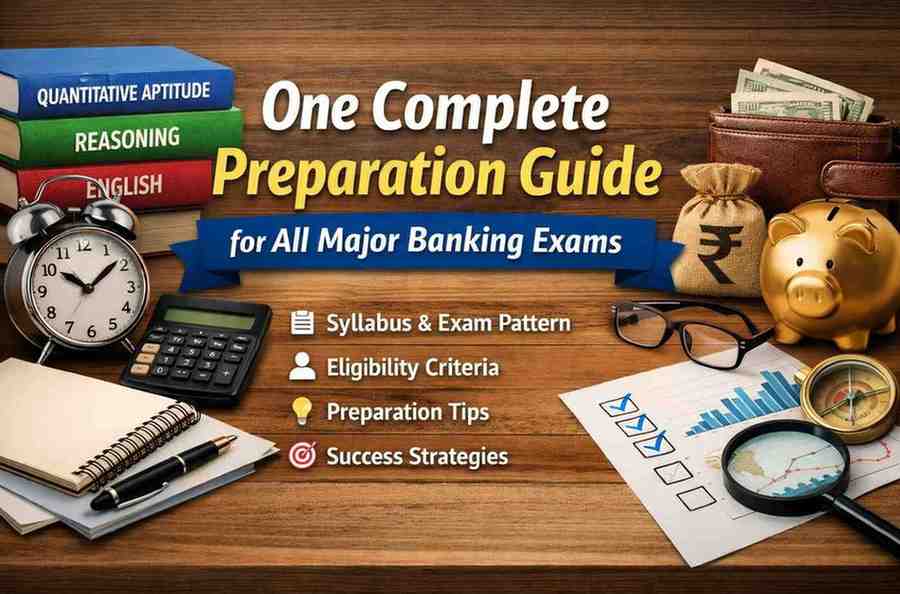
Preparing for banking exams can feel confusing at first. With so many exams, subjects, and strategies floating around, aspirants often don’t know where to begin. This guide is written to give you a clear, structured roadmap—from understanding exams to planning daily study—so that your preparation becomes focused, practical, and stress-free.
Whether you are a beginner or someone who has already attempted bank exams, this guide will help you build a solid preparation plan that actually works.
Banking exams in India are conducted to recruit candidates for public sector banks, regional rural banks, and other financial institutions. These exams are competitive, but they follow a predictable structure year after year.
Some of the most popular bank exams include SBI PO, SBI Clerk, IBPS PO, IBPS Clerk, RRB PO, and RRB Clerk. Each exam tests similar abilities, which makes it possible to prepare for multiple exams together with one smart strategy.
The key to success is not studying everything randomly, but understanding what is common across all bank exams and focusing on those areas first.
Before starting preparation, it is important to clearly understand bank exams eligibility. Many aspirants make the mistake of preparing seriously without checking whether they meet the basic criteria.
In most cases, the bank exams eligibility criteria include educational qualification, age limit, and nationality. A graduation degree in any discipline from a recognized university is usually required. The age limit typically ranges between 20 to 30 years, with relaxation for reserved categories as per government norms.
Understanding bank exams eligibility early helps you plan better, especially if age limit or educational qualification is a concern. It also ensures you apply only for exams you are actually eligible for, saving time and effort.
A clear understanding of the Bank exam syllabus is the foundation of smart preparation. Most banking exams test candidates on similar subjects, which allows you to prepare in an integrated way.
The Bank exam syllabus generally includes:
Instead of studying topics randomly, go through the Bank exam syllabus line by line and mark topics as strong, average, or weak. This helps you prioritize what needs more practice.
Most bank exams are conducted in two stages—Prelims and Mains. Some exams also include an interview or language proficiency test.
Prelims usually test speed and accuracy through objective questions, while Mains focus more on depth, accuracy, and sometimes descriptive writing. Knowing the exam pattern helps you decide how much time to give to speed practice versus concept building.
Many aspirants fail not because they don’t know concepts, but because they don’t practice according to the actual exam pattern.
Quantitative Aptitude is often feared, but it becomes manageable with consistent practice. Focus on arithmetic topics like percentages, profit and loss, time and work, and simple interest first. These topics appear frequently and are scoring.
Practice daily calculation drills to improve speed. Avoid learning shortcuts without understanding concepts, as clarity matters more than tricks in the long run.
Reasoning tests logical thinking and pattern recognition. Topics like seating arrangement, puzzles, syllogism, inequality, and coding-decoding are common.
Start with basic concepts and gradually move to complex puzzles. Regular practice is the only way to improve reasoning skills.
English is a scoring section if prepared correctly. Focus on reading comprehension, vocabulary, grammar rules, and sentence correction.
Reading newspapers, articles, or short passages daily improves both comprehension and vocabulary naturally.
General Awareness, especially banking awareness, plays a crucial role in Mains exams. Focus on current affairs of the last 6 months along with basic banking concepts.
Make short notes and revise them multiple times instead of reading bulky material repeatedly.
A good study plan is one that you can actually follow. Instead of copying toppers’ schedules, create a plan based on your daily routine and capacity.
Divide your day into slots for concept learning, practice, revision, and mock analysis. Even 4–5 hours of focused study daily is enough if done consistently.
Weekly planning works better than daily planning, as it gives flexibility while maintaining discipline.
Mock tests are the backbone of bank exam preparation. They help you understand exam pressure, improve time management, and identify weak areas.
However, giving mocks without analysis is a waste of effort. Spend more time analyzing mistakes than attempting new mocks. Understand why you got a question wrong and how to avoid repeating the same mistake.
Over time, mock tests help you develop exam temperament and confidence.
Revision is often ignored, but it is the key to retaining what you study. Without proper revision, even well-prepared topics fade away.
Use short notes, formulas sheets, and error notebooks for revision. Weekly and monthly revision cycles help strengthen memory and improve accuracy in exams.
Smart revision saves time and boosts confidence before the exam.
Many aspirants prepare hard but still fail due to common mistakes. Avoid studying too many sources, as it creates confusion. Stick to limited, reliable material.
Do not ignore weak areas completely, and don’t over-focus on only one subject. Balanced preparation is essential to clear cut-offs.
Also, avoid comparing your preparation journey with others. Everyone’s pace is different.
Bank exam preparation is a marathon, not a sprint. There will be days when motivation drops, scores fluctuate, or progress feels slow.
Set small, achievable goals and reward yourself for completing them. Stay connected with positive aspirants and avoid unnecessary negativity.
Consistency matters more than intensity. Even small daily efforts add up over time.
Cracking bank exams is absolutely possible with the right approach, discipline, and mindset. Understand the exam structure, follow a clear plan, practice regularly, and revise smartly.
Instead of rushing through topics, focus on building strong fundamentals. Trust the process, stay patient, and keep improving a little every day.
With the right guidance and consistent effort, success in banking exams is only a matter of time.

© 2025 Crivva - Hosted by Airy Hosting Managed Website Hosting.