Japanese and Korean are two fascinating languages that often spark curiosity among learners. Both come from rich cultural backgrounds and have unique grammar, pronunciation, and writing systems. While they may look similar on the surface, they’re completely different once you start learning them. Understanding how they compare helps you choose which one fits your interests and goals better.
If you’re drawn to Japan’s culture, films, or anime, then exploring a Korean or trustworthy Japanese language course can be a great first step toward connecting with the language and its people. But before that, let’s break down how these two languages differ and what makes each one special.
Despite sounding somewhat alike, Japanese and Korean don’t come from the same linguistic roots.
Japanese belongs to the Japonic language family. Its earliest form developed within Japan, though it borrowed heavily from Chinese characters over centuries. Korean, in contrast, is a language isolate — it doesn’t belong to any known family. While it also absorbed Chinese words, its structure and grammar are entirely different.
In short, both languages evolved side by side in East Asia but took very separate paths.
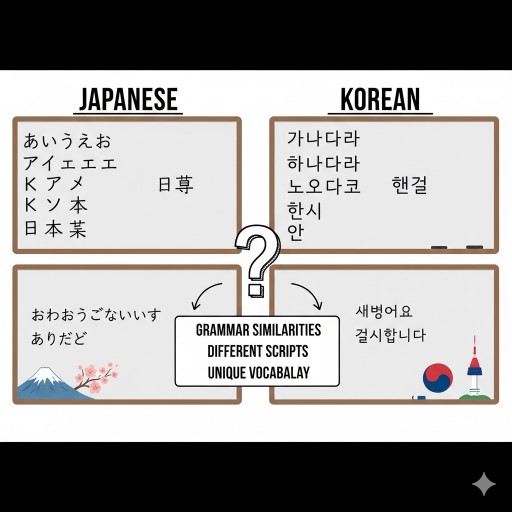
The most noticeable difference between Japanese and Korean is how they’re written.
Japanese uses three scripts — Hiragana, Katakana, and Kanji. Hiragana is for native words, Katakana is used for foreign terms, and Kanji represents entire ideas or meanings. Learning all three takes time, especially Kanji, which has thousands of symbols.
Korean uses Hangul, an alphabet system created in the 15th century. Hangul has just 24 letters and is phonetic, so once you learn the sounds, reading becomes simple. Many learners find Hangul far easier than Kanji.
Both languages follow the same sentence order: Subject–Object–Verb (SOV). For example, instead of saying “I eat an apple,” both say “I apple eat.”
Particles are another common feature — small words attached to nouns to show their function in a sentence. However, there are differences too.
That’s why both languages require a solid understanding of context and tone.
Pronunciation is smooth and rhythmic in both languages, but the sound systems aren’t identical.
Japanese pronunciation is simpler, using five basic vowels. Words sound exactly as they’re written. Korean includes more consonant sounds — some soft, some tense — that can be tricky for beginners. Still, both languages are non-tonal, so learners don’t have to worry about changing pitch to alter meaning.
Japanese and Korean share a surprising number of words that originated from Chinese. Over time, they’ve also borrowed from English — often giving them a local twist.
For instance, “computer” is konpyūta in Japanese and keompyuteo in Korean. The pronunciation differs, but the origin is the same. This mix of native and borrowed vocabulary makes both languages vibrant and modern.
If you’re interested in studying either, you might consider joining a Korean reliable Japanese Language Institute or Korean learning center where you can learn under expert trainers and get structured guidance.
Language and culture go hand in hand. Both Japan and Korea emphasize politeness and hierarchy, but express it differently.
In Japanese, honorifics are used to show respect, with various speech levels for formal and casual situations. Korean also has a detailed honorific system, but its verb endings change more dramatically based on age and relationship.
Understanding these subtleties isn’t just about grammar — it’s about showing cultural respect.
This depends on your goals. Korean is often easier to read and write because Hangul is straightforward. Japanese takes longer due to Kanji, but its consistent pronunciation helps.
Some learners start with Korean to get familiar with sentence patterns before switching to Japanese. Others dive straight into Japanese because of their love for its culture and entertainment.
When comparing Japanese vs Korean Language, the choice really depends on what inspires you. Both are equally rich, expressive, and rewarding to learn.
Japanese opens the door to a culture that values harmony, tradition, and innovation. Korean connects you to a dynamic world of K-pop, media, and fast-growing global influence.
If you already feel drawn toward Japan and its heritage, learning Japanese could be a life-changing experience. And if you’re searching for the right place to start, you can always look for a trusted Korean or Japanese Language Institute that offers authentic, well-structured programs for learners of all levels.
Whichever you choose, both paths lead to a deeper understanding of Asia’s culture, values, and the beauty of human expression through language.
10. What’s the best way to start learning them?
Join a good language institute or online course, practice daily, and immerse yourself in cultural materials like shows, songs, or books.

© 2025 Crivva - Hosted by Airy Hosting Managed Website Hosting.