

In this article we are going to discuss the importance of checking levelling and parallelism of a 60 Mtr paper making machine and why accurate machine alignment plays a major role in the paper manufacturing industry. In modern industrial production systems, machine accuracy directly affects production speed, paper quality, equipment life, and maintenance costs. Even a very small misalignment in a large paper machine can create serious operational problems that impact the entire manufacturing process.
As we know, a 60-meter paper making machine is a large industrial system where multiple machine sections work together continuously for paper production. These sections include rollers, bearings, dryers, press sections, gear systems, motors, and structural supports. If the machine foundation, rollers, or sections lose proper levelling or parallelism, it can affect machine efficiency and create unnecessary stress on mechanical components.
For this reason, industries now use advanced laser alignment technology to maintain precise machine geometry and improve overall operational reliability.
Levelling refers to maintaining the machine structure perfectly balanced throughout its entire foundation. Since paper making machines operate continuously under heavy loads, even a small foundation deviation can create long-term operational problems.
Proper levelling helps all machine sections work uniformly and prevents unnecessary mechanical stress.
In long industrial machines such as 60-meter paper production lines, accurate levelling is one of the most important maintenance requirements.
Parallelism means maintaining all machine rollers, shafts, and production sections perfectly parallel throughout the entire machine length.
A paper making machine contains multiple rollers that guide paper continuously through different stages of production. If these rollers are not properly aligned, paper movement becomes unstable.
Poor parallelism can create serious problems such as:
Regular parallelism inspection helps maintain production accuracy and protects machine components from early damage.
Large industrial machines naturally develop alignment issues over time because they operate continuously in demanding production conditions.
A 60-meter paper machine faces several technical challenges during long-term operation.
Without regular inspection, these small alignment errors gradually become serious maintenance problems.
Incorrect levelling and poor parallelism directly affect both production quality and equipment reliability.
Industries that ignore machine alignment often face expensive breakdowns and reduced overall profitability.
Modern industries no longer depend on traditional manual alignment methods because they are slower and less accurate.
Today, advanced laser alignment systems provide highly accurate measurement results and help engineers detect even very small alignment deviations.
Laser systems use digital sensors and computer-based measurement technology to verify machine geometry precisely.
Laser alignment technology has become one of the most trusted maintenance solutions in heavy industrial plants.
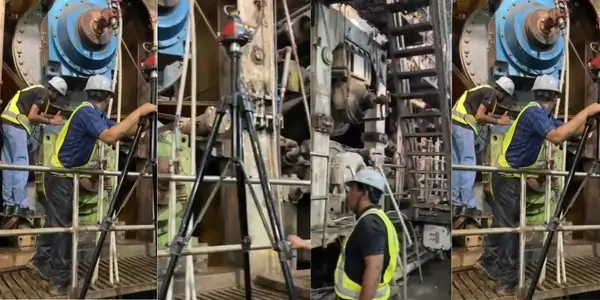
Professional alignment engineers follow a systematic inspection procedure while checking paper making machine geometry.
The complete machine structure, foundation condition, rollers, supports, and base frame are inspected carefully.
Accurate reference points are created throughout the complete 60-meter machine structure.
Using laser alignment instruments engineers measure:
Measurement data is analyzed to identify:
Necessary machine adjustments are performed to restore accurate levelling and alignment.
A final inspection confirms the machine meets required engineering tolerances.
As we know, industrial machines gradually lose alignment because of continuous operation and mechanical movement.
Regular preventive maintenance helps industries identify alignment problems before serious damage occurs.
Regular alignment inspection is a critical part of modern predictive maintenance programs.
Checking levelling and parallelism of a large industrial machine requires technical expertise, proper methodology, and advanced measuring instruments.
Professional alignment engineers ensure:
Experienced technicians use advanced laser systems to provide highly reliable industrial alignment solutions.
Laser alignment and geometrical inspection services are commonly used in:
Any industry operating large rotating machinery benefits greatly from precision alignment services.
Investing in proper machine alignment helps companies improve profitability over time.
Long-term advantages include:
Machine alignment is not just maintenance — it is an important investment in long-term operational performance.
In conclusion, checking levelling and parallelism of a 60 Mtr paper making machine is extremely important for maintaining machine accuracy, smooth production, better paper quality, and reliable equipment performance.
Because paper making machines are large industrial systems operating continuously under heavy load conditions, even a small alignment error can create serious operational problems including vibration, bearing damage, roller wear, production losses, and costly downtime.
Using advanced laser alignment services allows industries to perform highly accurate machine inspection, maintain engineering tolerances, improve structural accuracy, and ensure long-term operational reliability.
Regular machine alignment maintenance helps industries reduce breakdowns, improve productivity, extend machine life, and maintain consistent production quality.
For every paper manufacturing plant, investing in professional laser alignment and geometrical inspection services is one of the smartest long-term solutions for achieving maximum efficiency and reducing maintenance expenses.

© 2025 Crivva - Hosted by Airy Hosting Managed Website Hosting.