


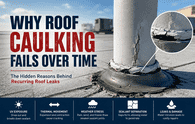
Many commercial roof leaks begin with what seems like a simple repair. Someone notices water around a rooftop penetration, applies fresh caulking around the flashing, and assumes the issue is solved. For a while, it may even hold through a few storms. Then the leak comes back. That’s usually where the real problem starts.
Understanding why roof caulking fails over time is important for commercial property owners, roofing contractors, and facility managers because many recurring leaks trace back to sealant joints that slowly break down under real-world roof conditions.
According to NRCA, flashing and penetration areas remain some of the most vulnerable parts of a commercial roofing system because they experience constant movement, weather exposure, and water stress.
The issue is not that caulking has no value. The problem is that when exposed sealant becomes the primary waterproofing method, it does so rather than supporting a properly integrated flashing system. Over time, weather, thermal expansion, rooftop vibration, and UV exposure gradually weaken sealant joints until water begins to work beneath the membrane.
Commercial roofing systems are built to handle years of:
Sealants do not always age at the same pace as the surrounding roofing assembly.
That’s one of the main reasons why roof caulking fails over time on commercial roofs.
As the roof expands and contracts throughout the year, exposed caulking gradually begins to:
This becomes especially noticeable around:
A lot of waterproofing failures start because the original repair relied too heavily on exposed sealant instead of layered flashing protection. This becomes even more important on solar-equipped roofs where attachment points experience constant movement and weather exposure. A properly engineered waterproof solar mount system helps reduce stress around penetrations while supporting long-term waterproofing performance.
Experienced roofing contractors usually treat caulking as a supporting waterproofing component rather than the entire repair system.
Commercial roofs move more than most building owners realize. Metal flashings expand during hot summer afternoons. Membranes contract during winter temperatures. Rooftop HVAC units create vibration almost daily. Wind uplift repeatedly applies pressure to penetration flashings during storms.
Over time, those small movements create constant stress around exposed sealant joints.
One common field issue is sealant separating around metal flashing corners after repeated thermal expansion cycles. At first, the gaps may be almost invisible. But once moisture begins to enter beneath the flashing, leaks can spread far beyond the original point of penetration.
Freeze-thaw climates make the problem worse. Water enters small cracks in the caulking, freezes overnight, expands, and slowly widens the separation. Several seasons later, the waterproofing detail may fail completely.
This is another major reason why roof caulking fails over time, especially on aging commercial roofs with older flashing assemblies or deferred maintenance.
That’s why properly engineered waterproof roof penetrations depend on integrated flashing systems rather than exposed sealant alone.
Another problem with overusing sealant is that it can temporarily mask larger waterproofing failures beneath the surface.
This happens often during emergency leak repairs.
A contractor applies another layer of caulking around a penetration because water is entering during storms. The leak slows down for a while, but the underlying issue may still exist:
Months later, the leak returns.
Repeated patch repairs and constant roof movement are exactly why exposed sealant joints tend to break down much faster over time. Facility managers deal with this constantly on older commercial roofs where multiple repair crews have patched the same area over several years.
By the time the roof is opened for inspection, layers of old sealant often make it difficult to locate the original waterproofing failure.
This becomes especially important with rooftop solar systems, where attachment points experience continuous movement and exposure to weather. A properly engineered waterproof solar mount system helps reduce long-term stress around penetrations while improving waterproofing performance over time.
A small cracked sealant joint may not look serious at first. But on commercial roofs, slow water intrusion usually spreads quietly beneath the membrane long before the leak becomes visible indoors.
In one reroofing project on a distribution facility, recurring leaks kept appearing around a retrofit solar installation. Maintenance crews had repeatedly added fresh caulking around the mounting penetrations whenever leaks appeared after storms.
For a while, the repairs seemed successful. The real issue was movement around the attachment system itself. Over multiple seasons, thermal expansion slowly separated the flashing details beneath the exposed sealant layer. Water migrated below the membrane and spread through the insulation system.
By the time moisture scans identified the damage, several sections of insulation required replacement. The roof membrane itself was still in decent condition. The actual failure happened around stressed penetration details hidden beneath the solar array.
Once the affected areas were rebuilt using proper flashing integration and a stable solar rail system, the recurring leaks finally stopped.
Situations like this are common on commercial roofs with aging rooftop equipment, retrofit solar systems, and years of deferred maintenance.
Understanding why roof caulking fails over time helps explain why so many commercial roof leaks continue returning after temporary repairs.
Caulking plays an important role in roof waterproofing systems, but it was never designed to serve as the sole waterproofing solution.
Over time, UV exposure, thermal movement, rooftop vibration, standing water, and seasonal weather slowly weaken exposed sealant joints. Once separation begins, water intrusion usually follows.
What starts as a small crack around flashing or conduit can eventually lead to saturated insulation, hidden moisture damage, operational downtime, and expensive commercial roof repairs.
For commercial property owners, contractors, and solar installers, long-term leak prevention depends on properly engineered flashing systems, coordinated installation practices, and regular roofing inspections, not just another layer of caulking over the last repair.

© 2025 Crivva - Hosted by Airy Hosting Managed Website Hosting.