


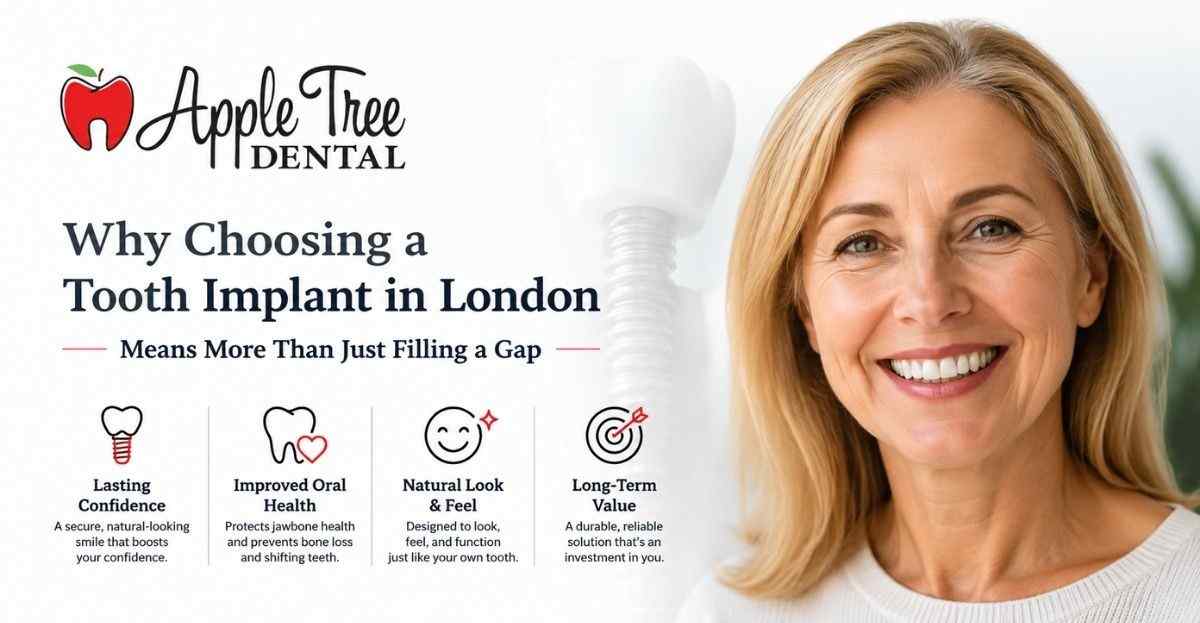
When you lose a natural tooth, the immediate concern is almost completely cosmetic and psychological. You might cover your mouth when you laugh, adjust your smile for photographs, or feel a sudden drop in self-confidence during business meetings. But while that visible gap in your smile is the most obvious consequence, the true cost of a missing tooth lies hidden beneath the gum line.
For decades, traditional dental solutions like porcelain bridges or removable partial dentures were the standard answer. They looked fine and functioned reasonably well. Today, however, restorative dentistry has fundamentally evolved. Dental implants have shifted the conversation from simply covering up a missing tooth to biologically replacing it.
But why is this distinction so critical for your long-term oral health? To understand why modern dentistry views implants as the gold standard, we have to look at the anatomy of the jaw and the cascading effects of tooth loss.
Bone Preservation: Implants are the only restorative option that stimulates the jawbone, preventing the bone resorption (shrinkage) that naturally occurs after a tooth is lost.
Adjacent Tooth Protection: Unlike dental bridges, implants do not require shaving or grinding down healthy neighboring teeth for structural support.
Bite Mechanics & Digestion: A fully integrated implant restores up to 99% of natural chewing efficiency, directly aiding in proper gastrointestinal digestion.
Lifelong Durability: With proper oral hygiene, the biocompatible titanium root of an implant is designed to last a lifetime.
To understand why implants are often a medical necessity rather than just a cosmetic luxury, you have to understand what happens to your facial structure when a tooth goes missing. It is never an isolated event; it is the first domino in a chain reaction.
Think of a natural tooth root like the roots of a tree holding soil in place on a steep hill. Every time you bite or chew, the root stimulates the surrounding jawbone, signaling your central nervous system to send vital nutrients to that specific area. When the tooth and its root are extracted, that mechanical stimulation stops.
The human body is highly efficient—if it senses a bone is no longer being used, it begins to resorb (dissolve) it to use those minerals elsewhere. Within the first year of losing a tooth, a patient can lose up to 25% of the supporting bone volume in that localized area. Over time, this cumulative bone loss leads to a sunken facial appearance, often referred to in dentistry as “facial collapse.” This alters the underlying shape of your face, causing premature wrinkling around the mouth and making you look years older.
Your teeth rely on each other for structural stability, acting like books packed tightly on a bookshelf. When a gap appears, the adjacent teeth slowly begin to drift and tilt into the empty space. Furthermore, the opposing tooth on the opposite jaw may begin to “super-erupt” (grow downward or upward into the gap) because it no longer has a chewing partner to keep it in place.
This shifting severely disrupts your natural bite alignment. A misaligned bite can trigger a cascade of secondary issues, including temporomandibular joint (TMJ) disorders, chronic headaches, and uneven wear on your remaining enamel.
We often forget that teeth are crucial for two of our most basic daily functions: speaking clearly and digesting food. Missing teeth can cause involuntary lisps or changes in how you pronounce certain consonants. More importantly, compromised chewing efficiency means you swallow larger, unchewed pieces of food. This places immense strain on your digestive tract, leading to acid reflux, indigestion, and poor nutrient absorption.
The reason dental professionals globally advocate for implants is due to a remarkable biological process called osseointegration. Discovered somewhat accidentally in the 1950s by an orthopedic surgeon named Per-Ingvar Brånemark, osseointegration is the phenomenon where living bone tissue permanently fuses to titanium.
An implant isn’t just a fake tooth sitting on top of your gums. It is a highly engineered, three-part system:
The Post: A biocompatible titanium screw surgically placed into the jawbone, acting as the new root.
The Abutment: A precision-milled connector piece that sits just above the gum line, securely linking the post to the crown.
The Crown: The custom-crafted ceramic or porcelain tooth that is color-matched and shaped to blend seamlessly with your natural teeth.
Because the body recognizes titanium as biocompatible, the bone heals tightly around the microscopic threads of the post. This fusion tricks your jaw into thinking the natural root is still present, completely halting the bone loss process.
When consulting with a dentist, patients are often presented with three main choices for replacing a tooth. Here is how they compare biologically and functionally:
If you are currently evaluating your restorative options and looking for a tooth implant in London, Ontario, it is highly encouraging to know that the procedure is no longer the daunting, unpredictable surgery it was decades ago. Thanks to advancements in 3D CBCT (Cone Beam Computed Tomography) imaging and computer-guided surgery, the modern implant journey is incredibly precise and comfortable.
Comprehensive Digital Diagnostics: Before any procedure begins, clinicians use 3D imaging to map out your jawbone density, nerve pathways, and sinus cavities. This ensures the implant is planned at the perfect microscopic angle and depth.
Preparatory Procedures (If Necessary): If you have been missing a tooth for several years, you may have already lost too much bone to support an implant. In this case, a minor bone grafting procedure is performed to rebuild the foundation.
Surgical Placement: The titanium post is gently placed into the jaw. Surprisingly to many patients, this step involves very little discomfort. Because the jawbone itself has very few nerve endings, most patients report that getting an implant is less painful than the original tooth extraction.
The Healing Phase: Over the next three to six months, the jawbone undergoes osseointegration. During this time, a temporary crown or flipper is often provided so you never have to navigate your daily life with a visible gap.
Final Restoration: Once the post is fully integrated and tested for stability, the permanent, highly durable custom crown is attached, completing your smile.
While dental technology has made implants accessible to more people than ever, successful treatment relies on a few key physiological factors.
An ideal candidate must have a healthy immune system to facilitate proper bone healing. Chronic conditions like uncontrolled diabetes or autoimmune disorders can slow the healing process and increase the risk of implant failure. Additionally, gum health is paramount; active periodontal (gum) disease must be treated and resolved before an implant can be placed, as the bacteria can infect the bone surrounding the new titanium root (a condition known as peri-implantitis).
Finally, lifestyle factors play a major role. Heavy smoking restricts blood flow to the gums and jawbone, drastically lowering the success rate of osseointegration. Your dental team will conduct a thorough medical history review to ensure you are positioned for a successful outcome.
When researching permanent dental implant solutions, patients often naturally weigh the upfront financial investment against older, cheaper alternatives. However, when viewed through a long-term lens, the return on investment (ROI) heavily favors implants.
A traditional dental bridge may cost less initially, but because it relies on the health of the adjacent teeth, those anchoring teeth often succumb to decay over time. This means the bridge will likely need to be replaced every 7 to 10 years, compounding the cost over a lifetime. Furthermore, dentures require ongoing maintenance, messy adhesives, and frequent professional adjustments (relining) as your jawbone continues to change shape.
An implant is an investment in permanence. It offers the psychological security of knowing your tooth will not slip during a business presentation or a family dinner. It allows you to eat crisp apples, tough proteins, and raw vegetables without hesitation, directly supporting your systemic health.
Choosing how to replace a missing tooth is a significant healthcare decision that dictates how you will eat, speak, and feel about yourself for decades to come. By choosing an implant, you are doing far more than filling a cosmetic gap. You are investing in the structural integrity of your jaw, protecting your remaining natural teeth from damage, and reclaiming an unrestricted, confident quality of life.
Apple Tree Dental is a premier family and restorative dental practice based in London, Ontario. Led by a dedicated team of credentialed dental professionals, the clinic specializes in comprehensive oral rehabilitation, digital dentistry, and personalized implantology. Committed to patient education and modern clinical excellence, Apple Tree Dental focuses on delivering evidence-based, comfortable, and long-lasting solutions for optimal oral health.

© 2025 Crivva - Hosted by Airy Hosting Managed Website Hosting.








