


You know that moment when you take your shoes off after a long day and your legs just feel heavy? Not painful exactly. Just tired and full. Maybe you rub your calves without thinking about it. Maybe you prop them up on the couch and don’t move for a while.
But here’s the thing. That heaviness? That ache? That’s your veins telling you they’re struggling. They’re working against gravity all day long, pushing blood back up to your heart. When the little valves inside them stop working right, the blood goes backward and pools. That’s what makes the veins bulge. That’s what makes your ankles swell. That’s what keeps you awake at night with cramps.
The good news is you don’t have to live with it. And you definitely don’t need to go through some big scary surgery to fix it. The way doctors treat veins now is completely different than it was twenty years ago.
If you’ve been searching for information about varicose veins treatment in India, you probably have a lot of questions. How much will it cost? Will it hurt? How do you find someone who actually knows what they’re doing?
Let’s just talk through it.
Veins don’t fail overnight. It’s slow. Most people don’t even notice until the veins are sticking out. But if you know what to look for, you can catch it earlier.
You might see little red or blue lines under the skin. Like a tiny spider web. Doctors call them spider veins. They don’t usually hurt much. Maybe a little burning if you stand in one place too long. A lot of people stop here because it doesn’t seem serious. And honestly, if it doesn’t bother you, you don’t have to do anything. But this is the easiest time to deal with them if you want to.
Now the veins are raised. You can feel them when you run your hand over your leg. They look ropey. This is when the symptoms usually start. Your legs feel heavy by afternoon. You might notice you’re shifting from foot to foot a lot just to get comfortable. Heat makes it worse. Summer is rough.
Your ankles start swelling. If you press your thumb into the swollen part, it leaves a little dent. That means fluid is leaking out of the veins into the tissue. The veins aren’t just bulging anymore. They’re actually failing at their job. The skin around your ankle might start looking different too. Shiny. Flaky. Maybe a little brownish.
This is when ulcers can show up. Open sores that just don’t want to heal because the skin isn’t getting enough blood flow. If you’re here, you really need to see someone soon. Don’t wait.
Most people reading this are probably in the middle stage. That’s where most people land before they start looking for help.
Here’s the thing that surprises most people. You don’t get cut open anymore.
The old surgery where they stripped the vein out of your leg? That’s pretty much gone. You might find a few old school surgeons who still do it, but it’s not the standard anymore.
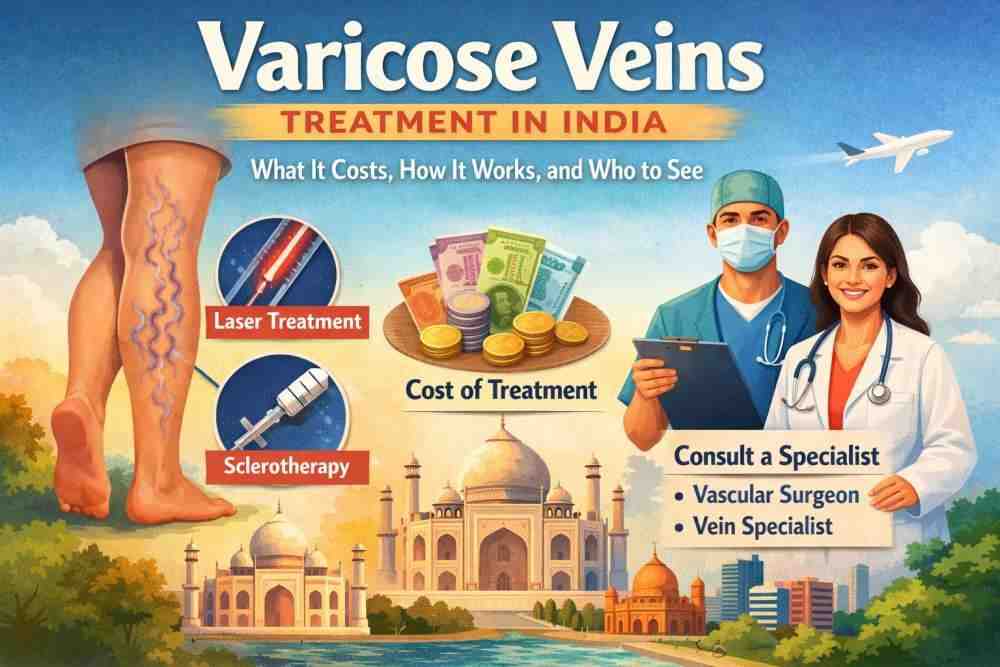
Today, varicose veins treatment in India is mostly done through tiny pokes. No stitches. No hospital stay. You walk in and you walk out.
Laser treatment. They put a tiny fiber into the vein through a small hole. The laser heats the vein from inside and seals it shut. Your body just reroutes the blood to healthier veins and the bad one eventually fades away. It takes about an hour. You’re awake the whole time.
Radio frequency. Same idea but they use radio waves instead of a laser. Feels like a little tugging. Most people say it’s not really painful. Just weird.
Injection treatment. This is for the smaller veins. They inject a solution right into the vein. It irritates the walls and makes them stick together. The vein collapses and disappears over a few weeks. They call it sclerotherapy. Works best for the little ones.
Glue. Newer option. They actually use medical glue to seal the vein shut. No heat. No tugging. Just a little injection of glue and done. Not every doctor offers it yet but it’s becoming more common.
The recovery is simple. You wear compression stockings for a bit. You walk around right after the procedure. They actually want you to walk. Helps the blood flow.
Let’s talk money because this is where India really changes the game.
If you looked up treatment costs in the US or UK, you probably closed the browser pretty fast. Those numbers are scary. We’re talking five figures easy. Per leg.
In India, the numbers are different. The equipment is the same. The doctors have the same training. But the cost is way lower because overhead is lower and hospitals run differently here.
A first visit to a good vascular surgeon will run you maybe five hundred to fifteen hundred rupees. They’ll do an ultrasound right there to see what’s happening inside. No extra charge usually.
For the actual procedure, here’s the range.
If you need laser or radiofrequency on one leg, you’re looking at fifty thousand to one lakh rupees. Maybe a little more in a fancy hospital in a big city. Both legs together might go up to one lakh twenty or one fifty.
Sclerotherapy for the small veins is cheaper. Three to eight thousand per session. You might need a couple sessions.
If you’re coming from another country, here’s how the math works. Your flight to India, your hotel for a week, and the procedure combined will often cost less than just the procedure back home. That’s just reality. A lot of people from the UK, Australia, and the Middle East come here specifically for this.
Insurance is tricky. Some Indian policies cover it if the veins are causing symptoms. Some don’t. You have to check your specific plan. If it’s just cosmetic, insurance usually says no.
Not every doctor who offers vein treatment should be doing vein treatment. You have to be a little careful.
The title you want is vascular surgeon. Not general surgeon. Not dermatologist unless they specifically specialize in veins. A proper vascular surgeon did extra years of training just on blood vessels. That’s all they do all day.
When you go for a consultation, pay attention to how they talk to you. A good doctor asks about your day. Do you stand a lot? Sit all day? Cook for hours? They should care about why this happened, not just which vein to zap.
Also watch how they use the ultrasound. A good vascular surgeon does their own ultrasound. They don’t send you to a technician and then read a report. They look at the veins themselves while you’re right there. They show you what’s happening. You can see the blood flowing backward on the screen. That’s how you know they know their stuff.
The big hospital chains in Mumbai, Delhi, Bangalore, Chennai all have vascular departments. Apollo, Fortis, Max, Manipal. They’re reliable. But some of the best care actually comes from smaller vein clinics run by one really good specialist. Those doctors built their whole practice around veins. That’s all they do.
Word of mouth matters too. Ask around. Someone in your circle probably had this done. See who they went to and how it went.
Here’s the thing about varicose veins. They don’t get better on their own. They only get worse. Slow maybe, but steady. Gravity keeps working. Blood keeps pooling. Pressure keeps building.
The ache gets a little worse each year. The swelling gets harder to manage. The skin changes become permanent.
But the real reason people finally do something about it is simpler. They just want to feel normal again. They want to walk through the market without looking for a place to sit every ten minutes. They want to stand in the kitchen and cook without their legs screaming at them. They want to wear shorts without thinking about it.
That’s the real goal. Not perfect legs. Just normal legs. Legs you don’t have to think about all the time.
The technology is there now. The doctors are there. The cost is manageable for most people. The only thing missing is just making the call.
If your legs are heavy at the end of the day, that’s not nothing. That’s a signal. You can ignore it and keep going. A lot of people do. Or you can get it checked and see what’s actually happening under the skin.
Varicose veins treatment in India has come a long way. It’s quick now. It’s not scary. It’s not going to put you in bed for weeks. And it might just give you back something you didn’t realize you lost. The ability to stand without thinking about it. The ability to walk without counting the minutes.
Find a good vascular doctor. Get that ultrasound. See where you stand. You can decide what to do after that. But at least you’ll know.

© 2025 Crivva - Hosted by Airy Hosting Managed Website Hosting.