When we think about healthcare, we usually think about doctors, nurses, and life-saving treatments. We think about the trust we place in medical professionals to take care of us. But behind the scenes, there is a complex system designed to ensure that the people providing that care are qualified, honest, and safe to be around.
For anyone managing a medical practice, a hospital, or a healthcare agency, hiring the right people is the most important job. This is where background screenings come in. Specifically, two critical terms often come up: the sanction check and the OIG check.
While these might sound like complicated legal terms, they are actually very simple tools used to protect patients and taxpayer money.
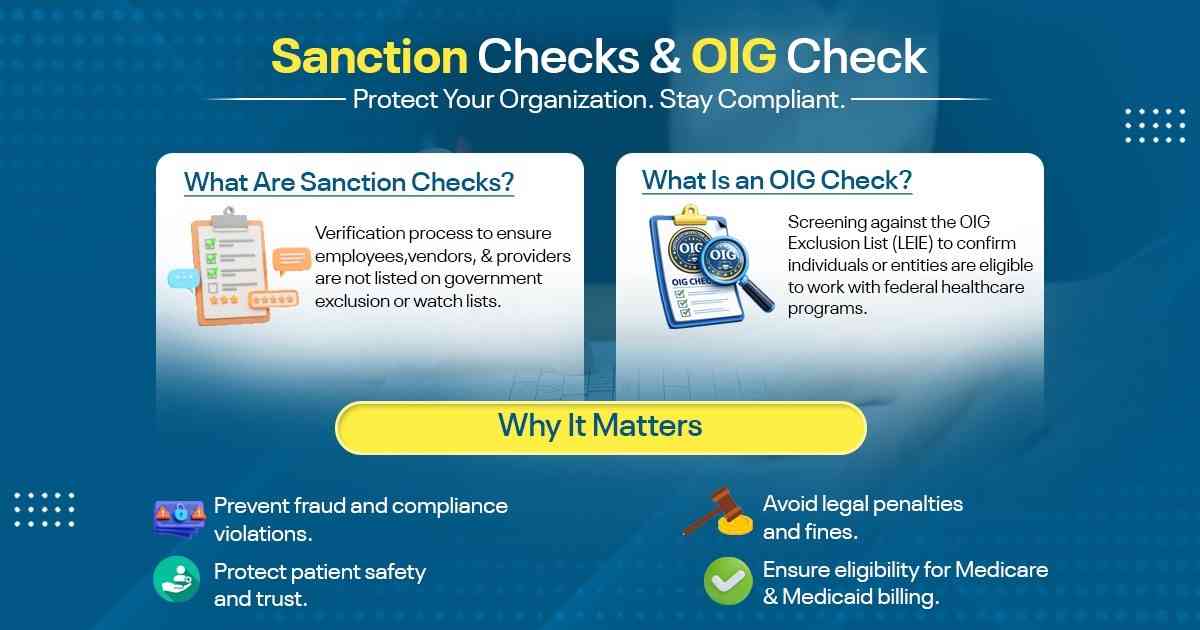
How does an OIG check work? To get started with an OIG check, it helps to first understand what the OIG is. An OIG check is a type of background screening of a candidate against the Office of Inspector General (OIG), which is a department of the U.S. Government. The OIG was created to investigate and prevent fraud, waste, and abuse in the Federal health care programs, specifically the Medicare and Medicaid programs.
Healthcare professionals can commit fraud or act inappropriately in many ways such as billing for services not rendered (billing fraud), abusing their patients, or defaulting on their student loans. As a result of such actions, the OIG will exclude those individuals or companies by placing them on the List of Excluded Individuals/Entities (LEIE).
Once a person is placed on the LEIE, they are “excluded” from working at any facility that receives federal funding. Therefore, if a prospective employee is on the LEIE and hired by you, the U.S. The government will not cover any services they provide to patients, your facility may face substantial penalties for hiring that individual.
When you visit your doctor, trust is the most important part of the experience. You trust them to diagnose you correctly, treat you with care, and prescribe the medication that is best for your health. However, healthcare is also a massive industry. Sometimes, financial relationships exist between the doctors we see and the companies that make the drugs and medical devices we use.
This is where the CMS Open Payments program comes into play. If you have ever wondered about the financial ties in the healthcare system, this federal database is the tool designed to give you answers.
The OIG check is the process of checking the LEIE to confirm a candidate is not listed as having committed an act of fraud, waste, or abuse.
While the OIG manages federal exclusions, sanction checks are typically conducted more comprehensively than an OIG exclusion search. “Sanction” means the action taken against a health care provider by a state licensing board or certification body.
For example, a nurse could have his and her license suspended in one state due to substance abuse or negligent practice; if he and she relocates to another state in pursuit of employment, a routine criminal background check will likely not reveal the license has been suspended. A complete sanction check, however, will examine the disciplinary history of a nurse across states and boards.
Sanction checks allow employers to determine whether an applicant has engaged in any instances of professional misconduct, regardless of whether they have yet been federally excluded by the OIG.
It is important to remember that finding a record in the Open Payments CMS database does not mean your doctor has done anything wrong. Collaboration between doctors and drug companies is often necessary to develop new life-saving treatments. Research requires funding, and innovation requires cooperation.
Nonetheless, transparency plays an important role in creating an honest healthcare environment. The Centers for Medicare and Medicaid Services (“CMS”) Open Payments program provides you with the opportunity to see any financial relationship between your doctors and the companies they may prescribe. This way you can have an open, honest conversation with your doctor.
An essential part of taking charge of your health is doing your due diligence in researching the doctor you are working with every time you get a new medication or are going to have a procedure done. By taking just a few minutes to research the doctor you will be working with, you will gain confidence in the system and the people who are helping you get to better health. Transparency can lead to building trust with your doctor, and trust is an essential component of effective medical practice.
There are two main reasons why every healthcare organization must prioritize these screenings
The most important goal of healthcare is to “do no harm.” If a hospital hires a doctor who has a history of losing their license for malpractice, they are putting their patients at risk. By performing a thorough sanction check and OIG check, employers act as a gatekeeper. They ensure that bad actors are kept out of exam rooms and operating theatres.
The government takes fraud very seriously. If a clinic employs an excluded person, the fines can be devastating. The government can demand back every dollar paid for services that the excluded employee was involved with. On top of paying the money back, the clinic can be hit with Civil Monetary Penalties—heavy fines for every item claimed. For small practices, these costs can be enough to put them out of business.
When should you verify a potential hire’s career credentials? Most organizations tend to perform these types of verifications only during an employee’s onboarding process; however, it is important to keep in mind that a physician’s status could change at any moment. For example, although a physician may be in good standing in January, he/she could become sanctioned in July.
As a result of this potential for employee status change, industry best practices (and government recommendations) recommend that you perform an oig verification and sanction verification every month. This process will allow you to discover if an employee has encountered an issue since being hired.
To summarize, ensuring the integrity of the healthcare system through documentation is part of the healthcare administrative process. Many organizations view compliance as just another box to check; however, oig and sanction verification are two of the most important methods of maintaining the integrity of the healthcare system, and keeping your patients and employees safe from unqualified providers or costly fines. These very simple processes can create a huge impact in the healthcare delivery process.

© 2025 Crivva - Hosted by Airy Hosting Managed Website Hosting.