Most people think a healthy smile only depends on white teeth. In reality, your bite matters just as much. When the upper and lower teeth do not align properly, dentists call it malocclusion of teeth.
In simple words, malocclusion means a “bad bite.” It affects how your teeth fit together when your mouth closes. Some people develop mild bite issues, while others struggle with severe jaw misalignment that affects speaking, chewing, and confidence.
Many patients visiting Nipissing Dental ask the same question:
“Is my bite normal, or should I get treatment?”
The answer depends on the type and severity of your dental occlusion.
Before understanding malocclusion, it helps to know what dental occlusion means.
In dentistry, occlusion refers to how the upper and lower teeth meet when you close your mouth. Healthy teeth in occlusion should align comfortably without excessive pressure on the jaw or teeth.
Dentists use the term occlusion in dentistry to evaluate:
Good dental occlusion helps protect teeth from uneven wear. It also reduces jaw strain and improves oral function.
If you want a deeper overview of bite correction and alignment problems, visit this detailed guide on malocclusion of teeth and bite correction.
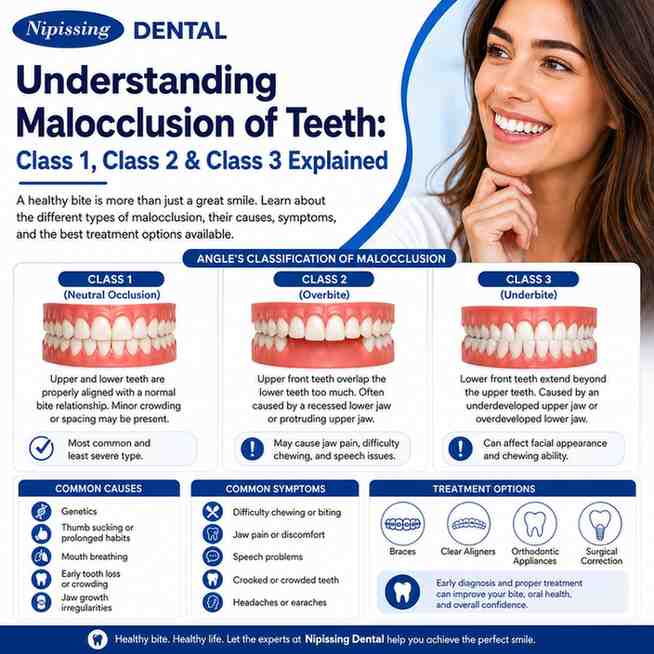
Dentists commonly use Angle’s classification to identify the three main dental occlusion classes.
This system focuses on how the upper and lower first molars align.
The three primary dental occlusion classes include:
Let’s break them down clearly.
Class 1 dental occlusion is the most common type of malocclusion.
In this case:
Many people with malocclusion class 1 do not notice major bite problems initially.
Usually, Class 1 cases remain mild. However, untreated crowding increases the risk of cavities and gum disease because cleaning becomes harder.
Many patients improve Class 1 alignment issues using modern orthodontic solutions like Invisalign and clear aligners.
You can also explore professional orthodontic and cosmetic treatment options offered at Nipissing Dental Care.
Class 2 malocclusion usually creates an overbite smile.
This happens when upper teeth extend too far over lower teeth.
Dentists sometimes call this a “retrognathic bite.”
Many people confuse overbite vs overjet, but they are different.
| Condition | Description |
|---|---|
| Overbite | Vertical overlap of upper teeth over lower teeth |
| Overjet | Horizontal protrusion of upper teeth outward |
An overbite measures downward overlap. Overjet measures forward projection.
Imagine a laptop closing too far downward versus sliding too far forward. Different issue, same frustration.
If you are dealing with an overbite, this guide explains whether clear aligners can help:
Does Invisalign Fix Overbites?
Class 3 malocclusion occurs when the lower jaw extends beyond the upper jaw.
This condition creates a class 3 underbite or class 3 bite.
It often appears more noticeable than other bite problems.
Some severe cases require orthodontic treatment combined with oral surgery.
In many cases, yes.
Research published by the National Institutes of Health (NIH) shows strong genetic links to skeletal Class 3 malocclusion patterns.
Patients looking for non-surgical correction often ask whether Invisalign can help. This detailed article explains treatment possibilities for underbites:
Can Invisalign Fix Underbite in Milton?
Besides the three major classes, dentists also diagnose other bite conditions.
Upper and lower teeth fail to touch when the mouth closes.
Common causes include thumb sucking and tongue thrusting.
Some upper teeth sit inside lower teeth instead of outside.
Crossbites may lead to uneven jaw growth.
Teeth overlap because the jaw lacks enough space.
Large gaps appear between teeth due to missing teeth or jaw size differences.
These conditions may occur alongside standard occlusion classification categories.
Not every patient experiences pain immediately.
However, common symptoms include:
Some patients also avoid smiling due to cosmetic concerns.
That emotional impact matters more than many people realize.
Dentists evaluate dental occlusion using:
At Nipissing Dental Clinic, dentists assess both tooth alignment and jaw function before recommending treatment.
A proper diagnosis helps prevent unnecessary procedures.
Yes. In many cases, braces successfully correct bite alignment.
Orthodontic treatment gradually shifts teeth into healthier positions.
Mild to moderate cases often respond well to clear aligners.
Severe skeletal problems may require surgery alongside orthodontics.
Treatment depends on the type of malocclusion and the patient’s age.
Braces remain one of the most effective solutions for correcting dental occlusion classes.
Clear aligners offer a discreet option for mild and moderate alignment issues.
Dentists sometimes remove overcrowded teeth to create space.
Severe Class 3 bite cases may need orthognathic surgery.
Retainers help maintain long-term results after orthodontic treatment.
Early intervention often reduces treatment complexity later.
For professional guidance and customized treatment planning, visit Nipissing Dental Milton.
Untreated malocclusion may lead to:
Children benefit greatly from early orthodontic evaluations because jaw development remains flexible during growth.
The American Association of Orthodontists recommends orthodontic screening by age 7.
Malocclusion refers to improper alignment between upper and lower teeth when the mouth closes.
The three major classes include:
These categories follow Angle’s classification system.
Class 3 malocclusion occurs when the lower jaw extends beyond the upper jaw, creating an underbite.
Class 1 describes mostly normal bite alignment with mild crowding or spacing issues.
Yes. Braces and clear aligners successfully treat many forms of malocclusion.
Understanding malocclusion of teeth helps patients recognize early warning signs before complications develop.
A healthy bite supports:
Small bite issues may seem harmless today, but untreated problems often worsen over time.
If you notice crowding, jaw discomfort, or bite imbalance, scheduling a professional dental evaluation can help protect both your smile and your oral health.
You can learn more about orthodontic and cosmetic dental services at Nipissing Dental.

© 2025 Crivva - Hosted by Airy Hosting Managed Website Hosting.