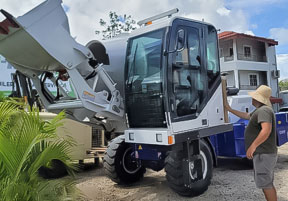
The United Arab Emirates is a country built on concrete. Skyscrapers, villas, malls, roads, and airports. The demand never stops. Yet for all its sophistication, the UAE construction industry faces a persistent challenge. Getting concrete to the exact place it is needed, at the exact time it is needed, in the exact quantity needed. Ready-mix trucks are the traditional solution. They work well on large, open sites. They struggle on the rest. Narrow access roads, tight turning circles, remote locations, and small-volume pours. Enter the self loading concrete mixer. A machine that loads its own materials, mixes them on board, and pours exactly where required. It is not a replacement for ready-mix. It is a complement. A solution for the gaps. This article describes the specific challenges of the UAE market and explains why self-loading mixers are increasingly the answer. The tone is friendly. The information is practical. Let us explore.
A standard ready-mix truck needs space. Lots of space. A turning circle of 10 to 12 meters. A width of 2.5 meters. A height clearance of 4 meters. These dimensions work on a highway project or a large commercial site. They do not work on a villa extension in Emirates Hills. They do not work on a backfill pour in a narrow alley in Deira. The truck arrives. The driver looks at the entrance. The driver shakes their head. The concrete goes back to the plant or gets dumped. The contractor is frustrated. The schedule slips. The self-loading mixer has no such problem. The machine is compact. A typical unit is 5 to 7 meters long and 2 to 2.5 meters wide. It can turn in a 6-meter radius. It fits through standard gateways. It manoeuvres around obstacles that would stop a truck. The friendly observation is that the self-loading mixer does not need the site to accommodate it. It accommodates the site. That is a significant advantage in the built-up urban environment of the UAE.
The UAE has sand. Lots of sand. A ready-mix truck weighs 25 to 35 tonnes when loaded. It sinks into soft sand. It gets stuck. The driver calls for a tow. The tow arrives hours later. The concrete in the drum continues to hydrate. By the time the truck is free, the concrete is unusable. The load is wasted. The contractor pays for the concrete and the tow. The self-loading mixer weighs 6 to 10 tonnes. It is lighter. It has lower ground pressure. It can operate on sand that would swallow a ready-mix truck. The machine may still leave ruts. It will not get stuck. The friendly advice is that for any site with unpaved access or soft ground, the self-loading mixer is the safer choice. It arrives. It pours. It leaves. No drama.
Ready-mix suppliers have minimum order quantities. The number varies. 4 cubic meters. 6 cubic meters. Sometimes 8. The reason is economic. A truck costs the same to dispatch whether it carries 1 cubic meter or 8. The supplier needs to cover the cost. The contractor with a 2 cubic meter pour faces a dilemma. Order from a ready-mix supplier and pay for concrete they do not need. Or mix manually using bags and a portable mixer. Manual mixing is labour-intensive. It is slow. It is inconsistent. The self loading mixer in UAE solves this problem. The contractor buys aggregates and cement in bulk. The machine produces exactly the volume required. No waste. No premium. No compromise. The friendly observation is that the self-loading mixer turns uneconomical small pours into profitable work. A contractor who owns a self-loading mixer can bid on projects that ready-mix suppliers will not touch.
A typical day for a UAE residential contractor might include three small pours. A garden retaining wall. A set of fence posts. A small slab for an air conditioning unit. Each pour is 1 to 2 cubic meters. A ready-mix supplier would require three separate orders. Three delivery fees. Three minimum order charges. The cost would be prohibitive. The contractor with a self-loading mixer loads the machine once in the morning. They travel to the first site. They pour. They travel to the second site. They pour. They travel to the third site. They pour. The machine carries its materials between sites. The only consumables are fuel and wear parts. The friendly advice is that the self-loading mixer is a mobile batching plant. It brings the plant to the pour, not the pour to the plant. That flexibility changes the economics of small-scale concrete work.
The UAE is not just Dubai and Abu Dhabi. It is Al Ain. It is Ruwais. It is the Liwa Oasis. It is the desert between cities. Ready-mix plants are concentrated in urban areas. A site 100 kilometres from the nearest plant faces long delivery times. The concrete may set before it arrives. The supplier may refuse the order. The contractor must find an alternative. The self-loading mixer is the alternative. The contractor buys materials locally or transports them from the city. The machine produces concrete on site. No delivery time. No setting risk. The friendly observation is that the self-loading mixer is not dependent on a ready-mix supply chain. It creates its own supply chain. That independence is valuable in remote locations.
The UAE’s oil and gas sector requires concrete in remote locations. A pipeline valve station. A wellhead pad. A worker accommodation camp. These projects are often 50 to 200 kilometres from the nearest ready-mix plant. The contractor could build a temporary batching plant. The cost is high. The plant must be moved when the project ends. The self-loading mixer offers a middle path. One machine. No additional equipment. The operator produces concrete as needed. The friendly advice is that for remote infrastructure projects, the self-loading mixer is not a convenience. It is a necessity. It enables work that would otherwise be logistically impossible.
The final argument for self-loading mixers is cost certainty. A ready-mix quote includes the concrete, delivery, and often a fuel surcharge. The price can vary. The self-loading mixer owner buys materials at market prices. They control the production cost. They are not subject to a supplier’s pricing decisions. The friendly observation is that independence has value. The contractor who produces their own concrete is not at the mercy of a ready-mix supplier’s schedule, minimum order quantities, or pricing. They are in control. That control is winning.
The second argument is quality control. A ready-mix truck arrives with a fixed mix. If the slump is wrong, the contractor can add water. Adding water changes the water-cement ratio. It reduces strength. The contractor has no other option. The self-loading mixer operator can adjust the mix before pouring. Too dry? Add water at the control panel. Too wet? Add a little more cement. The operator has real-time control. The friendly advice is that on-site mixing allows on-site adjustment. That flexibility improves quality. It reduces rejected loads. It reduces waste. That is why self-loading mixers are winning. They solve real problems. Access. Volume variability. Remote locations. Cost certainty. Quality control. The UAE construction market is demanding. The self-loading mixer is answering.

© 2025 Crivva - Hosted by Airy Hosting Managed Website Hosting.