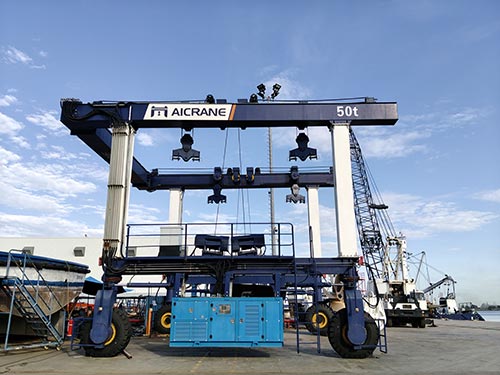
Marine travel lifts have become one of the most important lifting solutions in modern shipyards, marinas, and boat maintenance facilities. Their ability to lift, transport, and launch vessels of varying sizes makes them indispensable in the marine industry. However, what truly defines a high-performance marine travel lift is not just its lifting capacity, but its design features that ensure stability and safety during complex lifting operations.
In environments where heavy loads, water proximity, and uneven ground conditions coexist, stability and safety are not optional—they are engineering priorities. This article explores the key design features that make marine travel lifts both stable and safe, and explains why these systems are trusted in demanding marine operations worldwide.
The most critical element of a travel lift for sale is its main structural frame, which must withstand dynamic loads, environmental stress, and continuous operation.
Most modern designs use high-strength welded box girders or rectangular steel frames. These structures distribute stress evenly across the entire frame, reducing localized pressure points that could lead to deformation.
Key structural stability features include:
A well-designed frame ensures that even when lifting asymmetrical vessels, the load is evenly transferred to all wheels, maintaining balance and preventing structural twisting.
One of the most important stability features in a marine travel lift is its multi-wheel configuration. Instead of relying on a few load points, marine travel lifts use multiple wheel sets to distribute weight evenly across the ground.
This system provides:
Each wheel group is often equipped with independent suspension or equalizing beams, allowing the machine to adapt to minor ground irregularities without compromising stability.
In real-world operations, this means that even large yachts or fishing vessels can be lifted and transported safely without tilting or uneven stress distribution.
Safety in lifting operations depends heavily on synchronized movement. Marine boat hoists typically use advanced hydraulic systems that ensure all lifting points rise and lower at the same speed.
This synchronization system includes:
Without synchronization, one side of the vessel could rise faster than the other, leading to dangerous tilting or even structural damage. By maintaining precise control, the hydraulic system ensures that the load remains level throughout the lifting process.
This is especially important when handling expensive yachts or structurally sensitive vessels.
Stability is not only about lifting—it also includes movement control under load. Marine travel lifts are designed with multiple steering modes to enhance maneuverability while maintaining structural balance.
Common steering modes include:
These modes allow operators to navigate tight marina spaces without abrupt turning, which could destabilize the load.
Advanced control systems also include:
By reducing sharp turns and uncontrolled movements, these systems significantly enhance operational safety.
Load sway is one of the most dangerous risks in marine lifting operations. To address this, modern marine travel lifts incorporate anti-sway design features.
These may include:
When lifting a vessel, even small oscillations can create large dynamic forces due to the weight and size of the load. Anti-sway systems minimize this risk by controlling motion at both the lifting and travel stages.
This ensures smooth handling even in windy conditions or on slightly uneven surfaces.
The sling system is the direct interface between the marine travel lift and the vessel. Its design plays a critical role in safety and stability.
Modern systems use:
A properly designed sling configuration ensures that the vessel is lifted from structurally reinforced points, preventing hull deformation.
Additionally, adjustable beams allow operators to match different hull shapes, improving both flexibility and safety.
Marine travel lifts often operate on outdoor surfaces that are not perfectly level. To address this, they are equipped with wheel alignment and ground adaptation technologies.
These include:
This ensures that all wheels maintain proper contact with the ground, even on uneven or slightly sloped surfaces.
Without this system, uneven terrain could cause dangerous tilting or wheel slippage during operation.
Modern marine travel lifts are increasingly equipped with digital monitoring systems that enhance operational safety.
These systems typically include:
Some advanced systems also integrate IoT-based remote monitoring, allowing operators to track machine status, maintenance needs, and performance data in real time.
These intelligent features significantly reduce human error, which is one of the leading causes of industrial accidents.
Safety is also influenced by how well the operator can control and observe the lifting process. Marine travel lifts are designed with ergonomic operator cabins that prioritize visibility and control efficiency.
Key features include:
Good visibility allows operators to precisely position vessels and avoid obstacles, while ergonomic controls reduce fatigue during long operations.
A critical aspect of safety design is the inclusion of fail-safe mechanisms that activate during system failure or emergencies.
These include:
In the event of power loss or hydraulic failure, the system is designed to hold the load securely in place, preventing sudden drops or uncontrolled movement.
This ensures that both personnel and equipment remain safe even in unexpected situations.
The stability and safety of a marine travel lift are not achieved through a single feature, but through a carefully engineered combination of structural design, hydraulic synchronization, intelligent control systems, and operator-focused safety mechanisms.
From multi-wheel load distribution to advanced anti-sway technology and real-time monitoring systems, every component plays a role in ensuring safe and efficient marine operations.
As shipyards and marinas continue to demand higher efficiency and safer handling of larger vessels, marine travel lifts will continue to evolve—integrating smarter control systems, stronger materials, and more adaptive mobility technologies.
In the end, a well-designed marine travel lift is not just a lifting machine—it is a complete safety system engineered for one of the most challenging environments in industrial material handling.

© 2025 Crivva - Hosted by Airy Hosting Managed Website Hosting.