

The lending industry has changed dramatically over the last few years. Customers now expect instant approvals, paperless onboarding, and a seamless digital experience. Traditional loan processing methods that rely on manual paperwork, spreadsheets, emails, and disconnected systems are no longer sufficient for modern lenders.
A Loan Origination System (LOS) has become an essential technology for banks, NBFCs, fintech companies, microfinance institutions, and digital lenders. It automates the complete loan lifecycle—from lead generation and customer onboarding to underwriting, approval, documentation, and disbursement.
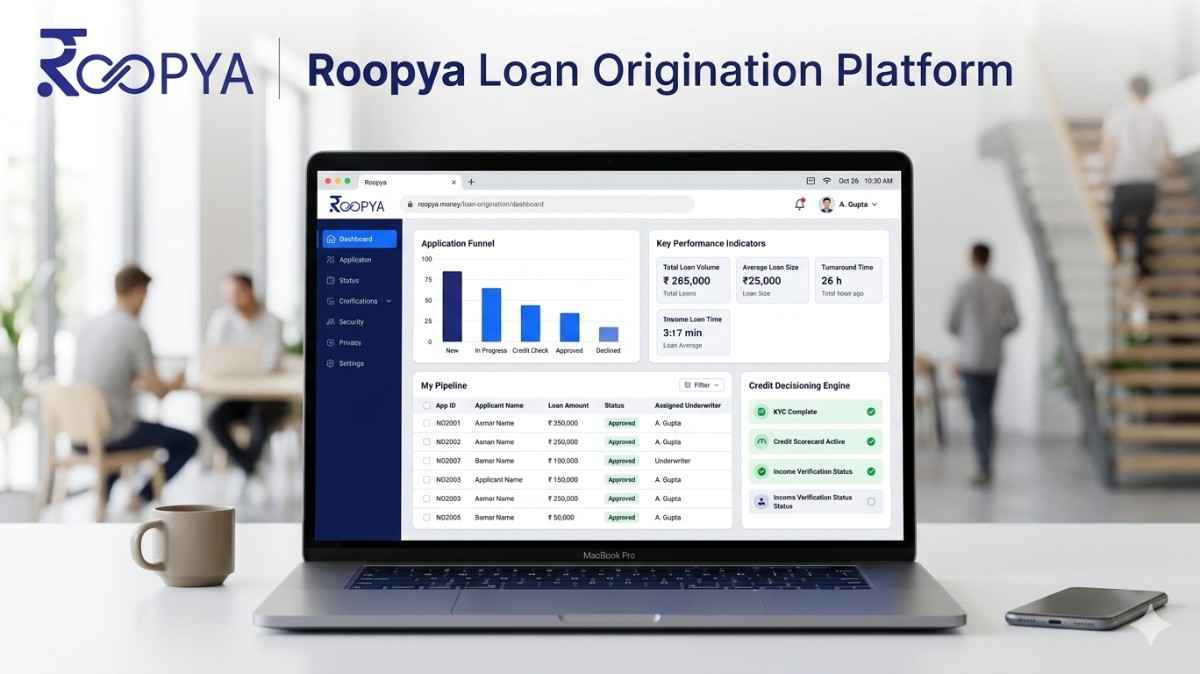
Modern platforms like Roopya’s Loan Origination System provide cloud-based automation, AI-driven workflows, digital KYC, business rule engines, and third-party integrations that help lenders reduce operational costs while improving customer satisfaction. Roopya positions its platform as an end-to-end digital lending infrastructure with configurable workflows, automated underwriting, and rapid deployment for Indian lenders.
In this comprehensive guide, we’ll explore the top benefits of implementing a modern Loan Origination System and why it is becoming the backbone of digital lending in India.
A Loan Origination System (LOS) is software designed to manage and automate every stage of the loan application process, including:
Instead of handling these activities manually, lenders can process applications through a centralized digital platform that improves speed, consistency, and compliance.
One of the biggest advantages of a modern LOS is significantly reduced turnaround time.
Traditional lending often involves:
With automation:
Loans that once took days can often be processed within hours or even minutes.
Today’s borrowers expect convenience.
A modern Loan Origination System offers:
This improves customer satisfaction and increases conversion rates while reducing application abandonment.
Manual operations increase costs and create bottlenecks.
An LOS automates repetitive tasks such as:
Employees can focus on credit decisions and customer relationships instead of administrative work.
Automation directly impacts profitability.
Organizations can reduce:
Lower operational expenses improve lending margins while allowing teams to scale efficiently.
Modern systems integrate multiple data sources to assess borrower risk.
These may include:
Advanced rule engines help lenders make consistent and data-driven credit decisions.
Regulatory compliance is critical for financial institutions.
A modern LOS can automate:
This reduces compliance risks and minimizes manual errors.
Loan documents are often scattered across emails, folders, and physical files.
A centralized LOS provides:
This simplifies operations and improves data security.
One of the most powerful features of modern LOS software is the Business Rule Engine.
Instead of manually checking every application, lenders can define rules such as:
Applications are automatically evaluated according to predefined policies.
Modern lending depends on multiple external services.
A robust LOS integrates with:
This creates a connected digital lending ecosystem.
Manual processes often lead to:
Automation improves accuracy through:
The result is fewer processing errors and better data quality.
Management teams need visibility into operations.
An LOS dashboard provides:
Real-time reporting enables faster business decisions.
As lending volumes increase, manual systems struggle.
A cloud-based Loan Origination System allows institutions to:
Scalability becomes much easier without proportional increases in staffing.
Fraud prevention is increasingly important in digital lending.
Modern LOS platforms help detect:
Automated verification reduces fraud exposure.
Customers value speed.
After approval, modern LOS platforms can automate:
Faster funding improves customer trust and competitiveness.
A flexible Loan Origination System supports multiple products, including:
This enables lenders to diversify without implementing separate systems.
Loan processing involves multiple stakeholders:
A centralized LOS keeps everyone aligned with shared workflows and role-based access.
Analytics help improve lending strategies.
An LOS can provide insights into:
Data-driven decisions improve profitability over time.
Borrowers increasingly apply using smartphones.
Modern systems support:
This expands market reach and improves accessibility.
Lenders using advanced technology can:
This creates a significant competitive advantage in India’s rapidly evolving lending ecosystem.
Artificial Intelligence is transforming lending.
Modern LOS platforms increasingly support:
These technologies improve both efficiency and credit quality.
Roopya offers an end-to-end digital lending platform designed for NBFCs, banks, fintechs, and financial institutions in India.
Key capabilities include:
According to its platform information, Roopya aims to help lenders automate the journey from application through underwriting and disbursement while reducing origination costs and accelerating go-live timelines.
A modern Loan Origination System is no longer a luxury—it is a necessity for lenders looking to compete in today’s digital-first financial landscape.
By automating workflows, improving customer experiences, reducing operational costs, strengthening compliance, and enabling data-driven decisions, an LOS helps financial institutions achieve sustainable growth.
For NBFCs, banks, and fintech companies in India, adopting a modern Loan Origination System can lead to faster approvals, better risk management, improved productivity, and long-term scalability.
A Loan Origination System is software that automates the entire loan lifecycle, including application processing, underwriting, approval, documentation, and disbursement.
Banks, NBFCs, fintech companies, MFIs, cooperative banks, housing finance companies, and digital lenders can benefit from an LOS.
It automates data collection, document verification, credit checks, workflows, and approvals, significantly reducing manual effort.
Yes. Modern LOS platforms automate KYC, maintain audit trails, and support regulatory compliance workflows.
Yes. Most modern systems integrate with credit bureaus and other third-party services through APIs.
Reputable providers use encryption, role-based access controls, and secure cloud infrastructure to protect borrower data.
Financial institutions including banks, NBFCs, fintech lenders, microfinance organizations, and cooperative lenders.
Yes. It enables paperless applications, online verification, automated approvals, and digital disbursement workflows.

© 2025 Crivva - Hosted by Airy Hosting Managed Website Hosting.