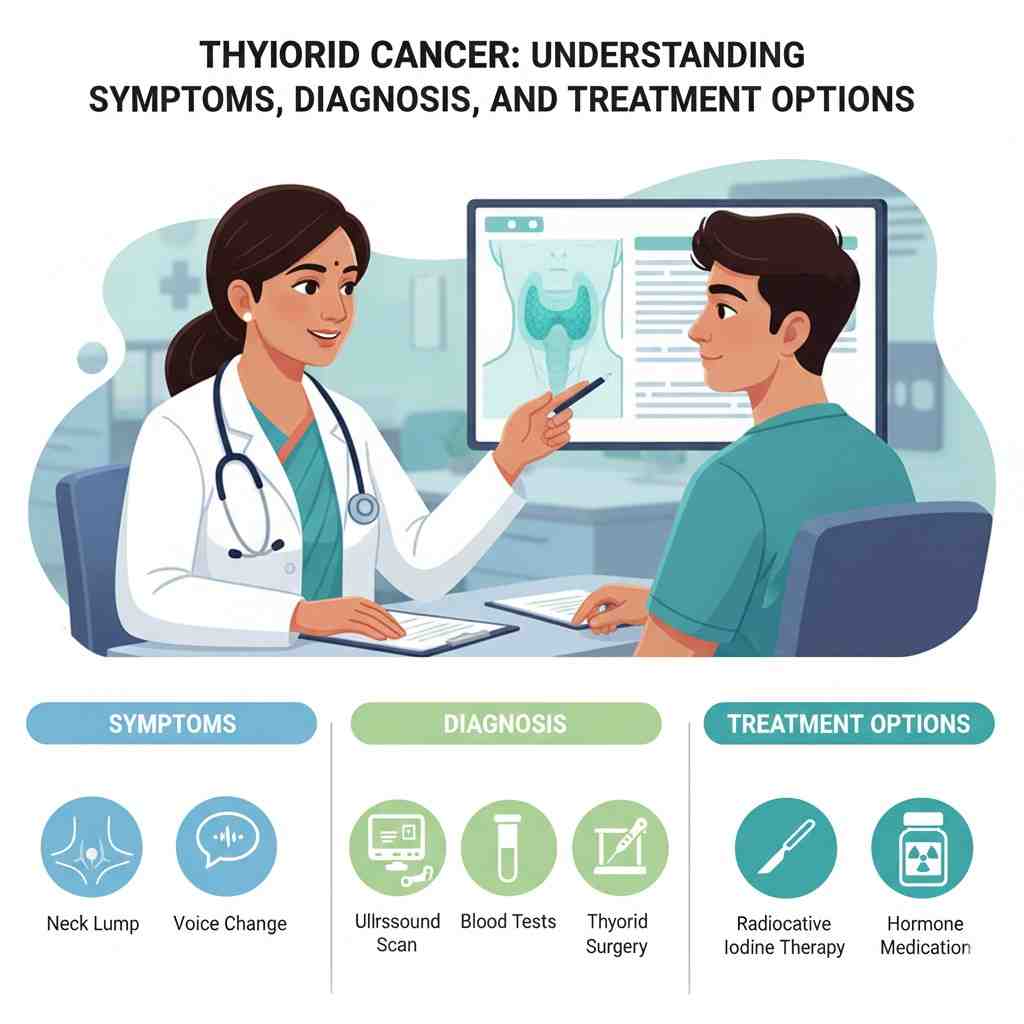
Thyroid cancer is one of the fastest-growing cancers in India, with incidence rates increasing significantly over the past two decades. Fortunately, it’s also one of the most treatable cancers, with excellent survival rates when detected and treated appropriately. Understanding thyroid cancer, recognizing symptoms, and knowing when to seek medical attention are essential for optimal outcomes.
Understanding the Thyroid and Thyroid Cancer
The thyroid is a butterfly-shaped gland located at the front of the neck, just below the Adam’s apple. Though small, it plays a crucial role in regulating metabolism, heart rate, body temperature, and energy levels by producing thyroid hormones. Thyroid cancer occurs when cells in the thyroid gland grow abnormally and form tumors.
Several types of thyroid cancer exist, each with different characteristics and prognoses. Papillary thyroid cancer accounts for about 80 percent of all thyroid cancers, grows slowly, and has an excellent prognosis. It most commonly affects people aged 30-50 and is more common in women. Follicular thyroid cancer represents about 10-15 percent of cases, grows slowly but is slightly more aggressive than papillary cancer. It’s more likely to spread to distant organs but still has a good prognosis with appropriate treatment.
Medullary thyroid cancer makes up about 3-4 percent of cases and develops from cells that produce calcitonin hormone. It can be hereditary and may be associated with genetic syndromes. Anaplastic thyroid cancer is rare, accounting for 1-2 percent of cases, but is the most aggressive type, growing and spreading rapidly. It primarily affects older adults and is challenging to treat.
Several factors increase thyroid cancer risk. Gender plays a role, as women are three times more likely than men to develop thyroid cancer, though the reasons aren’t fully understood. Age matters, with most cases diagnosed between ages 25-65, though it can occur at any age. Radiation exposure to the head and neck during childhood significantly increases risk. Family history and genetic syndromes like familial medullary thyroid cancer, multiple endocrine neoplasia, or familial adenomatous polyposis increase risk. Existing thyroid conditions including goiter or thyroid nodules may be associated with increased cancer risk. Dietary factors, particularly iodine deficiency or excess, may influence thyroid cancer risk, though the relationship is complex.
The increasing incidence of thyroid cancer in India and globally is partly due to improved detection through advanced imaging techniques that identify small thyroid nodules that might have gone unnoticed in the past. However, true increases in incidence are also occurring, possibly related to environmental factors, radiation exposure, and lifestyle changes. In urban areas like Ahmedabad, increased access to diagnostic imaging and specialized cancer hospitals like Zanish Cancer Hospital has led to earlier detection of thyroid abnormalities.
Recognizing Symptoms and Signs
Most thyroid cancers develop slowly and cause no symptoms in early stages. Many are discovered incidentally during imaging studies performed for other reasons or during routine physical examinations. However, as tumors grow, various signs may appear.
A lump or nodule in the neck is the most common sign, felt or seen in the front of the neck, below the Adam’s apple. While most thyroid nodules are benign, any persistent lump should be evaluated. Neck pain or discomfort that doesn’t resolve may indicate thyroid problems. Difficulty swallowing (dysphagia) can occur if the tumor grows large enough to press on the esophagus. Difficulty breathing or a feeling of constriction may develop if the tumor compresses the windpipe. Hoarseness or voice changes that persist for more than two weeks, particularly if the cancer affects nerves controlling the vocal cords, warrant evaluation. Persistent cough not related to cold or allergies should be checked. Swollen lymph nodes in the neck may indicate cancer spread to nearby lymph nodes.
It’s important to note that these symptoms can be caused by many benign conditions. However, any persistent symptom, especially a lump in the neck, should be evaluated by a healthcare provider. Cancer hospitals in Ahmedabad like Zanish Cancer Hospital offer specialized thyroid evaluation services with advanced ultrasound technology and experienced endocrinologists.
The Diagnostic Process
When thyroid cancer is suspected, a systematic evaluation is performed. Physical examination involves the doctor carefully feeling the thyroid gland for lumps, checking their size, firmness, and whether they move when you swallow. Lymph nodes in the neck are also examined. Blood tests check thyroid hormone levels (TSH, T3, T4) to assess thyroid function and calcitonin levels if medullary thyroid cancer is suspected.
Ultrasound is the primary imaging tool for evaluating thyroid nodules. This non-invasive test uses sound waves to create detailed images of the thyroid, showing nodule size, number, characteristics, and whether they appear suspicious for cancer. Ultrasound also evaluates lymph nodes for signs of cancer spread.
Fine needle aspiration (FNA) biopsy is the gold standard for diagnosing thyroid cancer. Using ultrasound guidance, a thin needle is inserted into the nodule to collect cells for microscopic examination. This outpatient procedure causes minimal discomfort and provides crucial information about whether the nodule is benign or malignant. In some cases when FNA results are inconclusive, molecular testing of the biopsy sample can help determine cancer risk.
If cancer is confirmed, additional tests determine its extent. CT scan or MRI provides detailed images of the neck and chest to assess cancer spread. Radioiodine scan uses a small amount of radioactive iodine to see if cancer cells have spread beyond the thyroid, as most thyroid cancer cells take up iodine. PET scan may be used for aggressive cancers to check for distant spread.
Thyroid cancer staging ranges from Stage I (small tumor confined to thyroid) to Stage IV (large tumor or spread to distant organs). However, staging for thyroid cancer also considers patient age, as younger patients generally have better prognoses even with more advanced disease. At Zanish Cancer Hospital in Ahmedabad, comprehensive thyroid diagnostic services ensure accurate staging and personalized treatment planning.
The Role of Surgical Oncology
Surgical expertise is crucial for optimal thyroid cancer outcomes. Specialized thyroid surgeons or surgical oncologists trained in endocrine surgery bring several advantages including extensive experience with complex thyroid anatomy, skill in preserving parathyroid glands and recurrent laryngeal nerves, ability to perform comprehensive lymph node dissection when needed, and lower complication rates.
Studies consistently show that surgeon experience correlates with better outcomes. High-volume thyroid surgeons achieve better cancer control, lower rates of voice and calcium complications, reduced need for revision surgery, and better functional outcomes. When choosing where to receive treatment, patients should inquire about the surgeon’s experience and volume of thyroid cancer surgeries performed.
Zanish Cancer Hospital has established itself as a leading cancer hospital in Ahmedabad for thyroid and parathyroid cancer treatment, with surgeons who perform high volumes of thyroid cancer surgeries annually. This expertise translates to superior outcomes for patients throughout Gujarat and neighboring regions.
Multidisciplinary Approach to Care
Effective thyroid cancer treatment requires coordination among multiple specialists. A comprehensive team typically includes surgical oncologists or endocrine surgeons performing thyroidectomy, endocrinologists managing thyroid hormone replacement and TSH suppression, nuclear medicine specialists administering and monitoring RAI therapy, pathologists analyzing thyroid tissue, radiologists interpreting imaging studies, and when needed for advanced cases, medical oncologists managing targeted therapy or chemotherapy.
Regular multidisciplinary tumor board meetings where specialists discuss complex cases ensure optimal treatment planning for each patient. At Zanish Cancer Hospital in Ahmedabad, this collaborative approach is standard practice, ensuring every thyroid cancer patient benefits from collective expertise.
Living with and After Thyroid Cancer
Most people treated for differentiated thyroid cancer are cured and live normal, healthy lives. However, lifelong management is necessary. After total thyroidectomy, patients must take thyroid hormone replacement medication daily. Finding the right dose takes time, with regular blood tests to adjust medication. Most people feel completely normal once the proper dose is established.
Follow-up care is essential for monitoring potential recurrence. This includes regular physical examinations, blood tests measuring thyroglobulin (a tumor marker for differentiated thyroid cancer) and TSH levels, periodic neck ultrasounds, and occasionally whole-body radioiodine scans or other imaging.
Most thyroid cancer patients enjoy excellent quality of life after treatment. With proper hormone replacement, energy levels, metabolism, and overall function return to normal. Some patients experience a subtle scar on the neck, though careful surgical technique minimizes this. Voice changes, if they occur, are usually temporary. Low calcium levels requiring supplementation affect some patients but are manageable with medication.
For patients with medullary thyroid cancer, calcitonin levels are monitored. For those with hereditary forms, genetic counseling and family member testing are important.
Prevention and Early Detection
Unlike many cancers with clear preventive measures, thyroid cancer prevention is challenging since many risk factors aren’t modifiable. However, certain steps can help. Avoiding unnecessary radiation exposure to the head and neck is important, particularly in children. For those with family history of medullary thyroid cancer or associated genetic syndromes, genetic testing and counseling are crucial. Regular medical check-ups allow doctors to detect thyroid abnormalities early.
If you notice a lump in your neck or experience any persistent symptoms, don’t dismiss them. Early medical evaluation leads to early diagnosis and treatment, ensuring the best possible outcomes.
When to Consult a Specialist
You should seek consultation with an endocrine surgeon or surgical oncologist specializing in thyroid cancer if you have a lump or swelling in your neck, particularly in the thyroid area, hoarseness or voice changes persisting for more than two weeks, difficulty swallowing or breathing, family history of thyroid cancer, especially medullary type, previous radiation exposure to the head or neck, or diagnosis of thyroid nodules that may need evaluation or treatment.

© 2025 Crivva - Hosted by Airy Hosting Managed Website Hosting.