


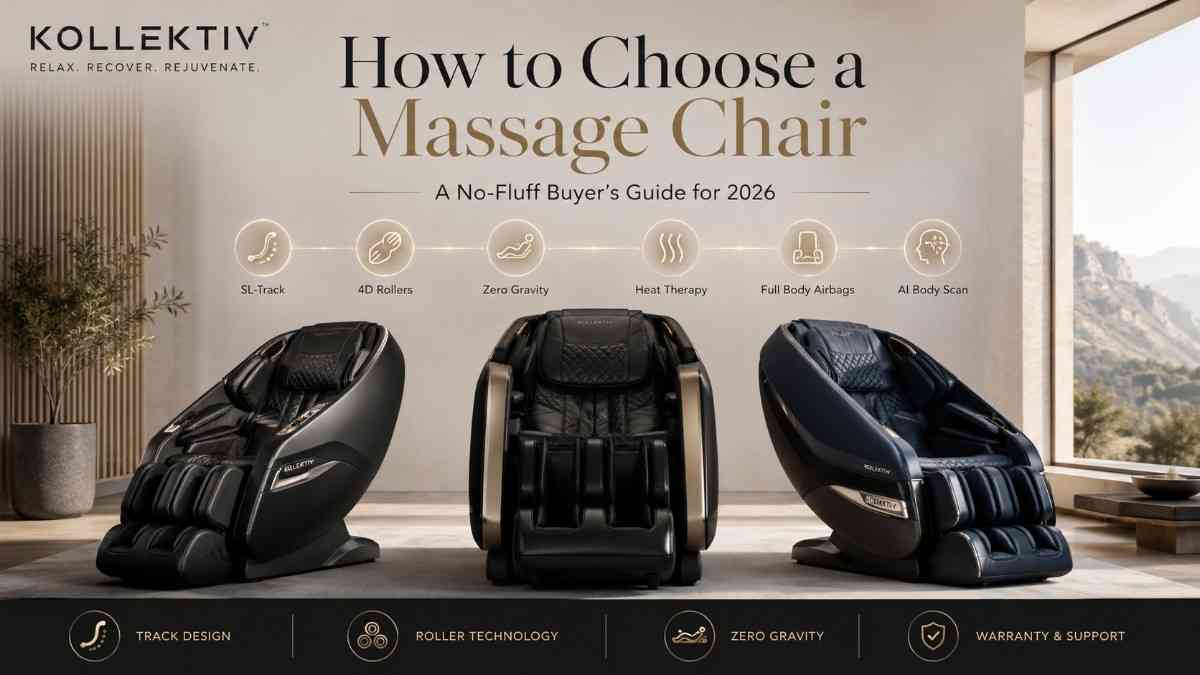
Every product page describes its chair in superlatives. Every feature sounds essential. Every dimension number promises a qualitatively different experience from the one below it. And the buyer who reads enough product descriptions without a framework for evaluating them ends up more confused after the research than before it — because the information is abundant but the signal-to-noise ratio is poor.
This guide is structured differently. It identifies what each specification actually does — in plain terms — and what it does not do, so the buying decision is based on an accurate understanding of what you are getting rather than an impression created by marketing language.
Most buyers spend more time evaluating roller technology than track design. This is the wrong priority order — because the track determines what anatomy the rollers can physically reach, and a sophisticated roller on a short or poorly designed track is less therapeutically useful than a simpler roller on a well-designed long track.
Three track types appear consistently in the 2026 market. The S-track follows the natural spinal curve from the cervical to the lumbar region. It covers the upper and mid-back adequately. It stops before the glutes. For general relaxation and thoracic coverage, S-track is functional. For lower back pain and sciatica — the most common therapeutic purchase motivations — it is structurally inadequate because it cannot reach the anatomy involved.
The L-track extends the roller pathway from the neck through the lumbar and into the glutes — a meaningful improvement over S-track for lower body coverage.
The SL-track is the current quality standard. It follows the spinal S-curve and extends through the lumbar, sacrum, glutes, and upper hamstrings — covering the complete posterior chain. For anyone with lower back pain, hip tension, or sciatica, the SL-track is the baseline requirement rather than a premium upgrade.
Track length within the SL-track category is the specification that most product pages understate. A 49-inch SL-track and a 59-inch SL-track are both SL-tracks — but the ten-inch difference represents significant anatomy in the lower posterior chain. For taller users or anyone whose condition originates in the deep gluteal region, track length in inches is the number worth verifying before any other comparison.
The honest summary: an S-track chair with impressive roller technology does not outperform an SL-track chair with simpler rollers for lower back pain or sciatica — because the S-track chair cannot reach the anatomy involved in those conditions.
Zero gravity is consistently framed as a comfort feature in product descriptions. It is more therapeutically significant than this framing implies — and understanding what it actually does changes how you use it and what outcomes you can reasonably expect.
In the zero gravity position — thighs roughly parallel to the ground, calves elevated above heart level, torso at approximately 120 to 128 degrees — lumbar spinal compression drops by up to 75% compared to standard seated posture. Postural muscles release the gravitational tension they maintain upright. The tissue the rollers engage has already begun relaxing passively before any massage program starts. The practical consequence is that the same intensity setting produces deeper, more effective pressure in zero gravity than upright — because the tissue is not braced against the intervention.
Single-stage zero gravity provides one preset position and delivers the core decompressive benefit. Multi-stage zero gravity — two or three distinct positions — allows personalised angle adjustment for individual anatomy. For disc-related back pain or sciatica where the precise decompressive angle changes how much space is created around compressed nerve roots, three-stage adjustment produces meaningfully better outcomes than a single preset.
The honest caveat: not all zero gravity implementations interact with the roller track correctly. In poorly designed chairs, the rollers lose contact with portions of the back when fully reclined — reducing coverage at precisely the moment the tissue is most receptive to intervention. Verifying that the track maintains consistent coverage across all zero gravity stages is worth confirming before committing to a specific model.
The roller track covers the posterior chain. The airbag system covers everything else — and the everything else matters more than first-time buyers typically anticipate.
Full-body airbag coverage of at least 30 airbags — addressing shoulders, arms, hips, calves, and feet — extends therapeutic scope beyond what the roller mechanism can reach. For athletic users whose training loads the calves and shoulders as heavily as the back, the extremity coverage of a comprehensive airbag system addresses the recovery dimension that rollers alone cannot. For desk workers managing lower extremity circulation issues, calf and foot compression therapy addresses the venous return problem that rollers cannot reach.
Dedicated foot rollers — scraping and rolling mechanisms targeting the plantar surface — provide reflexology point coverage that airbag compression alone does not replicate. For users whose primary complaint includes foot fatigue from prolonged standing or running, dedicated foot rollers are a meaningful specification rather than a novelty.
The honest assessment on airbag count marketing: 50 airbags that cover the same six body regions as 32 airbags in a different coverage pattern are not automatically more therapeutically effective. Coverage pattern and pressure range matter more than raw airbag count. Verify the body regions covered rather than accepting the count as the proxy.
Two dimensions require verification before any other evaluation: whether the chair fits your body, and whether it fits your room.
Most quality chairs accommodate users between 5’2″ and 6’1″ adequately. For users above 6’1″, track length in inches — not just the SL-track designation — determines whether lumbar roller coverage is maintained at the correct anatomical position. A 59-inch SL-track provides significantly better coverage for taller users than a 50-inch SL-track at the same price tier. Body scanning technology adjusts roller positioning for individual proportions within the chair’s physical range but cannot expand the mechanical range beyond the track’s actual length.
Wall clearance is the spatial requirement most frequently overlooked until the day of delivery. Standard massage chairs require 18 to 24 inches of wall clearance to recline fully. Space-saving designs achieve full zero gravity recline with as little as two inches of clearance — a meaningful practical difference for rooms where furniture proximity is a constraint.
Measure the room in full recline dimensions rather than seated footprint. The recline depth extends the chair’s floor occupation significantly beyond what the product dimensions suggest.
Warranty length is the most underweighted buying factor and the one most consequential over a multi-year ownership period. A chair used daily accumulates wear at seven times the rate of one used weekly — and warranty coverage should reflect the use intensity the purchase requires.
Three years is the appropriate minimum for daily therapeutic use. Six years — the coverage available on Kollecktiv’s flagship models — indicates manufacturer confidence in mechanical longevity at daily use frequency. A one-year warranty on a chair the buyer intends to use every day is a strong signal about the manufacturer’s expectation of the chair’s functional lifespan.
After-sale support quality — the speed and competence of issue resolution when something requires servicing — determines the ownership experience across the full multi-year period more than the specification sheet. The best after-sale support in the category comes from brands that have built service infrastructure specifically around the massage chair category rather than treating it as one product line among many.
Track design first — SL-track of at least 55 inches for any therapeutic purchase motivation. Roller technology second — 4D minimum, genuine continuous 5D adaptive for variable recovery needs. Zero gravity staging third — multi-stage for disc-related conditions. Heat type and placement fourth — graphene lumbar plus calf for comprehensive thermal preparation. Full body coverage fifth — 30 or more airbags with dedicated foot rollers. Size and space sixth — verified against both body proportions and room dimensions. Warranty and support seventh — three years minimum, six years preferred.
Everything else is secondary.
For model-specific guidance applying this framework to every current Kollecktiv model by therapeutic focus, use case, and price tier, the Kollecktiv buying guide provides the most structured path through the decision without requiring individual product page research across the full range.
Explore the complete lineup in the Kollecktiv luxury massage chair collection — free US shipping, no sales tax, 30-day returns, and white-glove delivery on every order.
originally published on :
https://kollecktiv.com/how-to-choose-a-massage-chair-buyers-guide-2026/

© 2025 Crivva - Hosted by Airy Hosting Managed Website Hosting.








