

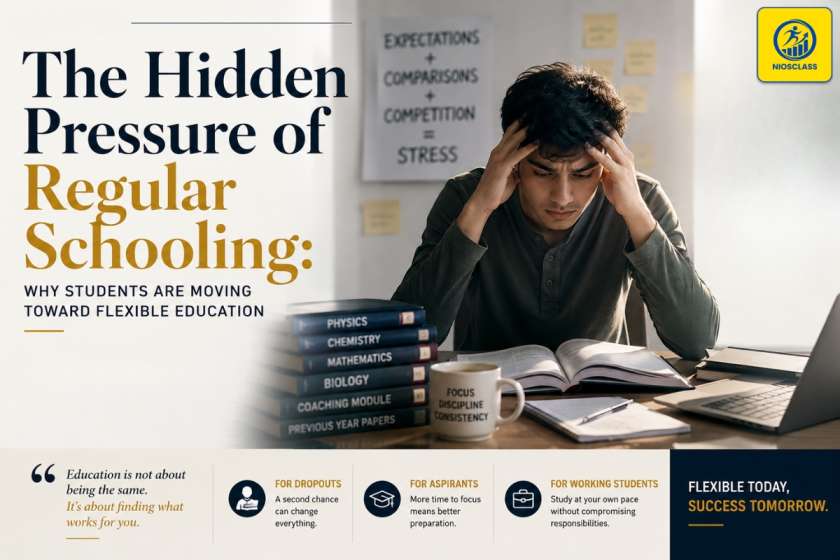
A student leaves home at 7 in the morning.
School till afternoon.
Coaching after that.
Homework later at night.
Then revision.
Then guilt for not studying enough.
And the next morning, the same cycle begins again.
From the outside, this routine looks normal. Parents call it discipline. Teachers call it preparation. Society calls it competition.
But many students quietly call it exhaustion.
Especially students exploring the nios senior secondary course after struggling inside traditional systems often describe the same feeling — they were not losing interest in education itself. They were losing energy trying to survive constant academic pressure.
That difference matters.
Because many students today are not failing due to lack of intelligence.
They are mentally overloaded.
And increasingly, students are beginning to question whether rigid schooling systems still fit the realities of modern education anymore.
The pressure students experience now is very different from previous generations.
Modern students are expected to manage:
All at the same time.
The dangerous part is that this pressure often becomes invisible because everyone around them is experiencing similar chaos too.
So exhaustion starts looking “normal.”
A student sleeping four hours daily becomes “hardworking.”
A student constantly anxious before exams becomes “serious.”
A student emotionally burned out becomes “lazy” if performance drops.
And slowly, students stop understanding their own mental limits.
One low score today rarely remains “just one low score.”
Students immediately begin comparing themselves with classmates, rankings, mock scores, social media posts and family expectations.
That comparison creates silent emotional damage.
Students start connecting self-worth directly to marks.
If they perform well, they feel accepted.
If they struggle, they feel behind in life itself.
This emotional instability slowly affects concentration too.
Many students sit with books for hours while mentally absorbing very little because anxiety already consumed their focus before studies even began.
But traditional systems often continue increasing pressure instead of understanding the student underneath it.
This is something education systems still struggle accepting honestly.
Different students learn differently.
Some students need:
Yet traditional schooling usually expects everyone to move identically.
Students who cannot fit perfectly into that structure often begin believing something is wrong with them personally.
But sometimes the issue is not the student.
Sometimes the system itself simply does not fit their learning reality.
JEE and NEET aspirants especially are beginning to question whether traditional schooling actually supports focused preparation properly anymore.
A typical aspirant’s day often includes:
Eventually, preparation becomes emotionally exhausting.
Students remain busy constantly but still feel academically unsatisfied because deep focus becomes difficult under continuous mental fatigue.
This is why many serious aspirants now prefer more flexible academic structures where preparation quality improves instead of energy getting divided everywhere.
And naturally, searches around nios tuition and flexible preparation support are increasing because students want smarter study systems, not endless emotional pressure.
Many students today feel they are never allowed to relax fully.
Even during breaks, guilt remains.
If they rest:
someone else may be studying.
If they sleep:
someone else may be practicing questions.
If they take time for themselves:
they fear falling behind.
This constant psychological pressure slowly creates emotional instability around education itself.
Some students stop enjoying learning completely.
Studies become survival instead of growth.
And eventually, even talented students begin doubting themselves constantly.
A few years ago, alternative education was heavily misunderstood.
Today, perspectives are changing rapidly.
Students now understand that learning no longer depends entirely on physical classrooms because education itself evolved.
Modern students study through:
This shift naturally increased interest in nios coaching online because students now value flexibility, accessibility and focused learning more than rigid academic appearances.
And honestly, this shift reflects modern reality far better.
Earlier, students rarely spoke openly about emotional exhaustion.
Now they do.
Because pressure became impossible to ignore.
Students increasingly struggle with:
And many families are finally beginning to realize that academic performance suffers badly when mental health completely collapses underneath.
This awareness is changing how parents and students view flexible education systems.
Not as “easy options.”
But as healthier alternatives for certain situations.
This distinction matters.
Students choosing flexibility are not automatically avoiding effort.
Most still work extremely hard.
The difference is that they want preparation systems that feel sustainable emotionally.
Students preparing through the nios secondary course often use flexibility strategically:
And many students actually become more disciplined because they must manage their own routine independently.
One misconception still exists strongly.
People assume flexible education means no discipline.
In reality, successful students inside flexible systems usually follow strict personal routines.
They manage:
The difference is that the structure becomes personalized instead of forced identically on every student.
And that personalization often improves concentration significantly.
This is why many students search for nios coaching classes that combine flexibility with mentorship and accountability.
Because students still need guidance.
They simply do not want emotional suffocation.
Another major reason flexible education is growing is because many students now balance work and studies together.
Some support family income.
Some fund their own preparation.
Some left studies temporarily due to financial stress.
Traditional systems often fail supporting these realities practically.
Flexible learning works better because students can continue education without abandoning responsibilities completely.
And honestly, this reflects real-life adulthood more realistically than perfect academic timelines ever did.
Modern students increasingly care about:
instead of simply appearing “busy.”
They are asking smarter questions now:
These are mature questions.
And education systems must adapt around them.
One reason students prefer flexibility is because it allows customization.
Students can choose:
This becomes especially useful for students exploring nios secondary subjects according to their career goals instead of blindly following fixed structures.
And increasingly, students appreciate having more control over how they learn.
Because independence builds maturity too.
People usually discuss NIOS board benefits academically.
But emotionally, the benefits matter deeply too.
Students regain confidence.
They feel less trapped.
They recover focus gradually.
They stop associating studies only with stress.
And perhaps most importantly, they begin believing education can still support life instead of emotionally overwhelming it completely.
That emotional shift changes learning quality enormously.
Today, students can:
This accessibility makes flexible education far more practical in 2026 than it once was.
And naturally, more students are considering it seriously.
Because education is no longer limited by geography or traditional classroom structures alone.
Also read: Why Choosing NIOS Coaching Is Better Than Taking a Drop Year
Modern students are not rejecting education.
They are rejecting emotional overload that destroys focus instead of improving performance.
They still want:
But increasingly, students want systems that help them grow without permanently exhausting them mentally.
That is why platforms like NIOS CLASS are becoming part of conversations among students searching for more balanced academic options. Whether someone is preparing for competitive exams, recovering after burnout, balancing work responsibilities, exploring different nios courses or restarting studies through nios class 12, the deeper goal often remains the same – continuing education without losing mental stability in the process.
And for students who need structured flexibility with proper mentorship, choosing the right nios coaching institute and supportive nios coaching centre can help create a healthier academic experience than many traditional systems currently provide.
Sometimes students do not need more pressure to succeed.
Sometimes they simply need enough space to think clearly again.

© 2025 Crivva - Hosted by Airy Hosting Managed Website Hosting.