

From outside, the end of a school year looks like the end line. Students and teachers finally get their much-desired breaks. Yet, if you are looking closely, you find that the school administrators go through a completely different phase. K-12 end of year planning does not simply refer to report submission and grade finalization. It refers to a transition where one year ends and another begins. This means double workload, double responsibilities, and more data to analyze.
In simple words, the end-of-the-year transition means –
The school administrative checklist is long enough to create administrative friction. Challenge escalates when schools manage this checklist through a fragmented system where you will find spreadsheets, digital tools, files, and multiple systems all working together. As a result, it often leads to delays and confusion. Imagine stumbling upon duplicate data entries just before the report submission deadline.
A well-designed school information system (SIS) can transform your school operation and reduce the transition time and work pressure. School information systems simplify operation through centralization and real-time data visibility.
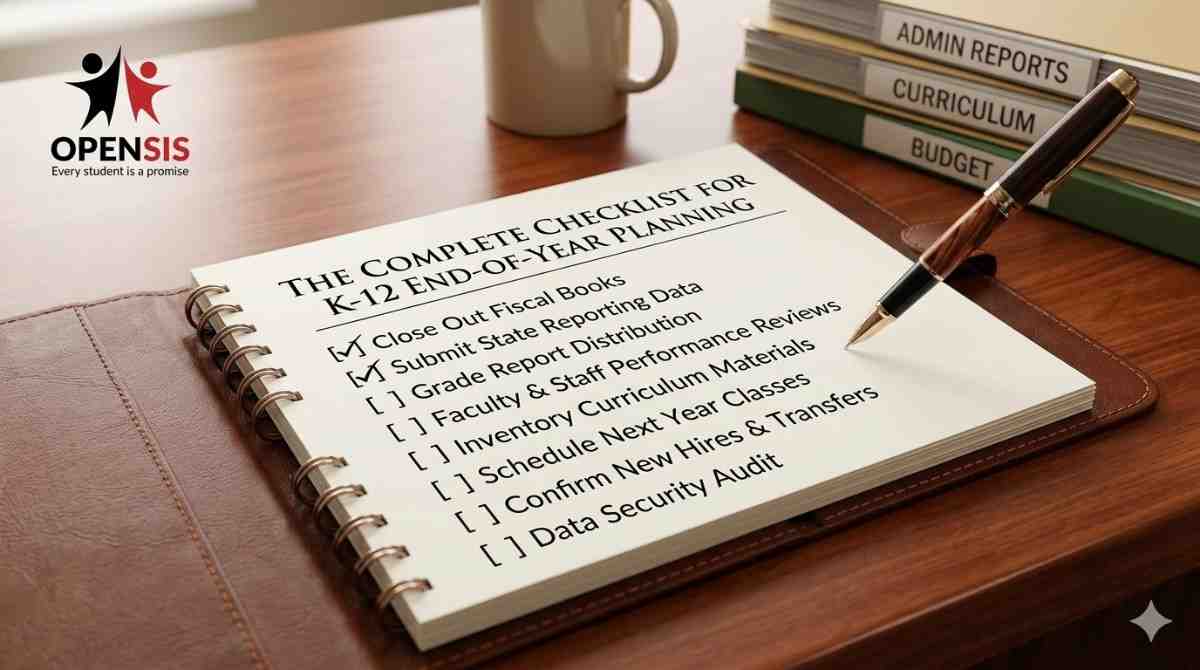
Often, people undermine the challenge of K-12 end of year planning. School administrators handle multiple tasks. From attendance record keeping to finance bill checking, the administrators assess every report before submission. Different departments generate different reports, and administrators verify them before submission. Year-endings usually include –
If you look carefully, you will find that each task needs an accurate data review. A single mistake can delay the whole operation. The K-12 technology planning process needs strict focus on each piece of information. The school year-end planning is a complete operation that requires more than efficiency.
Some schools are still clinging to the old operational order. They use spreadsheets, paper files, and text threads as a data storage system. Now, bring these three branches together and try to extract data from these sources. What will you find?
For a smooth K-12 technology planning, you need a centralized system that connects your departments and makes data access easy. Otherwise, you are going to be stuck in year-end delays, work fatigue, and confusion.
What Can a Modern School Information System Do for You?
An advanced school software implementation is not a technical upgrade. It is a shift from a static operational system to an expansive one. Traditional operations may have operated successfully on a scattered information system. But when your student volume is increasing, and courses are doubling in number, you need more than paper files to manage information. Also, you must be careful about who has access to your data when you are in expansion mode.
Data security is not an option for modern schools anymore. This is why – advanced School Information Systems come with a customizable dashboard that filters access and offers visibility to only the authorized people.
openSIS can be the right backend partner for your school operation. This AI-enabled Student Information System not only centralizes data, but also offers AI-powered insight for pattern recognition and risk prediction. openSIS is built to offer you real-time data visibility without any hassle.
Because it is a web-based system, you don’t have to install any bulky server for openSIS to work for your institution. Rather than making you depend on separate systems for different information, this SIS platform consolidates them and brings them all under one roof. As a result, you get everything under one canvas, ready to be viewed. This system helps you operate all your administrative tasks from one place.
openSIS can reduce your dependency on spreadsheets and paper files. It works on multiple areas and simplifies them for your greatest advantage. Student record verification is perhaps one of the most important features of openSIS. Other than this, the AI-enabled Student Information System brings to you –
Each one of the tasks requires extreme focus and strict accuracy. Before the new year begins, each report and entry must be verified. And openSIS simplifies this verification process by automating the data entry process and removing duplicate data.
openSIS acts as a memory bank for the schools. Anything you need will be at your fingertips. Modern schools deal with a huge data system. This expansive landscape needs a modern school administrative checklist. You cannot afford to run your new operation on the old formula.
If you want to convert data into an actionable insight, you will need an automated school software implementation. You need a system that will handle everything, from trend recognition to strategic planning support.
Lastly,
openSIS not only improves your K-12 end of year planning, but it also tightens the security measures by enabling role-based access to the dashboard. Users can only view relevant data. It improves both data security and compliance.
K-12 end-of-year planning is the process of completing all academic and administrative tasks before the school year ends. It includes finalizing grades, attendance records, report cards, student promotions, staff evaluations, scheduling, and data backups to ensure a smooth transition into the next academic year.
An end-of-year checklist helps schools stay organized, reduces administrative errors, ensures compliance with reporting requirements, and guarantees that student records are complete before the new school year begins.
A comprehensive checklist should include:
A Student Information System (SIS) centralizes student data, automates report generation, manages attendance and grades, streamlines scheduling, and reduces manual work, making end-of-year operations more efficient.
Schools should ideally begin planning at least 6–8 weeks before the academic year ends. Early preparation allows administrators and teachers to resolve data discrepancies and complete required tasks on time.
Schools should review teacher-submitted grades, confirm calculations, validate grading policies, and conduct administrative checks before publishing final report cards to students and parents.
Accurate attendance records are essential for state reporting, student promotion decisions, funding compliance, and maintaining reliable historical records.
Schools should archive completed records, update student profiles, process promotions or graduations, verify contact information, and ensure all academic data is accurate before rollover.
Modern school management software automates repetitive tasks, minimizes paperwork, generates reports quickly, stores data securely, and improves collaboration between administrators, teachers, parents, and students.
Schools can reduce errors by using automated validation tools, conducting data audits, verifying grades and attendance early, maintaining standardized workflows, and using centralized digital systems.
Yes. Backing up student records, attendance, grades, financial information, and administrative documents is a critical best practice that protects against accidental data loss and supports compliance requirements.
Schools should archive:
Administrators should finalize academic records, prepare class schedules, assign teachers, update enrollment information, communicate with families, and verify that all systems are ready before reopening.
Common challenges include incomplete student records, grading errors, attendance discrepancies, delayed report cards, scheduling conflicts, manual paperwork, and insufficient communication among staff.
openSIS provides tools for student information management, attendance tracking, grading, report cards, scheduling, analytics, and centralized administration, enabling schools to streamline end-of-year workflows while reducing manual effort.

© 2025 Crivva - Hosted by Airy Hosting Managed Website Hosting.