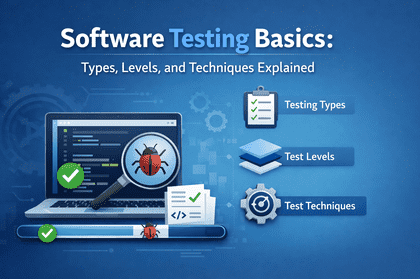
Quality software does not happen by accident. It is the result of structured validation, clear requirements, and disciplined engineering practices. Understanding software testing basics is essential for developers, QA engineers, and product teams who want to ship reliable applications.
Whether you are working on a startup product or a large enterprise system, knowing the types of testing, testing levels, and core techniques will help you build software that performs consistently under real-world conditions.
This guide breaks down the fundamental concepts every modern team should understand.
What Are Software Testing Basics?
At its core, software testing is the process of verifying that an application works as intended and identifying defects before release. Software testing basics include understanding:
-
Different types of testing
-
Various testing levels
-
Core test design techniques
-
The role of validation in the development lifecycle
Testing ensures that the system meets both functional requirements and performance expectations.
Types of Software Testing
Software testing can be broadly categorized based on what is being validated.
Functional Testing
Functional testing verifies that features behave according to defined requirements. It answers a simple question: does the system do what it is supposed to do?
Examples include:
-
Login authentication
-
Payment processing
-
Form submissions
-
Data validation
Functional testing focuses on user actions and expected outputs.
Non-Functional Testing
Non-functional testing evaluates how well the system performs under certain conditions. It focuses on system attributes rather than specific features.
Common types include:
-
Performance testing
-
Load testing
-
Security testing
-
Usability testing
-
Compatibility testing
For example, performance testing checks how the system behaves under heavy traffic, while security testing identifies vulnerabilities.
Manual Testing
Manual testing involves human testers executing test cases without automation tools. It is useful for exploratory testing, usability validation, and early-stage feature checks.
Manual testing provides flexibility and human insight, especially when evaluating user experience.
Automated Testing
Automated testing uses scripts and tools to execute test cases automatically. It is ideal for repetitive validation, regression testing, and CI pipelines.
Automation improves speed and consistency, especially in fast release cycles.
Levels of Software Testing
Testing occurs at different levels within the application architecture. Each level validates a specific scope.
Unit Testing
Unit testing focuses on individual functions or methods. It is usually performed by developers during coding.
Key characteristics:
-
Tests small pieces of logic
-
Executes quickly
-
Isolates dependencies
Unit tests form the base of a strong testing strategy. They provide fast feedback and reduce the likelihood of regression issues.
Integration Testing
Integration testing verifies that different components work together correctly.
Examples include:
-
API calls between services
-
Database interactions
-
Third-party integrations
Even if individual units work correctly, integration failures can occur due to communication gaps or configuration issues.
System Testing
System testing evaluates the entire application as a whole. It validates complete workflows and ensures that the system meets requirements.
This includes:
-
End-to-end scenarios
-
Full user journeys
-
Business process validation
System testing often simulates real user behavior.
Acceptance Testing
Acceptance testing determines whether the application meets business expectations. It is often performed before release and may involve stakeholders or clients.
It answers the question: is the product ready for deployment?
Black Box vs White Box Testing
Another key part of software testing basics is understanding different testing approaches.
Black Box Testing
Black box testing focuses on system behavior without examining internal code. Testers provide inputs and verify outputs.
This approach is commonly used for:
-
Functional validation
-
User acceptance testing
-
End-to-end testing
White Box Testing
White box testing examines the internal logic and structure of the code. It is typically performed by developers.
It involves:
-
Code coverage analysis
-
Branch testing
-
Path testing
Both approaches are valuable and often complement each other.
Core Testing Techniques
Beyond types and levels, effective testing relies on structured design techniques.
Boundary Value Analysis
Boundary value analysis focuses on testing values at the edges of input ranges.
For example, if a field accepts values between 1 and 100, you should test:
-
0
-
1
-
100
-
101
Edge cases often reveal hidden defects.
Equivalence Partitioning
Equivalence partitioning divides inputs into valid and invalid groups. Instead of testing every possible value, you test representative samples from each group.
This reduces redundant test cases while maintaining coverage.
Decision Table Testing
Decision tables map combinations of inputs to expected outcomes. This technique is useful for complex business rules.
It ensures all logical conditions are evaluated.
Error Guessing
Error guessing relies on experience and intuition to predict where defects might occur. While less structured, it can uncover issues that formal techniques miss.
The Importance of Test Planning
Testing is most effective when planned carefully.
A basic test plan includes:
-
Scope of testing
-
Testing objectives
-
Resources and roles
-
Schedule
-
Entry and exit criteria
Without planning, testing efforts may become inconsistent or incomplete.
Shift-Left Testing and Modern Practices
Modern development encourages shift-left testing. This means moving testing activities earlier in the development lifecycle.
Developers write unit tests during implementation. Continuous integration pipelines run automated tests on every commit. Early validation reduces late-stage defects and minimizes rework.
Shift-left practices strengthen software testing basics by embedding quality into the development process rather than treating it as a final step.
Common Mistakes in Testing
Even teams familiar with software testing basics sometimes make avoidable mistakes:
-
Testing only happy paths
-
Ignoring edge cases
-
Over-relying on manual regression
-
Writing fragile automated tests
-
Skipping tests under tight deadlines
Testing should be consistent and disciplined to remain effective.
Measuring Testing Effectiveness
Testing should produce measurable outcomes. Some of the common metrics include:
-
Test coverage percentage
-
Defect density
-
Test execution time
-
Defect leakage rate
Metrics help teams identify gaps and improve quality continuously.
Final Thoughts
To sum up, understanding software testing basics is critical for building reliable and scalable applications. By mastering the testing types, levels, and design techniques, teams can detect defects early and reduce production risks.
Software testing is not just a quality checkpoint. It is an engineering practice that shapes system design, improves maintainability, and enhances collaboration between developers and QA teams.
When applied strategically, structured testing ensures that software behaves predictably, performs efficiently, and meets user expectations.