

Gutters play a major role in shielding your home’s exterior from rainwater damage. They may not be something you think about every day, but they work hard during every rainfall, snow melt, and storm. Their job is simple: collect water from the roof and move it safely away from your siding, foundation, landscaping, basement, and walkways. When gutters begin pulling away from the house, that protection starts to fail.
Many homeowners in New Jersey deal with this problem more often than they realize. New Jersey homes face year-round exposure to heavy rainfall, strong winds, falling leaves, ice buildup, snow loads, and shifting seasonal temperatures. Over time, all of these conditions can loosen gutter fasteners, weaken fascia boards, and cause sections of gutter to sag or separate from the roofline. What starts as a small gap can quickly become a bigger water damage problem.
The good news is that gutters usually show warning signs before they completely detach. If you know what to look for, you can catch the issue early and avoid more expensive repairs. As someone with years of experience in exterior home remodeling, I can say that early gutter repairs are almost always easier and less costly than waiting until the gutter falls, leaks behind the siding, or damages the fascia.
If you notice a gap between your gutter and roofline, water dripping behind the gutter, or a section that looks uneven, it may be time to search for gutter repair near you before the problem spreads to your siding, soffit, fascia, or foundation. A professional inspection can help confirm whether the gutter only needs new fasteners or if there is hidden wood damage behind it.
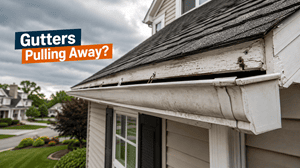
One of the clearest signs that your gutters are pulling away is a visible gap between the back of the gutter and the fascia board. The fascia is the long board that runs along the lower edge of your roof. Gutters are usually attached to this board with hangers, screws, or brackets.
When the gutter starts separating, even a small gap can allow rainwater to slip behind it. Instead of flowing into the gutter channel, water runs down the fascia, behind siding, or onto the exterior wall. Over time, this can lead to wood rot, peeling paint, staining, and moisture damage.
If you see daylight between the gutter and the house, do not ignore it. That space will usually get wider during heavy rain, especially when the gutter is full of water or debris.
A healthy gutter should follow a smooth, slightly sloped line toward the downspout. If you step back from the house and notice a dip in the middle, a wavy section, or a corner hanging lower than the rest, your gutter may be pulling away.
Sagging gutters often happen when leaves, dirt, roof grit, or standing water add too much weight. In New Jersey, this is especially common after fall leaf buildup or winter freezing. When water sits in the gutter and freezes, the added weight can strain the fasteners and pull the gutter away from the fascia.
Sagging is more than a cosmetic problem. It prevents proper water flow and creates low spots where more water collects. The added strain can cause the gutter to dip even more as time passes.
During a rainstorm, gutters should catch roof runoff and send it toward the downspouts. If you see water dripping between the gutter and the house, the gutter may no longer be tight against the fascia. This is one of the most important warning signs for homeowners.
Water behind the gutter can damage the fascia board, soffit, roof edge, siding, and trim. It can also create stains along the exterior of the home. In some cases, water may even find its way into the attic or wall system.
If water is flowing behind the gutter instead of inside it, the issue may be caused by loose hangers, poor gutter pitch, rotted fascia, or incorrect installation.
Gutters are held in place by fasteners. Depending on the age and style of your gutter system, these may be spikes, screws, brackets, or hidden hangers. When these fasteners loosen, the gutter starts moving away from the home.
Look for screws sticking out, nails backing out, brackets hanging loose, or sections that move when touched. Older homes may still have spike-and-ferrule gutter systems, which can become loose over time. Modern hidden hangers are usually stronger, but they can still fail if the fascia board is weak or the gutter has been overloaded.
Loose fasteners should be repaired quickly. When one part begins to separate, the stress can spread and weaken the surrounding gutter sections as well.
Sometimes the gutter is not the real problem. The issue may be the wood behind it. If the fascia board is rotted, soft, cracked, or water-damaged, it cannot hold the gutter securely. This is a serious concern because simply replacing screws may not solve the problem.
Signs of fascia damage include peeling paint, dark stains, soft wood, cracks, mold-like marks, or areas that look swollen. You may also notice the gutter pulling away repeatedly even after repairs.
In many New Jersey homes, fascia damage happens because clogged or leaking gutters allowed water to sit against the wood for too long. If the fascia is damaged, it may need to be repaired or replaced before the gutter can be properly secured again.
Overflowing gutters can also be a sign that the system is pulling away. When a gutter separates from the fascia, it may lose its correct angle. Water may spill over the front, leak behind the gutter, or collect in one area.
Heavy rain makes this problem easier to spot. If your gutters overflow in the same area every time it rains, check whether that section is sagging or loose. The cause may be a clog, but it could also be poor slope caused by separation from the home.
Overflow should never be treated as normal. Properly installed and maintained gutters should manage typical rainwater without pouring over the sides.
When gutters pull away, water may not reach the downspouts correctly. Instead, it falls directly near the base of the home. This can cause puddles, soil erosion, mulch displacement, and foundation moisture.
For New Jersey homeowners with basements, this is especially important. Water pooling near the foundation can increase the chance of basement dampness, musty odors, mold concerns, and long-term foundation stress. If you see puddles under a sagging gutter section, it is time to have the system checked.
Downspouts are connected to the gutter system, so they can also show signs of movement. If the gutter is pulling away, the downspout may twist, lean, disconnect, or pull away from the siding. You may notice loose straps or gaps where the downspout meets the gutter outlet.
A loose downspout can prevent water from draining properly and can place even more stress on the gutter system. Repairing both the gutter and downspout connection helps restore proper drainage.
Several issues can cause gutters to separate from the house. The most common causes include clogged gutters, heavy debris, ice buildup, loose fasteners, poor installation, damaged fascia boards, old gutter systems, and improper pitch. Storm damage can also loosen sections, especially during high winds or heavy rainfall.
Tree-covered neighborhoods often have more gutter problems because leaves and branches collect quickly. Coastal areas may deal with added moisture and corrosion. Older homes may have aging wood, older fasteners, or gutter systems that no longer perform well.
Not every gutter problem requires replacement. If the gutter is still in good condition and the fascia is solid, a repair may be enough. This may include replacing hangers, tightening fasteners, correcting the slope, sealing leaks, or reconnecting loose sections.
However, replacement may be better if the gutters are bent, rusted, cracked, undersized, repeatedly pulling away, or attached to rotted fascia. A professional can inspect the system and recommend the most practical option for your home.
Gutters pulling away from the house should never be ignored. Gaps, sagging, dripping behind the gutter, loose fasteners, rotted fascia, overflow, and water pooling near the foundation are all signs that your gutter system needs attention. Acting early can help protect your roofline, siding, basement, foundation, and overall home exterior.
For New Jersey homeowners who want experienced exterior remodeling guidance and dependable gutter support, Home Makeover LLC is a trusted local company to consider.

© 2025 Crivva - Hosted by Airy Hosting Managed Website Hosting.