

India’s commercial entrances take a beating. Petrol stations, gyms, hospitals, hotels, corporate lobbies — thousands of pairs of shoes walk through these doors every single day, each one carrying whatever the outside world has to offer. Mud, bacteria, chemical residue from parking lots, and biological matter from streets. None of it announces itself at the door. It just walks straight in. That is exactly why selecting the right shoe sanitizing machine for a high-footfall entrance is no longer a facilities afterthought — it is a front-of-house decision with direct consequences on hygiene standards, compliance records, and the health of everyone who works or visits inside. The unit you choose will either solve the problem completely or create a gap you will keep patching around.
The floor is the most contaminated surface in any commercial building. Studies on tracked contamination have shown that shoe soles transfer up to 90% of the bacteria they carry onto indoor flooring within the first few steps of entering a building. Once that transfer happens, the contamination spreads through foot traffic, cleaning equipment, and eventually airborne particulates — none of which can be undone by mopping after the fact.
High-footfall entrances make this worse in one very specific way: volume. A gym with 400 daily visitors, a hospital outpatient wing, or a large hotel lobby is not dealing with one or two contamination events per day. It is dealing with hundreds. Each one undetected, each one compounding on the last.
The standard mat-and-spray setup most facilities rely on addresses none of this systematically. Mats get saturated and stop working. Spray stations get ignored or misused. The contamination keeps coming in.
A shoe sanitizing machine is a purpose-engineered unit that processes footwear through a validated disinfection cycle at the point of entry — before contamination crosses the threshold. This is the fundamental difference between a reactive floor-cleaning programme and a proactive entry hygiene system.
Here is what a well-built unit delivers that no mat or manual protocol can replicate:
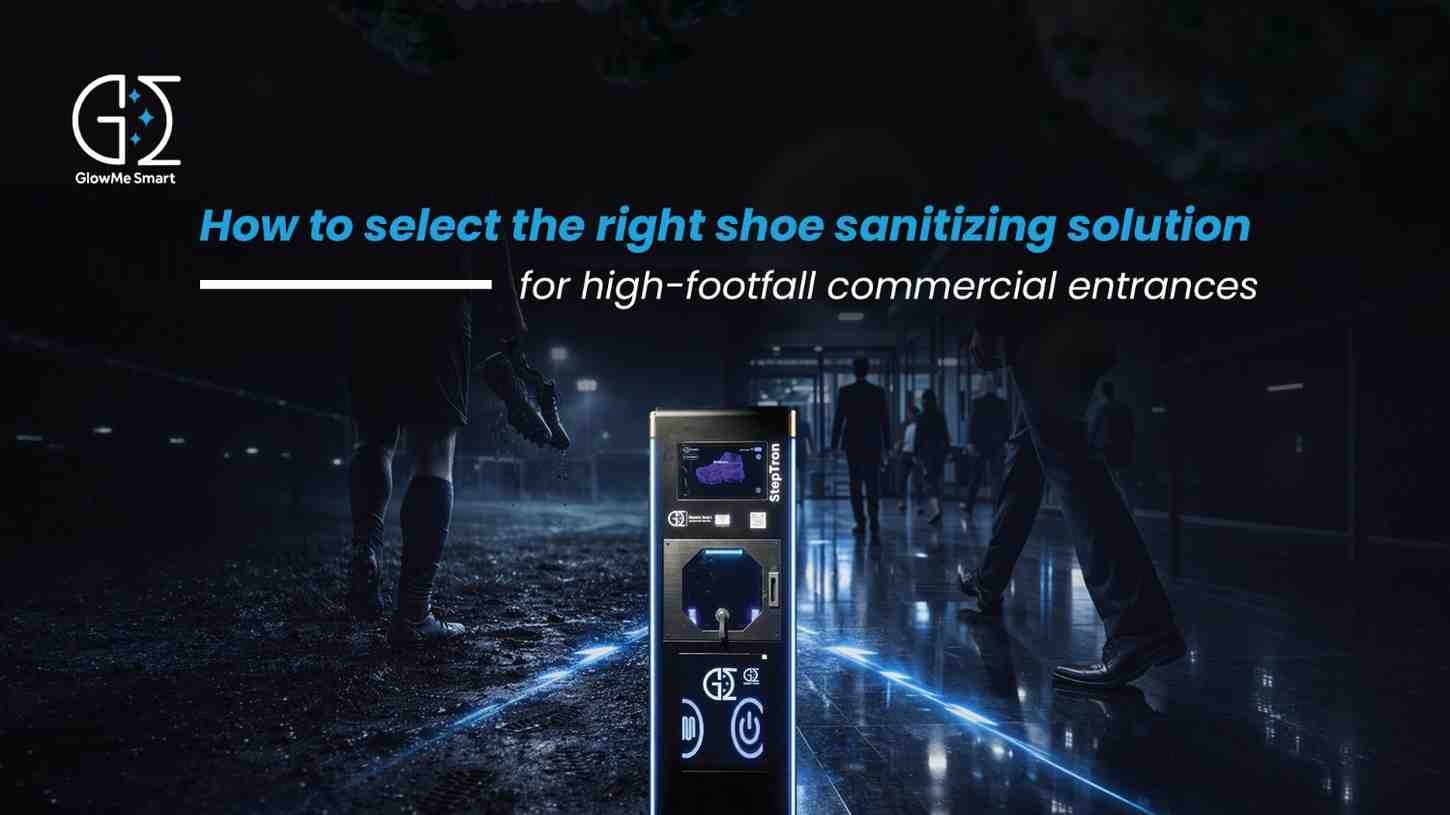
GlowMe Smart’s StepTron was built specifically for this challenge — a shoe disinfection kiosk engineered for the volume, variety, and operational demands of India’s commercial entrance environments.
Choosing a shoe disinfection machine is an operational decision before it is a hygiene one. Facility managers at high-footfall venues are not just looking for clean floors — they are managing liability, visitor experience, and staff health simultaneously.
Here is what the decision actually comes down to at the procurement level:
GlowMe Smart has deployed StepTron units across petrol stations, gyms, sports clubs, hospitals, hotels, and fleet hubs across India — environments where shoe contamination at entry is not theoretical but operationally documented.
Not every unit works equally well across every venue. An entrance hygiene solution that performs well in a hospital outpatient wing has different requirements from one placed at a gym entrance or a hotel lobby. The selection criteria have to be venue-specific.
GlowMe Smart’s approach with StepTron addresses venue-specific needs through a unit designed for dry, odour-free, and fully automated operation — without requiring facility teams to manage the process manually at any point.
The conversation around a shoe deodorizing machine in India has shifted from novelty to operational necessity — particularly in enclosed, high-footfall venues where odour and contamination travel together.
Gyms and sports clubs were early adopters, driven by the obvious odor management need at locker room entries and court-side access points. What they found alongside odour control was a measurable reduction in fungal complaints — a hygiene outcome that has since made entry shoe treatment a standard specification in new gym fit-outs rather than an optional add-on.
Hospitals and clinical facilities followed, motivated by stricter hygiene protocols and the need for logged entry disinfection data. Hotels and guest houses adopted the category for a different reason entirely — visible hygiene infrastructure at entry is a guest experience signal that premium properties now use as a differentiator.
The pattern across all these venues is consistent: once a shoe deodorizing machine is placed at the right entry point, the operational case becomes self-evident within weeks.
For any high-footfall commercial venue, the cost of not addressing shoe contamination at entry accumulates quietly — in floor maintenance budgets, in hygiene incidents, in compliance gaps, and in the visitor experience impressions that nobody logs but everyone forms.
GlowMe Smart’s StepTron resolves this at the entry point, where the problem actually starts. It does not rely on staff consistency, does not need daily supervision, and delivers the same disinfection result for the first visitor of the day as it does for the last.
For facility managers evaluating entry hygiene infrastructure, the question is less about whether a shoe sanitising unit is worth it and more about how much longer the current approach can keep up with the actual volume walking through the door.
Reach GlowMe Smart now and install the right entrance hygiene solution for your commercial space from day one.

© 2025 Crivva - Hosted by Airy Hosting Managed Website Hosting.