


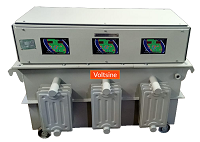
In today’s power-driven world, voltage fluctuations have become an unavoidable challenge for homes, industries, and commercial establishments. Unstable voltage can cause equipment malfunction, overheating, reduced efficiency, and even permanent damage. To address this, stabilizers are essential. But with multiple technologies available, the big question is: Servo Voltage Stabilizer vs Conventional Stabilizer – which one is truly better?
To understand the answer, we must first understand how each stabilizer works, their performance differences, their reliability, and the situations where one outperforms the other. This detailed guide will help you make the right decision for your machinery, appliances, and overall power setup.
To understand the answer, we must first understand how each stabilizer works, their performance differences, their reliability, and the situations where one outperforms the other. This detailed guide will help you make the right decision for your machinery, appliances, and overall power setup.
To understand the answer, we must first understand how each stabilizer works, their performance differences, their reliability, and the situations where one outperforms the other. This detailed guide will help you make the right decision for your machinery, appliances, and overall power setup.
Voltage stabilizers are devices designed to maintain consistent voltage output despite incoming fluctuations. They act as a protective shield for electrical appliances and machinery.
There are two popular types:
Conventional Stabilizers (Relay-based stabilizers)
Servo Voltage Stabilizers (Advanced motor-driven stabilizers)
Both serve the same purpose but operate differently—and that difference impacts performance, accuracy, cost, and long-term reliability.
A conventional stabilizer, also known as a relay-based stabilizer, uses the following components:
Step-up/step-down transformer
Multiple relays
Electronic control board
It works by switching between different voltage taps using relays. When the input voltage varies, the stabilizer shifts the relay position to bring voltage closer to normal.
Senses voltage drop or surge
Switches relay to appropriate tap
Provides stepped voltage correction
Simple and cost-effective
Quick relay switching
Suitable for low-load applications (TVs, refrigerators, small offices)
Stepped regulation, not smooth
Output accuracy: ±5% to ±10%
No correction for rapid fluctuations
Relays wear out over time
Makes clicking noise while switching
Limited lifespan under heavy load
Conventional stabilizers are acceptable for basic home appliances but fall short for precise or industrial-grade equipment.
A servo voltage stabilizer is a premium stabilizer designed for high accuracy and reliability. It uses:
A servo motor
Buck-boost transformer
Auto-transformer
Control circuit
Unlike relay-based stabilizers, a servo voltage stabilizer provides continuous, smooth correction.
The control board senses voltage variation in real time
The servo motor adjusts the auto-transformer
The buck-boost transformer adds or subtracts voltage
Output is regulated to a precise value
±1% output accuracy
Handles severe voltage fluctuations
No relay or step switching
Ideal for industrial, commercial & high-end residential use
Here is the core truth—technology, precision, and longevity clearly separate the two.
| Feature | Conventional Stabilizer | Servo Voltage Stabilizer |
|---|---|---|
| Output Accuracy | ±5% to ±10% | ±1% (Highly precise) |
| Voltage Steps | Stepped output | Smooth linear correction |
| Suitable For | Basic appliances | Industrial, medical, commercial |
A servo voltage stabilizer offers almost no deviation from desired voltage, making it far superior for sensitive equipment.
Conventional stabilizer: Works in steps; cannot handle fast-changing voltage
Servo stabilizer: Offers continuous correction with real-time response
This ensures better protection for motors, CNC machines, medical equipment, and IT infrastructure.
Conventional stabilizers are limited to small loads.
Servo voltage stabilizers are available from 1 kVA to 5000 kVA or more, supporting heavy machinery, industrial units, and large buildings.
| Feature | Conventional Stabilizer | Servo Voltage Stabilizer |
|---|---|---|
| Components | Relays (wear out faster) | Servo motor (long life) |
| Lifespan | 4–6 years | 12–15 years |
| Maintenance | Frequent | Low |
Servo stabilizers are built for long-term endurance and heavy-duty operation.
Conventional stabilizers produce relay clicking noise
Servo stabilizers operate with silent motor movement
This makes servo stabilizers suitable for hospitals, offices, laboratories, and quiet environments.
Servo voltage stabilizers typically have 95–98% efficiency, while conventional models range between 85–93%.
Higher efficiency means:
Lower energy bills
Less heat generation
Longer equipment lifespan
Basic overload protection
Low/High voltage cutoff
Surge & spike protection
Overload & short circuit protection
Low & high voltage cutoff
Bypass system
Thermal protection
Servo stabilizers offer advanced protection suitable for high-value equipment.
But…
Requires frequent relay replacements
Short lifespan
Higher energy loss
Weak performance under heavy load
But…
Very low operational cost
Less maintenance
Higher efficiency
Longer lifespan
Superior protection reduces equipment repair costs
In terms of long-term ROI, servo stabilizers clearly win.
TV
Refrigerator
Small AC
Computers
Home electronics
Small office devices
CNC machines
Medical equipment (MRI, CT, lab machines)
Printing machines & packaging industries
Textile machinery
Manufacturing units
Industrial motors
IT data centers
Commercial buildings
Hospitality & hotels
Elevator & lift systems
Any equipment with motors, heavy load, or sensitive electronics performs better with a servo voltage stabilizer.
Let’s summarize with a direct comparison:
| Factor | Winner |
|---|---|
| Accuracy | Servo Voltage Stabilizer |
| Durability | Servo Voltage Stabilizer |
| Efficiency | Servo Voltage Stabilizer |
| Noise | Servo Voltage Stabilizer |
| Industrial Use | Servo Voltage Stabilizer |
| Cost (Initial) | Conventional Stabilizer |
| Cost (Long-Term) | Servo Voltage Stabilizer |
| Protection Quality | Servo Voltage Stabilizer |
If your requirement is basic household protection, a conventional stabilizer may suffice.
But if you need:
Precise voltage regulation
Constant protection
Heavy-duty performance
Long-term reliability
Reduced downtime
Improved equipment lifespan
…then a servo voltage stabilizer is the best and smartest choice.
It provides accurate voltage, ensures smooth operation, reduces maintenance costs, and delivers peace of mind by protecting your most valuable electrical assets from unpredictable power challenges.

© 2025 Crivva - Hosted by Airy Hosting Managed Website Hosting.