

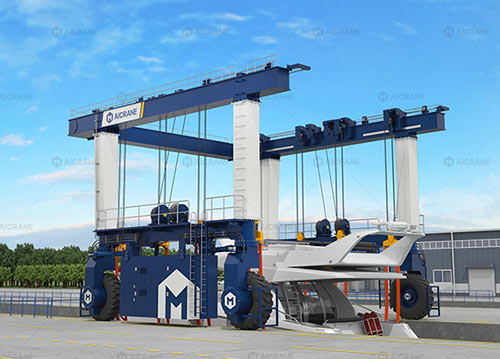
Mobile boat hoists play a critical role in marinas, shipyards, fishing ports, and boat maintenance facilities. These specialized lifting machines are designed to safely lift, transport, launch, and retrieve vessels of various sizes and weights. Because mobile boat hoists often operate outdoors in open waterfront environments, they are exposed to changing weather conditions, particularly wind. Strong winds can significantly affect lifting stability, load control, and overall operational safety. Therefore, advanced wind monitoring and safety protection systems are essential components of modern mobile boat hoists.
This article explores the importance of wind monitoring systems, the challenges posed by wind during boat handling operations, and the key safety protection technologies integrated into mobile boat hoists to ensure safe and reliable performance.
Unlike indoor lifting equipment, mobile boat hoists operate in coastal and marine environments where wind conditions can change rapidly. During vessel lifting and transportation, wind can create additional forces that affect both the hoist and the vessel being handled.
Several factors make wind monitoring particularly important:
Without proper monitoring, operators may unknowingly continue operations under unsafe wind conditions, increasing the risk of accidents, equipment damage, or vessel damage.
A reliable wind monitoring system provides real-time environmental data, allowing operators to make informed decisions and comply with safety requirements.
When a vessel is suspended by lifting slings, it becomes more vulnerable to wind forces. Wind can cause:
The larger the vessel, the greater the potential impact of wind. Yachts, catamarans, fishing boats, and commercial vessels with high superstructures are especially susceptible.
After lifting, the mobile boat hoist transports the vessel across the yard for storage, maintenance, or launching.
During transportation, wind may cause:
Continuous wind monitoring helps operators maintain safe travel speeds and determine whether transportation can proceed safely.
Launching and retrieving vessels require precise positioning near the water’s edge. Wind can make these operations more challenging by:
Real-time wind information enables operators to maintain better control during these critical stages.
Modern mobile boat hoists are equipped with integrated wind monitoring systems that continuously measure environmental conditions.
The core component of the system is the anemometer, which measures wind speed in real time.
The sensor is typically installed at an elevated position on the mobile boat hoist to ensure accurate readings and avoid interference from surrounding structures.
The anemometer continuously measures:
These measurements are transmitted directly to the control system.
Some advanced systems also include wind direction sensors.
Monitoring wind direction provides additional operational benefits:
Combining wind speed and direction data allows for more comprehensive risk assessment.
The wind monitoring system is typically connected to the PLC-based control system.
This integration enables:
The PLC continuously compares measured wind speed with predefined safety thresholds.
Wind information is displayed on the operator control panel or touchscreen interface.
Typical display information includes:
Clear visual presentation allows operators to react quickly to changing conditions.
Modern mobile boat hoists incorporate multiple alarm levels to provide early warning before conditions become dangerous.
When wind speed approaches the allowable operating limit, the system activates a warning alarm.
The purpose of the pre-warning alarm is to:
The warning may include:
If wind speed exceeds the preset safety threshold, a high wind alarm is triggered.
At this stage, operators are instructed to:
The alarm helps ensure that unsafe lifting activities do not continue under excessive wind loads.
Short-term wind gusts can be more dangerous than average wind speeds.
Advanced systems monitor gust speed separately and provide immediate alerts when sudden increases occur.
This feature is especially valuable in coastal regions where wind conditions may change rapidly.
In addition to alarms, many mobile boat hoists include automatic safety interlock functions.
When wind speed exceeds the allowable limit, the control system can automatically disable lifting motions.
This prevents:
The interlock remains active until wind speed returns to an acceptable range.
Some systems automatically reduce travel speed during elevated wind conditions.
Benefits include:
Speed limitation helps maintain safe operation even when conditions are approaching operational limits.
Wind monitoring systems can also interact with emergency stop circuits.
In extreme conditions, emergency protective actions may be activated to prevent hazardous situations.
Wind monitoring is only one part of a comprehensive safety strategy. Modern mobile boat hoists combine multiple protection technologies to ensure safe vessel handling.
Load monitoring sensors continuously measure lifting forces on each sling or lifting point.
Benefits include:
Real-time load data helps operators maintain safe lifting practices.
Overload protection systems prevent the mobile boat hoist from lifting beyond its rated capacity.
The system continuously compares actual load values with permissible limits.
If overload conditions occur:
The hydraulic system is responsible for lifting and supporting the vessel.
Pressure monitoring systems detect:
Early detection helps prevent unexpected equipment issues during operation.
Modern mobile boat hoists use multiple steering modes to maneuver efficiently in restricted spaces.
Safety functions include:
These systems enhance operational safety while transporting vessels throughout the yard.
In the event of power loss or system malfunction, emergency lowering systems allow operators to safely lower the vessel.
This capability helps:
Emergency lowering is a critical safety feature for all large-capacity boat handling equipment.
Combining wind monitoring with intelligent safety protection systems provides significant operational advantages.
Real-time environmental monitoring reduces the likelihood of accidents caused by unexpected wind conditions.
Controlled lifting and transportation minimize the risk of vessel movement, swinging, or impact damage.
Automatic protective functions reduce excessive stress on structural and mechanical components.
Many ports, marinas, and shipyards require compliance with safety regulations regarding wind limits and lifting operations.
Integrated monitoring systems help facilities meet these requirements.
Operators can make decisions based on accurate environmental data rather than visual estimation alone.
This leads to safer and more efficient operations.
Mobile boat hoists operate in challenging outdoor environments where wind conditions can have a significant impact on lifting safety and operational efficiency. Real-time wind monitoring systems provide critical information that helps operators assess environmental conditions, prevent accidents, and protect valuable vessels during lifting, transportation, launching, and retrieval operations.
Modern mobile boat hoists and travel lifts incorporate advanced anemometers, PLC-integrated monitoring systems, wind alarms, automatic safety interlocks, and multiple layers of protection, including overload monitoring, hydraulic supervision, emergency lowering, and steering safety systems. Together, these technologies create a comprehensive safety framework that enhances equipment reliability, vessel protection, and operator confidence.
As vessel sizes continue to increase and safety standards become more stringent, intelligent wind monitoring and integrated protection systems will remain essential features of high-performance mobile boat hoists used in marinas, shipyards, fishing ports, and marine service facilities worldwide.

© 2025 Crivva - Hosted by Airy Hosting Managed Website Hosting.