

The rapid rise of the Internet of Things (IoT) has transformed how devices communicate, businesses operate, and users interact with technology. As millions of smart devices continuously generate and exchange data, the demand for a scalable, secure, and efficient infrastructure has become more critical than ever. This is where cloud computing emerges as the backbone of modern IoT App Development, enabling seamless integration, real-time insights, and robust performance. Without cloud computing, the vast ecosystem of interconnected devices would struggle to function efficiently due to limitations in storage, processing, and connectivity.
Cloud computing provides the resources necessary to handle the growing complexity and volume of IoT data. Instead of relying solely on a device’s local processing power, IoT systems can leverage the cloud to store, analyze, and process data in a centralized environment. This reduces costs, improves performance, and enhances scalability—all essential qualities for developing reliable IoT applications. For any modern IoT App Development Company, cloud integration is no longer optional; it is fundamental to building intelligent, future-ready IoT solutions.
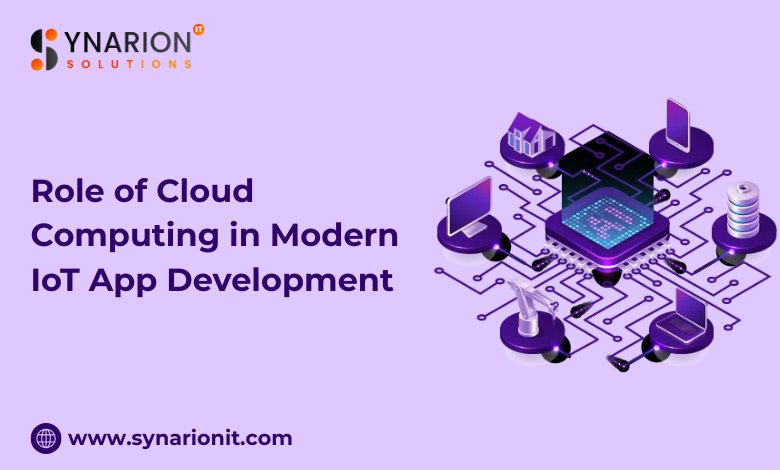
At the core of IoT is the concept of connected devices collecting data from sensors and sending it to applications for processing. Cloud computing serves as the central hub that facilitates this data exchange efficiently. IoT devices often have limited storage, memory, and processing capabilities. Cloud platforms like AWS IoT, Microsoft Azure IoT Hub, and Google Cloud IoT provide a robust and scalable infrastructure that helps manage this data flow effortlessly.
Modern IoT systems typically follow a layered architecture:
The cloud layer plays the central role, offering the computing power needed to transform raw data into meaningful insights.
One of the biggest challenges in IoT is scalability. As businesses grow, so does the number of connected devices and the volume of data they generate. Traditional on-premise systems cannot easily scale without significant hardware investments.
Cloud computing eliminates these limitations by offering on-demand scalability. IoT systems can automatically scale their resources based on real-time usage patterns. Whether a company is managing hundreds or millions of devices, the cloud provides the flexibility to adjust storage, computing power, and bandwidth requirements instantly.
For any IoT App Development Company, this scalability is crucial because applications must remain reliable even as user demand spikes or new devices are added to the network. Cloud-based platforms ensure uninterrupted performance without compromising speed or functionality.
IoT applications often require real-time or near-real-time processing. For example, smart home systems need immediate detection of unusual activities, and industrial IoT requires instant response to machinery performance issues.
Cloud computing enables real-time data analysis using advanced technologies such as:
Cloud platforms offer services like AWS Lambda, Azure Stream Analytics, and Google’s Dataflow, which allow IoT apps to analyze data instantly and trigger automated responses.
Through cloud-enabled analytics, businesses can optimize operations, detect problems early, reduce downtime, and make strategic decisions based on data-driven insights. This capability makes cloud computing indispensable in modern IoT App Development.
Security is one of the top concerns in IoT because devices often operate in open networks and can be vulnerable to cyberattacks. Cloud providers implement multi-layered security architectures that protect data at every stage—from transmission to storage.
Key security features include:
Additionally, cloud platforms provide automated compliance support for industry standards such as ISO, GDPR, HIPAA, and SOC. This helps simplify the development of secure IoT solutions and reduces risk.
A reliable IoT App Development Company can leverage cloud security tools to ensure that IoT devices and applications remain protected against unauthorized access, data breaches, and evolving cyber threats.
Cloud computing significantly reduces development and operational costs for IoT applications. Instead of investing in physical servers, storage systems, and maintenance teams, companies can utilize cloud services on a pay-as-you-go model. This means businesses only pay for the resources they use, allowing for better budget control.
Cost-saving advantages include:
For startups and growing businesses, these cost efficiencies make IoT development more accessible. Even large enterprises benefit from optimized resource allocation and reduced IT management expenses.
Cloud computing allows seamless integration of cutting-edge technologies like artificial intelligence (AI), machine learning (ML), and automation into IoT systems. These technologies help transform raw data into predictive insights, automated actions, and intelligent decision-making.
Examples include:
Modern IoT applications increasingly rely on these advanced technologies, and cloud computing provides the ideal environment for hosting AI/ML models. It accelerates innovation and makes it easier for developers to integrate complex features without overloading local devices.
The IoT ecosystem includes a wide variety of devices, platforms, and communication protocols. Ensuring seamless connectivity between different systems can be challenging. Cloud computing solves this by offering standardized APIs and development frameworks that support interoperability.
An experienced IoT App Development Company can leverage cloud-based tools to integrate multiple devices, manage data pipelines, and create unified ecosystem dashboards. This enhances user experience and ensures that different IoT components can operate harmoniously.
Cloud computing enables rapid application development through:
Developers can build, test, and deploy IoT applications faster, improving time-to-market and reducing development complexity. Continuous updates can be rolled out effortlessly, ensuring users always have access to the latest features.
Cloud computing plays an indispensable role in the evolution of IoT App Development, enabling scalability, security, cost efficiency, real-time data analytics, and seamless connectivity. As IoT devices multiply and user expectations rise, cloud platforms provide the infrastructure necessary to support robust, intelligent, and future-ready applications.
For any forward-thinking IoT App Development Company, leveraging cloud technology is essential to building solutions that are efficient, secure, and capable of transforming industries. The synergy between IoT and cloud computing will continue to drive innovation, empowering businesses and users with smarter, more connected experiences.

© 2025 Crivva - Hosted by Airy Hosting Managed Website Hosting.