

In today’s fast-paced software development environment, organizations are under immense pressure to deliver high-quality applications rapidly. Continuous integration and continuous delivery (CI/CD) pipelines have become essential for accelerating releases and ensuring consistency across environments. However, faster deployments often bring increased risk, as frequent code changes can inadvertently introduce defects. To maintain quality without slowing development, model based testing (MBT) has emerged as a critical strategy, enabling teams to automate test creation, improve coverage, and validate complex system behavior efficiently.
Model based testing is a systematic approach where abstract representations, or models, of a system’s behavior are used to automatically generate test cases. These models can describe user workflows, system states, business rules, or even expected API responses. Unlike traditional scripted testing, where tests are manually written and maintained, MBT allows teams to derive test cases directly from models, ensuring that tests reflect the actual system logic and requirements.
This methodology is particularly beneficial for complex or distributed systems where manual test creation becomes cumbersome and error-prone. By generating tests automatically, model based testing reduces human error, eliminates redundant test cases, and ensures consistent coverage across multiple components. For organizations adopting Agile and DevOps practices, MBT bridges the gap between rapid development cycles and robust quality assurance.
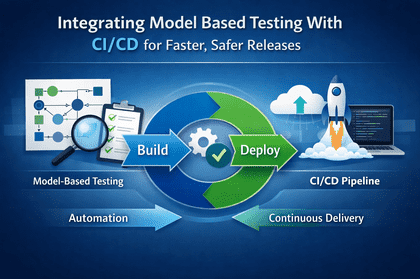
Integrating MBT into CI/CD pipelines transforms testing from a reactive to a proactive process. Automated model-based tests can be executed whenever code changes are committed, providing immediate feedback to developers. This approach reduces the likelihood of defects reaching production and enhances overall confidence in software releases.
Some of the key benefits include:
Early Defect Detection: Automated MBT ensures that regressions or unintended behavior are identified immediately after code commits, preventing issues from propagating through the pipeline.
Comprehensive Test Coverage: Models provide structured representations of system behavior, ensuring critical workflows, edge cases, and business rules are validated systematically.
Scalable Test Automation: MBT allows teams to generate thousands of test cases from a single model, reducing manual effort and enabling tests to scale as applications grow.
Faster Feedback Loops: CI/CD pipelines equipped with model-based tests provide near-instant feedback, enabling developers to fix defects quickly and maintain release velocity.
Reduced Maintenance Overhead: As models evolve alongside the application, test cases can be regenerated automatically, minimizing the effort required to update tests manually.
For successful adoption, integrating MBT with CI/CD requires a thoughtful strategy. Organizations should start by identifying the most critical components or workflows and creating models that accurately reflect desired behavior. Models should include key inputs, expected outputs, and various state transitions to ensure coverage of all meaningful scenarios.
Once models are defined, test generation tools can convert these representations into executable test cases that are integrated into the CI/CD pipeline. Automated tests should run as part of build verification, regression testing, and deployment validation stages. Proper reporting and monitoring systems are also essential to ensure that any test failures are quickly traceable to specific model scenarios.
In addition, teams should adopt version control practices for models, ensuring that any updates or changes are tracked and that test results remain reproducible. Modular test design can further enhance maintainability, allowing individual workflows or features to be tested independently while supporting broader system-level validation.
Modern software architectures, including microservices and cloud-native applications, pose unique testing challenges. Distributed systems involve multiple interconnected services, APIs, and data stores, which can result in unpredictable interactions. Model based testing is especially useful in these environments, as models can represent system-wide interactions, dependencies, and expected outcomes. By validating both individual components and end-to-end workflows, MBT ensures consistent behavior across the system and reduces the risk of cascading failures.
In large-scale enterprise applications, MBT can also help manage dynamic environments where services evolve rapidly. Automated test generation ensures that newly added features or updates do not break existing functionality, making it easier to maintain stability in fast-moving development pipelines.
Integrating MBT with modern tools enhances efficiency and effectiveness. Platforms that can capture real interactions and automatically generate test cases, like Keploy, allow teams to validate workflows, APIs, and business-critical functionality without manually scripting extensive tests. By leveraging actual system behavior for test generation, such tools ensure that model-based tests remain relevant, accurate, and aligned with real-world usage scenarios. This synergy between MBT and intelligent automation accelerates the delivery process while maintaining high-quality standards.
To fully realize the benefits of model based testing in CI/CD pipelines, organizations should consider the following best practices:
Prioritize Critical Workflows: Focus model creation on the most impactful business processes to ensure essential functionality is always validated.
Keep Models Up to Date: Continuously update models to reflect evolving requirements, system changes, or new feature additions.
Combine Unit and Behavior-Level Testing: Use MBT alongside unit tests to ensure both technical correctness and business-aligned behavior.
Monitor Test Coverage Metrics: Regularly assess which parts of the system are being exercised by generated tests and refine models as needed.
Leverage Automation Intelligently: Use AI-driven test generation or real interaction-based tools to augment, not replace, core MBT practices.
As organizations continue to accelerate software delivery, the role of model based testing in CI/CD pipelines will only grow. Its ability to provide comprehensive coverage, detect defects early, and integrate seamlessly with automated pipelines makes it an essential component of modern quality assurance strategies. By combining structured modeling with intelligent automation, development teams can maintain both speed and reliability—reducing risk, improving user satisfaction, and ensuring that software meets both technical and business expectations.
In an era where agility, test automation, and rapid releases define software development success, model based testing offers a strategic advantage. Organizations that adopt this approach alongside CI/CD can not only achieve faster, safer releases but also minimize manual effort, ensuring scalability and maintaining confidence in software quality.

© 2025 Crivva - Hosted by Airy Hosting Managed Website Hosting.