According to IMARC Group’s report titled “India Wedding Services Market Size, Share, Trends and Forecast by Type, Booking Type, Service Type, and Region, 2026-2034“, The report offers a comprehensive analysis of the industry, market growth, trends, share, and regional insights.
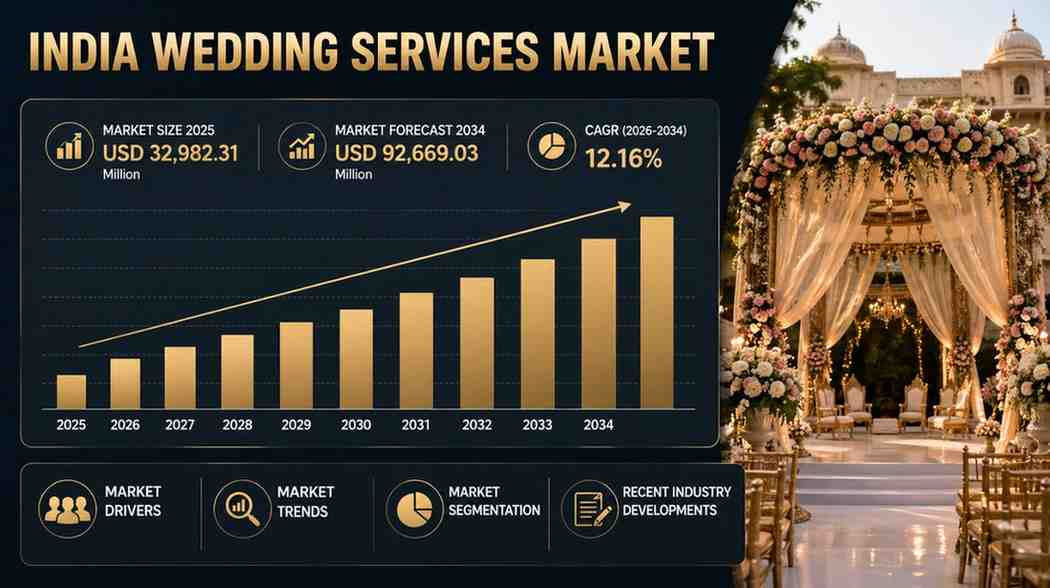
The India wedding services market size was valued at USD 32,982.31 Million in 2025 and is projected to reach USD 92,669.03 Million by 2034, growing at a compound annual growth rate of 12.16% from 2026-2034.
India’s wedding services sector is one of the largest consumption-driven markets in the world, with cultural, demographic, and economic forces aligning to create a decade-long structural growth opportunity for investors and service providers.
- The India wedding services market was valued at USD 32,982.31 million in 2025 and is projected to reach USD 92,669.03 million by 2034, growing at a CAGR of 12.16% (IMARC Group).
- Catering services command 34.9% of the market in 2025, making it the single largest service type reflecting food’s central role in Indian matrimonial culture across all regions and income segments.
- Local weddings account for 82.3% of the market, while the destination and premium segment is expanding at a faster pace, supported by rising per-capita incomes and aspirational lifestyle shifts.
- West India leads with 36.2% regional market share, anchored by Mumbai, Pune, and Goa the last being one of India’s most sought-after domestic destination wedding locations.
- India’s Minister of Tourism has stated that wedding tourism has the potential to add USD 1 trillion to the Indian economy, with approximately 68 crore people aged 25 and under expected to get married in the coming years creating a structurally sustained demand pipeline.
The Strategic Market Challenge: Navigating the India Wedding Services Market in India
The most consequential and systematically underestimated challenge in India’s wedding services sector is its profound fragmentation. The market remains overwhelmingly unorganized, with local vendors, informal planners, and community networks handling the majority of ceremonies outside formal contract structures. This fragmentation limits pricing transparency, makes quality assurance difficult to standardize, and constrains the ability of organized players to build scalable, brand-differentiated businesses. Industry data indicates that only 10.5% of local weddings in 2024–25 engaged professional planners, underscoring how vast the formalization opportunity remains and how significant the structural risk is for platforms attempting rapid aggregation without deep local trust.
India’s Strategic Vision for the Wedding Services Market:
- Ministry of Tourism’s “India says I do” campaign positioning India globally: The Ministry of Tourism launched the promotional campaign “India Says I Do,” which aims to showcase India as a premier wedding destination on the global stage, leveraging digital marketing, social media campaigns, influencers, and both offline and online activations. This initiative directly supports demand for premium venue and planning services.
- “Wed in India” expo formalizing the wedding tourism ecosystem: The Ministry of Tourism, in collaboration with the Government of Rajasthan and FICCI, organized the “Wed in India” expo alongside the Great India Travel Bazaar in Jaipur in May 2024, attended by wedding planners from India and abroad, State Governments, international and domestic tour operators, and event management companies.
- Multi-state tourism departments co-investing in wedding infrastructure: The 1st Wedding Tourism Summit and Expo (October 2024) was supported by state-level bodies including Gujarat Tourism, Madhya Pradesh Tourism, and Uttar Pradesh Tourism signaling that the state-level policy push is coordinated and broad-based, not concentrated in a single geography.
- Rising per-capita income expanding the addressable wedding economy: India’s per capita income exceeded USD 2,600 in FY2025 and is forecast to reach USD 4,500 by 2030, according to IMARC Group. This income growth is set to lift non-essential consumption including wedding expenditure from 36% to 43% of household spending, directly expanding the paying market for organized wedding service providers.
Why Invest in the India Wedding Services Market: Key Growth Drivers & ROI
- Demographic pipeline sustaining multi-decade demand volumes: India’s population skews young. With 54% of the population under 30 years old, and approximately 68 crore people aged 25 and under expected to marry in the coming years, the sheer volume of forthcoming ceremonies creates a sustained, structurally guaranteed demand base that is independent of economic cycles.
- Rising average wedding budgets driving revenue-per-event expansion: Average wedding expenditure in India has grown materially in recent years. Industry surveys indicate average wedding budgets have reached approximately INR 36.5 lakh (around USD 44,000) in 2024, while destination weddings command spending of approximately USD 61,600 per event creating a significant premium revenue opportunity for organized planners, venue operators, and catering specialists targeting the upper-middle and affluent segments.
- Destination and premium wedding segment growing faster than the base market: While local weddings dominate volume at 82.3% share, the destination wedding sub-market is expanding at a CAGR of 14.8% (2025–2033), outpacing the broader market. Goa, Rajasthan, Udaipur, and Kerala remain the premier domestic destination wedding corridors, with heritage properties and boutique resort venues reporting sustained high occupancy during wedding seasons.
India Wedding Services Market Trends & Future Outlook:
- Micro-weddings and intimate formats gaining share at the premium end: Curated guest lists of 50–100 attendees are becoming a deliberate lifestyle choice among urban professionals, who redirect budgets toward per-guest experience quality bespoke decor, heritage venues, and personalized hospitality rather than ceremony scale.
- Sustainability-led wedding planning moving from niche to mainstream: Millennial and Gen Z couples are increasingly adopting eco-conscious practices biodegradable decor, organic catering menus, bamboo mandap structures as deliberate brand signals that are reshaping vendor service portfolios across the planning, decoration, and catering segments.
- Technology integration accelerating across planning, visualization, and vendor management: AI-powered budget tools, augmented reality outfit try-ons, and virtual venue walkthroughs are moving from novelty to standard expectation in urban markets creating a product differentiation axis for tech-forward planning platforms.
- Tier 2 and Tier 3 city markets emerging as the next volume growth frontier: As incomes rise beyond metros and digital platform penetration expands vendor discovery, organized wedding service providers are finding growing demand in cities like Indore, Surat, Coimbatore, and Lucknow markets previously served exclusively by informal local networks.
Regulatory Landscape & Policy Catalysts in India:
- “India Says I Do” a national mandate for wedding tourism promotion: The Ministry of Tourism’s campaign officially confirmed in a Lok Sabha written reply (March 24, 2025) that the “India Says I Do” initiative aims to showcase India as a premier global wedding destination through digital marketing, social media, and influencer-led activations providing sustained institutional backing for the sector.
- State governments actively competing for wedding tourism revenue: The Ministry of Tourism’s “Wed in India” campaign uses a 360-degree approach across digital, social, and offline channels, featuring thematic focuses that include Beach Weddings, Royal Weddings, Nature Weddings, and Himalayan Weddings with multiple state tourism boards tailoring their hospitality infrastructure around these themes.
- GST framework governing wedding services requiring compliance from organized players: Wedding services in India attract GST at varying rates depending on service type banquet halls, catering, outdoor catering, and photography services each fall under distinct GST slabs. Organized players must manage multi-vendor GST compliance, which remains a friction point for platforms aggregating informal vendors who operate outside the GST net.
- Tourism infrastructure investment supporting destination wedding venues: According to the Ministry of Tourism’s annual reports, the government has been expanding Swadesh Darshan and PRASHAD scheme investments to improve connectivity and infrastructure at tier-two tourism destinations directly benefiting destination wedding venues in Rajasthan, Kerala, and Himachal Pradesh.
- FSSAI norms applying to wedding catering operations at scale: The Food Safety and Standards Authority of India (FSSAI) mandates that large-scale catering operations including those serving wedding events comply with food safety licensing, hygiene standards, and allergen disclosure requirements under the Food Safety and Standards Act, 2006. Organized catering businesses operating at institutional scale must maintain FSSAI licenses as a baseline compliance requirement.
Market Segmentation Breakdown and Share Analysis:
Analysis by Type:
Local weddings dominate the market with an 82.3% share in 2025, driven by strong cultural preferences, established local vendor networks, and families’ inclination toward traditional, community-centric ceremonies.
Analysis by Booking Type:
Offline bookings lead with a 66.8% market share in 2025, reflecting the importance of in-person consultations, trusted vendor relationships, and face-to-face negotiations in wedding planning.
Analysis by Service Type:
- Catering Services
- Decoration Services
- Photography and Videography Services
- Venue Providers
- Wedding Planning
- Others
Catering services account for 34.9% of the market in 2025, supported by the central role of elaborate food offerings, multi-cuisine menus, and live counters in enhancing guest experiences.
Regional Insights:
- West India
- North India (High-expenditure cultural hub)
- South India
- East India
West India holds a 36.2% share in 2025, driven by high-spending urban centers such as Mumbai and Pune, along with Goa’s popularity as a leading domestic destination wedding hub.
By the IMARC Group, the Top Competitive Landscape & their Positioning:
Covering an in-depth analysis of the competitive landscape, market structure, key player positioning, competitive dashboards, top winning strategies, and detailed profiles of all major industry participants you will gain access to all these exclusive insights within the full research report.
Note: If you need specific information that is not currently within the scope of the report, we can provide it to you as a part of the customization.
Frequently Asked Questions (FAQs):
Q1: What is the current value and projected growth of the India Wedding Services Market?
According to IMARC Group, the India wedding services market was valued at USD 32,982.31 million in 2025 and is projected to reach USD 92,669.03 million by 2034, registering a CAGR of 12.16% over the 2026–2034 forecast period. This growth is driven by India’s demographic profile, rising household incomes, growing preference for professionally managed ceremonies, and the progressive formalization of wedding service delivery.
Q2: Which service type dominates the India wedding services market, and why?
Catering services lead with a 34.9% market share in 2025, reflecting the central importance of food in Indian wedding culture. Elaborate multi-cuisine menus, live food counters, and high guest counts make catering the highest-cost and highest-value service category per wedding. This segment benefits from consistent demand across all income tiers and regional markets, making it the most attractive for organized food service businesses seeking to scale.
Q3: What proportion of Indian weddings use professional planners, and what does this indicate for investors?
Industry data indicates that only 10.5% of local weddings in 2024–25 engaged professional planners, despite the market’s large overall size. This represents a significant formalization opportunity. As urban consumers become more accustomed to managed, end-to-end wedding experiences driven by social media exposure and rising aspirations the professional planning segment has structural room to expand its penetration without needing to compete for market share from peers.
Q4: How is the online booking segment performing relative to offline channels?
Offline booking currently dominates at 66.8% of the market in 2025, reflecting trust-based, relationship-driven vendor selection. However, online booking at 33.2% is growing at an accelerating pace, supported by wedding discovery platforms, digital payment infrastructure, and the expanding digital literacy of younger couples. The convergence toward omnichannel where initial discovery is online but final vendor confirmation remains in-person is the dominant consumer behavior pattern in urban markets.
Q5: Which regions in India offer the most attractive investment opportunities in the wedding services sector?
West India leads in market share at 36.2%, anchored by Mumbai, Pune, and Goa’s destination wedding infrastructure. North India particularly Delhi-NCR, Jaipur, and Agra is a high-value corridor for royal and heritage wedding formats. South India, with cities like Bangalore, Chennai, and Kochi, offers strong mid-market catering and venue opportunities. Tier 2 cities across all regions represent the emerging growth frontier as organized providers expand beyond saturated metro markets.
Strategic Insight & Verdict
The India wedding services market occupies a rare position among consumer sectors: it is simultaneously large, structurally growing, and substantially underorganized. The combination of a 12.16% CAGR, a 68-crore pipeline of future wedding-age consumers, and active government policy promoting India as a global wedding destination creates a multi-decade commercial opportunity. Having tracked this sector across multiple growth cycles, we at IMARC Group have observed that investors who prioritize formalization through scalable platforms, quality-assured vendor networks, and tech-enabled planning tools will generate the most durable returns as organized players progressively capture share from the informal majority.
Tarang, Digital Insights Specialist at IMARC Group: https://www.linkedin.com/in/tarang-chauhan-31a82b265/
Verified Data Source: IMARC Group