

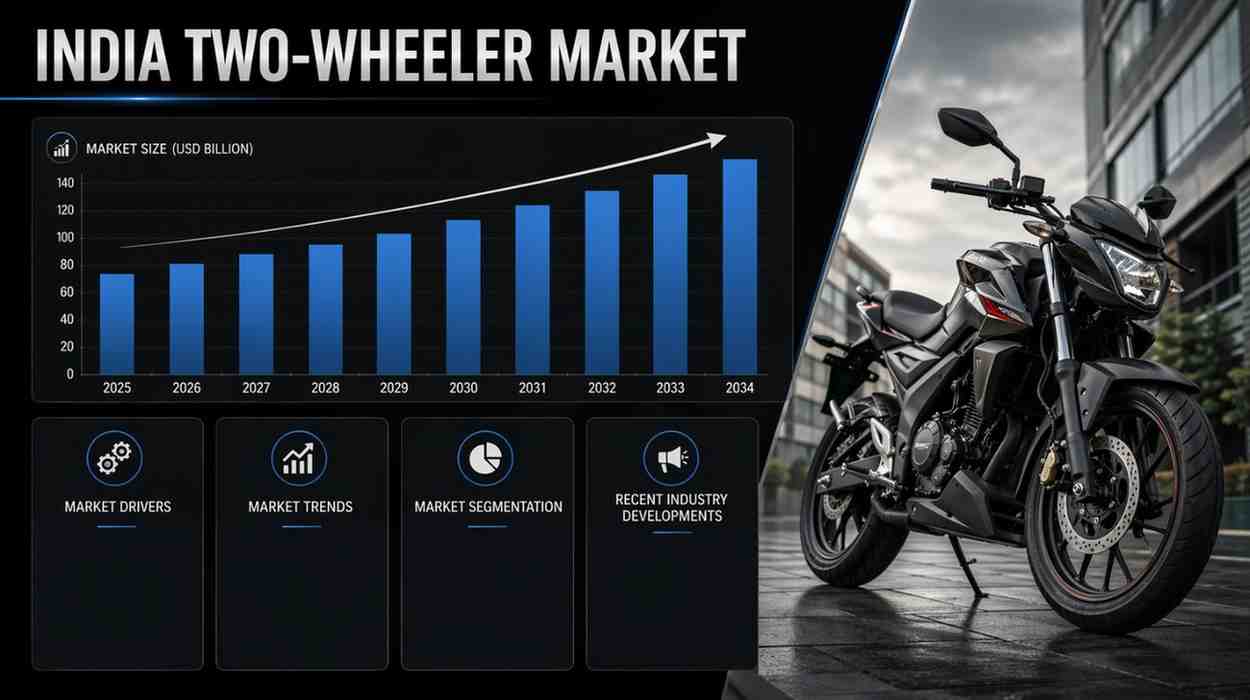
According to IMARC Group’s report titled “India Two-Wheeler Market Size, Share, Trends and Forecast by Type, Technology, Transmission, Engine Capacity, Fuel Type, End User, Distribution Channel, and Region, 2026-2034“, The report offers a comprehensive analysis of the industry, including market forecast, growth, two wheeler market size in india, and regional insights.
The India two wheeler market size was valued at USD 24.5 Billion in 2025 and is projected to grow to USD 46.1 Billion by 2034, with an expected compound annual growth rate (CAGR) of 7.08% from 2026 to 2034.
The India Two-wheeler Market Size: A Massive $46.1 Billion Boom Ignited by Smart Commuter Tech highlights a pivotal transformation in the automotive sector, driven by a rapid convergence of telematics, premiumization, and mass-scale commuter demand. As manufacturers inject advanced connectivity into both conventional ICE (Internal Combustion Engine) and EV architectures, the two-wheeler ecosystem is graduating from basic mobility to smart, data-driven personal transport platforms with massive high-margin potential for B2B stakeholders.
➤ Request Sample Report – Evaluate Core Statistics Driving Your Industry Trends
India’s Strategic Vision for the India Two-wheeler Market
India Two-wheeler Market Trends & Future Outlook
Why Invest in the India Two-wheeler Market Size Key Growth Drivers & ROI
By the IMARC Group, the Top Competitive Landscape & their Positioning:
Covering an in-depth analysis of the competitive landscape, market structure, key player positioning, competitive dashboards, top winning strategies, and detailed profiles of all major industry participants you will gain access to all these exclusive insights within the full research report.
Market Segmentation Breakdown:
Analysis by Type:
Motorcycles dominate the market with a 56% share in 2025, supported by their versatility for both urban and long-distance travel, affordability, and strong preference among budget-conscious middle- and lower-income consumers nationwide.
Analysis by Technology:
Internal combustion engine (ICE) vehicles account for 90% of the market in 2025, driven by well-established refueling infrastructure, consumer familiarity, lower upfront costs, and extensive service networks across urban and rural regions.
Analysis by Transmission:
Manual transmission leads with a 78% market share in 2025, reflecting consumer preference for better fuel efficiency, lower maintenance expenses, greater riding control, and cost-effective commuting solutions.
Analysis by Engine Capacity:
The 100–125cc segment holds a 42% share in 2025, owing to its optimal balance of fuel efficiency and adequate power, making it suitable for daily commuting in congested cities and longer rural routes.
Analysis by Fuel Type:
Petrol-powered vehicles dominate with a 47% share in 2025, supported by widespread fuel availability, mature supply chains, competitive pricing, and high consumer confidence in conventional fuel options.
Analysis by End User:
Personal usage accounts for 94% of the market in 2025, driven by rising demand for individual mobility, urban traffic congestion, limited public transport, and growing ownership aspirations among young professionals.
Analysis by Distribution Channel:
Offline channels lead with an 89% market share in 2025, as consumers continue to value physical inspection, test rides, assured after-sales service, and personalized dealer engagement.
Regional Insights:
West and Central India hold the largest share at 34% in 2025, fueled by dense metropolitan populations, industrial expansion, favorable economic conditions, and increasing purchasing power driving private vehicle adoption.
Recent News & Developments
Note: If you need specific information that is not currently within the scope of the report, we can provide it to you as a part of the customization.
Frequently Asked Questions (FAQs):
Q1. How big is the India two-wheeler market?
The India two-wheeler market was valued at USD 24.5 billion in 2025 and is projected to reach USD 46.1 billion by 2034, growing at a CAGR of 7.08% during 2026–2034.
Q2. What are the key drivers of the India two-wheeler market?
Key drivers include rising urbanization, increasing disposable incomes, strong rural demand, expanding road infrastructure, and growing adoption of smart and connected mobility solutions.
Q3. Which segment dominates the market by type?
Motorcycles dominate the market with a 56% share, particularly in the 100–125cc segment due to affordability and fuel efficiency.
Q4. How significant is ICE vs EV adoption in this market?
Internal Combustion Engine (ICE) vehicles dominate with a 90% share, although electric two-wheelers are steadily gaining traction due to policy support and cost benefits.
Q5. What trends are shaping the future of the two-wheeler market?
Key trends include connected vehicle technologies, EV adoption, flexible ownership models, telematics integration, and hybrid online-offline (phygital) sales strategies.
Strategic Insight & Verdict
Having analyzed the convergence of mass commuter demand, rapid telematics integration, and policy-driven EV localization, we at IMARC Group observe that the India two-wheeler market is evolving from a volume-driven mobility sector into a smart, technology-enabled transportation ecosystem. The projected expansion from USD 24.5 Billion in 2025 to USD 46.1 Billion by 2034 reflects a structurally strong trajectory fueled by motorcycle dominance, increasing premiumization, and gradual EV penetration. Stakeholders who align with connected mobility platforms, localized EV component manufacturing, and hybrid retail strategies will secure long-term value in this high-volume, innovation-driven automotive market.
Tarang, Digital Insights Specialist at IMARC Group: https://www.linkedin.com/in/tarang-chauhan-31a82b265/
Verified Data Source: IMARC Group
Contact Us:
IMARC Group
134 N 4th St. Brooklyn, NY 11249, USA
Email: [email protected]
Tel No:(D) +91 120 433 0800
United States: +1-202071-6302

© 2025 Crivva - Hosted by Airy Hosting Managed Website Hosting.