

According to the latest research report titled “India Quick Service Restaurants Market Size, Share, Trends and Forecast by Cuisine, Outlet, Location, and Region, 2026-2034” the report offers a comprehensive analysis of the industry, including market share, growth, trends, and regional insights.
How Big is The India Quick Service Restaurants Market?
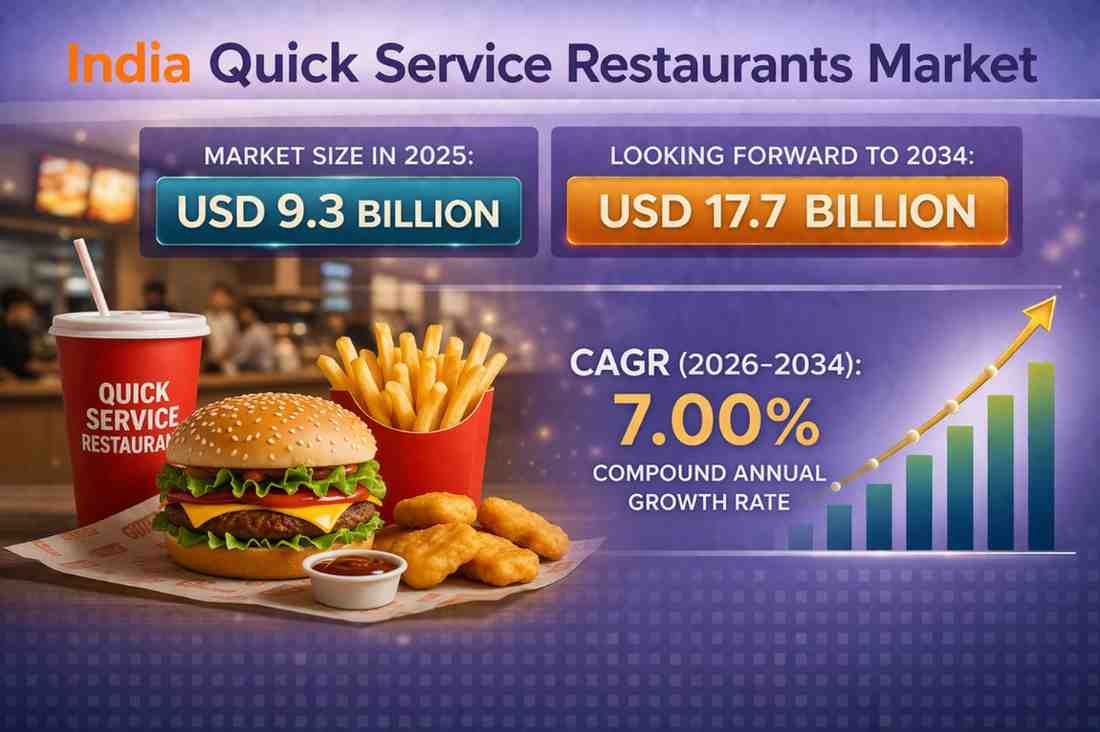
The India quick service restaurants market size reached USD 9.3 Billion in 2025 and is projected to reach USD 17.7 Billion by 2034. The market is forecasted to grow at a CAGR of 7.00% during the period from 2026 to 2034. Growth is supported by widespread technological integration improving customer experience and operational efficiency.
What are the Latest Emerging Trends in the India Quick Service Restaurants Market?
As consumers require faster service and greater accessibility through smartphones and the internet‚ the India QSR and fast food industry is rapidly digitizing․ Domestic players have adopted technologies and devised mobile apps‚ self-service kiosks‚ and contactless payment systems to provide customers with fast and convenient service at their outlets․ As consumers adopt UPI and QR code-based payments because of their ease of use‚ security‚ and speed‚ brands and retailers are adopting next-gen POS systems that provide more than just billing and payments․
In addition to these features‚ they also ease real-time stock management‚ demand forecasting‚ and customer relationship management‚ reducing waste and streamlining processes at the backend․ When combined with loyalty programs and real time order updates‚ digital delivery systems are positioning themselves as an important differentiator in the customer experience for restaurant operators․
AI and ML are the key pillars of the consumer tech experience in the QSR segment․ Brands are using data analytics capabilities to gain consumer understanding on their customer segments and purchase behavior‚ providing personalized recommendations on foods and menu items and other marketing messages․ Algorithms analyze an individual’s previous orders‚ time of day‚ season of the year‚ demographics‚ and psychographics to recommend complementary items to increase check size and a more personalized customer experience․
Mobile apps‚ email‚ and push notifications are being used to deliver more personalized marketing campaigns to improve brand engagement‚ while loyalty programs are increasingly integrated with digital properties to enable businesses to send custom-made offers that encourage repeat purchases․ To further improve convenience‚ retailers have begun using chatbots and virtual assistants to answer customer questions and ease transactions․ The data-driven approach also gives QSR operators the ability to optimize their pricing‚ menus‚ and promotions‚ which ultimately creates a better consumer experience․
As consumers become more health-conscious‚ QSR chains across India have started innovating their menu offerings to carry plant-based‚ gluten-free‚ high-protein‚ low-calorie‚ functional‚ and fortified foods that provide consumers with additional health benefits․ To help meet this demand‚ many QSR chains are working with nutritionists and food scientists to create healthier and more transparent menu items that adhere to consumer preferences regarding health and wellness․ Clear labeling of nutritional information‚ calorie count‚ and allergens has become more popular to assist consumers in making informed choices․
Other factors affecting the QSR industry include innovation in products and services‚ and the evolution of the delivery infrastructure․ Cloud kitchens‚ micro-fulfillment centers‚ partnerships with hyperlocal delivery platforms‚ and quick commerce services allow QSR brands to reduce their physical and labor costs to deliver food faster․ They also enable businesses to reach customers beyond those who visit the physical premises․ It allows QSR brands to leverage their infrastructure and strengthen their distribution network․
What Growth Factors are Driving the India Quick Service Restaurants Market?
The rapid growth of urbanization in India‚ along with continuous changes to lifestyle are the primary factors propelling the growth of the India QSR market․ The migration of people to urban areas for job purposes and higher standard of living‚ increases the trend of eating out at quick service restaurants․ This trend for ready to eat food and fast food outlets is supported by busy and demanding work life schedules‚ a rise in commute times as well as an increase of women in the work force․
An increase in disposable incomes‚ especially amongst younger and middle class consumers‚ also encourages eating out and ordering in․ This group is influencing market demand as they are more likely to experiment with foreign foods and new brands and restaurant experiences․ The growing international food trends and aspirational consumption lifestyles among urban consumers are contributing mostly to QSRs’ frequent consumption and long-term growth in this segment․
The rapid growth of the digital ecosystem in India has also enabled the expansion of the QSR sector․ The increasing penetration of smartphones‚ affordable availability of the internet‚ and the growing acceptance of digital modes of payment has made the online ordering of food convenient for the consumer․ Customers can browse a menu and place and pay for an order through mobile apps and on the Web․ Hyperlocal delivery networks and platforms for quick commerce have also reduced service time and held up the standard for reliability‚ as more consumers are seeking instant gratification in the QSR space․
Technologies such as route optimization‚ real-time tracking‚ electronic proof of delivery and advance notification can provide a better delivery experience and higher delivery satisfaction․ This has resulted in QSR brands extending their delivery footprint and consumers beginning to shift from eat-in to online ordering․ As the digital infrastructure improves‚ it is expected to remain one of the main enablers of market growth․
Tier 2 and tier 3 cities are likely to be high growth opportunities for QSR operators‚ with rising disposable incomes‚ improved infrastructure‚ and increased exposure to international food brands․ Thus tier 2 and tier 3 cities are becoming focus areas for growth for QSR operators․ This has led to companies adopting capital-light formats such as cloud kitchens and delivery-only restaurants․ This is in contrast to customary restaurant formats‚ where heavy investments are required in the form of real-estate and operational expenses for dine-in restaurants․
This allows large-scale expansions that would otherwise not have been possible․ Other franchise models are growing as systems to allow local businesses to invest in and expand established QSRs․ These models also partner with delivery service platforms and delivery aggregators to ease delivery and provide coverage․ These flexible‚ scalable business models are important for achieving market penetration and sustainability in a competitive business environment․
How will the India Quick Service Restaurants Market Evolve in the Coming Years?
The Structural drivers for growth in the India Quick Service Restaurants Market include rapid urbanization‚ changing lifestyles‚ increasing digital adoption‚ technology-enabled ordering platforms‚ AI-led personalization‚ the scalability of cloud kitchen business models‚ and increasing competition in the market․ Innovations focusing on health for customers and sustainability in various QSRs are expected to gain more prominence as consumers are becoming health-conscious․ The tier 2 and tier 3 cities are also expected to witness a growing consumer market in addition to favorable delivery infrastructure and rising income levels․ The digital transformation and evolving patterns of consumption are also anticipated to drive the market․
Evaluate Market Potential Before You Invest – Get the Report Sample
India Quick Service Restaurants Market Segmentation
Cuisine Insights:
The market segmentation includes these cuisines, reflecting diverse consumer preferences.
Outlet Insights:
These categories cover different types of operational outlets in the QSR market.
Location Insights:
Classification based on location helps capture various consumer access points.
Regional Insights
India Quick Service Restaurants Market Key Players
The report offers an in-depth examination of the competitive landscape, including market structure, key player positioning, leading strategies for success, a competitive dashboard, and a company evaluation quadrant.
India Quick Service Restaurants Market Recent Developments & News
India Quick Service Restaurants Market Key Highlights of the Report
About Us
IMARC Group is a global management consulting firm that helps ambitious changemakers create a lasting impact. The company offers comprehensive market assessment, feasibility studies, incorporation support, regulatory assistance, branding and strategy services, and procurement research.
Contact Us
IMARC Group
134 N 4th St. Brooklyn, NY 11249, USA
Email: [email protected]
Tel: (D) +91 120 433 0800
United States: +1-201971-6302

© 2025 Crivva - Hosted by Airy Hosting Managed Website Hosting.