According to IMARC Group’s report titled “India Plant-Based Milk Market Size, Share, Trends and Forecast by Product, Formulation, Category, Form, Distribution Channel, and Region, 2026-2034“, The report offers a comprehensive analysis of the industry, including market growth, share, trends, and regional insights.
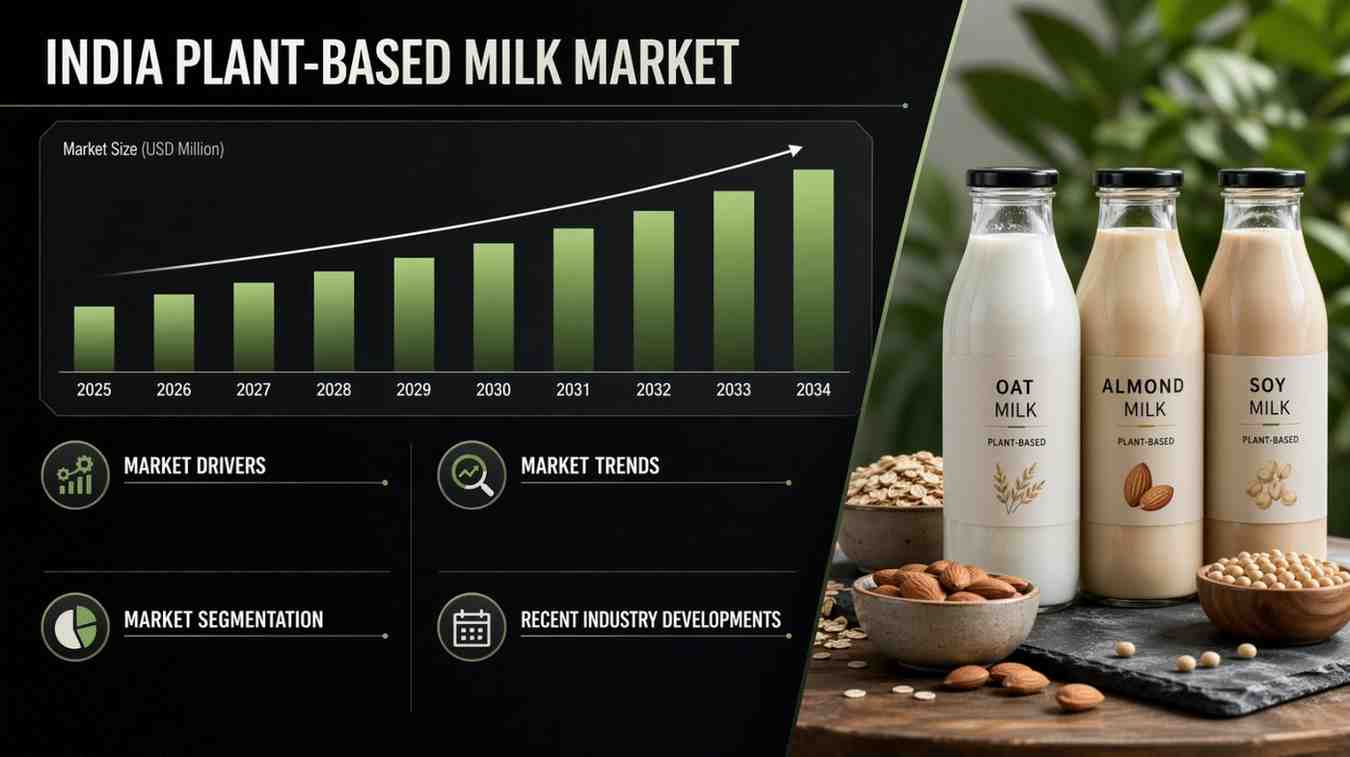
The plant based milk industry in india size reached USD 857.7 Million in 2025. The market is projected to reach USD 1,828.0 Million by 2034, exhibiting a growth rate (CAGR) of 8.33% during 2026-2034.
India’s plant-based milk sector is approaching an inflection point, driven by converging forces of health consciousness, lactose intolerance prevalence, and a structurally expanding middle class willing to pay a premium for functional, sustainable beverages.
- The India plant-based milk market reached USD 857.7 million in 2025 and is projected to expand to USD 1,828.0 million by 2034 at a CAGR of 8.33% (IMARC Group).
- Soy, almond, coconut, oat, and rice milk form the core product portfolio, with each sub-segment serving distinct consumer nutrition and lifestyle profiles.
- The market spans both B2B and B2C distribution channels, with organized retail, e-commerce, and foodservice verticals all recording increased penetration.
- North India, West and Central India, South India, and East and Northeast India represent distinct regional consumption pockets, with urban metros leading adoption.
- Rising awareness of lactose intolerance which affects an estimated 60–65% of the South Asian adult population according to published gastroenterology literature is converting a significant portion of dairy users into permanent plant-based milk consumers.
The Strategic Market Challenge: Navigating the India Plant-Based Milk Market in India
One of the most consequential and often underestimated challenges in India’s plant-based milk sector is the regulatory ambiguity surrounding product labelling and dairy-term usage. The FSSAI previously ordered online and offline platforms to delist plant-based products that used conventional dairy terms, forcing brands to restructure their packaging and marketing strategies while awaiting greater regulatory clarity. This creates a compounding effect: it raises compliance costs for emerging brands, slows retail shelf access, and complicates consumer communication at precisely the stage when category education is most critical for market development.
India’s Strategic Vision for the India Plant-Based Milk Market
- FSSAI establishing a structured regulatory framework for plant-based alternatives: The Food Safety and Standards Authority of India has regulatory authority over milk replacements and establishes requirements for their composition, labelling, hygiene, additives, contaminants, and packaging under the Food Safety and Standards (Food Products Standards and Food Additives) Regulations, 2011. This provides a defined compliance pathway for manufacturers scaling operations.
- New FSSAI labelling mandates creating a transparent consumer environment: A new FSSAI mandate, released in early 2024 and effective from July 1, 2025, mandates front-of-pack allergen disclosure requiring products containing common allergens such as soy and nuts to list them clearly on the front of the package. For plant-based milk brands, this compels investment in clearer, science-backed product communication.
- India’s broader food processing push indirectly supporting category growth: The Ministry of Food Processing Industries (MoFPI) has backed cold chain expansion and food technology infrastructure through schemes like PLI for Food Processing, with an approved outlay of ₹10,900 crore improving the supply chain capabilities essential for perishable plant-based beverages reaching Tier 2 and Tier 3 markets.
- Environmental policy alignment reinforcing category demand: India’s commitments under its Nationally Determined Contributions (NDC) framework targeting a 45% reduction in emissions intensity by 2030 relative to 2005 levels are generating institutional and corporate interest in lower-carbon food systems, of which plant-based dairy alternatives are a recognized component.
Why Invest in the India Plant-Based Milk Market: Key Growth Drivers & ROI
- Lactose intolerance as a structural, permanent demand driver: Medical literature consistently indicates that the majority of South Asian adults experience some degree of lactose malabsorption. Unlike a lifestyle trend, this physiological reality creates a durable, non-cyclical consumer base for plant-based milk alternatives particularly in the liquid segment that will expand in proportion to health diagnostics awareness and urbanization.
- Premiumization within the organic and flavored sub-segments: The market is segmented by category into organic and conventional, and by formulation into flavored and unflavored. Organic plant-based milk commands a meaningful price premium, and rising urban disposable incomes are supporting consumer willingness to pay for certified, clean-label products. Brands with GOTS or organic certifications are positioned to capture higher margin per unit than conventional variants.
- E-commerce and D2C channels reducing distribution barriers significantly: India’s e-commerce sector reached USD 107.7 billion in 2024 (IMARC Group), and plant-based milk brands operating through direct-to-consumer digital channels can reach health-conscious consumers in semi-urban geographies without the capital intensity of physical retail expansion materially improving return on distribution investment.
- Foodservice and institutional B2B demand accelerating volume growth: Cafes, cloud kitchens, corporate canteens, and healthcare institutions are increasingly adopting plant-based milk as a standard ingredient driven by menu diversification and patient dietary requirements. This B2B channel provides recurring, predictable volume contracts that complement consumer retail revenue, improving capacity utilization for manufacturers.
India Plant-Based Milk Market Trends & Future Outlook:
- Oat milk gaining traction as the fastest-growing sub-segment: Globally recognized for its neutral taste profile and strong barista performance, oat milk is gaining significant consumer and foodservice adoption in India particularly among urban café chains and health-oriented retail formats.
- Fortification becoming a baseline expectation, not a differentiator: As plant-based milk transitions from a niche health product to a mainstream alternative, calcium, Vitamin D, and Vitamin B12 fortification are becoming table-stakes requirements rather than premium add-ons, compressing margins for undifferentiated brands.
- Powder format emerging as a logistics and shelf-life solution: The market includes both liquid and powder forms. Plant-based milk powder variants are gaining attention for their longer shelf life, lower cold-chain dependency, and suitability for distribution in India’s vast rural and semi-urban markets where refrigeration infrastructure remains uneven.
- Private label growth in organized retail applying pricing pressure: As organized grocery chains introduce private label plant-based milk at competitive price points, incumbent branded players face margin compression in the mid-market tier necessitating a clear move toward either premium positioning or scale-based cost efficiency.
- Sustainability credentials becoming a measurable purchase driver: Consumer research across urban Indian markets indicates growing correlation between environmental labeling (carbon footprint, water usage disclosures) and purchase intent among the 25–40 age cohort a segment that disproportionately represents early adopters in the plant-based category.
Regulatory Landscape & Policy Catalysts in India:
- FSSAI’s 2025 labelling mandate reshaping packaging requirements: The new FSSAI mandate, effective July 1, 2025, requires clearer nutrition labelling food packages must now show the percentage of daily intake for added sugar, saturated fats, and sodium in a larger and bolder font. Plant-based milk brands must align packaging design accordingly across all SKUs.
- Allergen disclosure rules directly impacting soy and nut-based milk brands: Products containing common allergens including soy and nuts must now clearly list them on the front of the package, not just in the ingredients list. For soy milk and almond milk manufacturers specifically, this requires front-label redesigns across the product portfolio.
- Prohibition on unsubstantiated “100% natural” claims restricting marketing language: FSSAI’s 2024 mandate restricts terms like “100% natural” or “100% pure” unless they are scientifically backed directly affecting the marketing messaging of plant-based milk brands that have relied on natural-origin claims as primary selling propositions.
- FSSAI’s dairy-term restrictions requiring category-specific brand communication: The FSSAI previously ordered platforms to delist plant-based products that used dairy terminology, and India’s plant-based milk brands have since steered clear from conventional dairy terms on product labels until regulators issue greater clarity. Brands that proactively build distinct, plant-first identities are better insulated from future regulatory developments.
- Food Safety and Standards (Food Products Standards and Food Additives) Regulations, 2011 as the primary compliance baseline: The FSSAI ensures the quality and authenticity of milk alternatives through inspections, assessments, audits, and regulatory measures including testing for composition, additives, contaminants, and nutritional value in alignment with both domestic and international benchmarks.
- MoFPI’s PLI Scheme for Food Processing supporting manufacturing scale-up: The Ministry of Food Processing Industries’ Production Linked Incentive scheme (outlay: ₹10,900 crore) covers processed food categories, providing capital incentives for manufacturers investing in food technology upgrades including plant-based beverage processing infrastructure.
Market Segmentation Breakdown:
Product Insights:
- Soy Milk
- Almond Milk
- Coconut Milk
- Rice Milk
- Oat Milk
- Others
Formulation Insights:
Category Insights:
Form Insights:
Distribution Channel Insights:
- Business-to-Business
- Business-to-Consumer
- Modern Groceries
- Convenience Stores
- Specialty Stores
- Online Retail Stores
- Others
Regional Insights:
- North India
- West and Central India
- South India
- East and Northeast India
By the IMARC Group, the Top Competitive Landscape & their Positioning:
Covering an in-depth analysis of the competitive landscape, market structure, key player positioning, competitive dashboards, top winning strategies, and detailed profiles of all major industry participants you will gain access to all these exclusive insights within the full research report.
Note: If you need specific information that is not currently within the scope of the report, we can provide it to you as a part of the customization.
Frequently Asked Questions (FAQs):
Q1: What is the current value and projected growth of the India Plant-Based Milk Market?
According to IMARC Group, the India plant-based milk market reached USD 857.7 million in 2025 and is projected to grow to USD 1,828.0 million by 2034, at a compound annual growth rate of 8.33% over the 2026–2034 forecast period. This growth reflects rising health awareness, lactose intolerance prevalence, vegan dietary adoption, and expanding e-commerce access to plant-based products.
Q2: Which product segments are driving the most demand within India’s plant-based milk market?
The market spans soy milk, almond milk, coconut milk, rice milk, oat milk, and other variants. Soy milk holds a historically established position due to its protein content and affordability. Oat milk is gaining momentum rapidly in urban and foodservice contexts. Almond milk leads premium retail positioning. Coconut milk maintains strong demand in South Indian markets, supported by regional dietary familiarity.
Q3: What is driving the shift from conventional dairy milk to plant-based alternatives among Indian consumers?
Three primary factors are driving this shift: physiological (lactose intolerance affecting the majority of South Asian adults), health-motivated (lower cholesterol, calorie-conscious diets among urban professionals), and ethical-environmental (growing awareness of the carbon and water footprint of conventional dairy farming). These factors reinforce each other, creating compound demand growth rather than single-driver adoption.
Q4: Which distribution channels are most effective for reaching plant-based milk consumers in India?
The market operates across B2B and B2C channels. Within B2C, specialty health food stores and e-commerce platforms are the primary entry points for new brands, with modern trade gaining importance in metros. B2B channels including cafes, cloud kitchens, and healthcare institutions are growing in commercial significance. Brands with omnichannel presence across both are best positioned for sustained volume growth.
Q5: What compliance requirements must plant-based milk manufacturers meet under FSSAI regulations?
Manufacturers must comply with the Food Safety and Standards (Food Products Standards and Food Additives) Regulations, 2011, which govern composition, labelling, additives, and contaminants for milk analogues. From July 2025, the new FSSAI mandate additionally requires front-of-pack allergen disclosure, bolder nutritional labelling, and prohibition on unsubstantiated natural claims. Brands must also avoid conventional dairy terminology on packaging until FSSAI provides further guidance.
Strategic Insight & Verdict
The India plant-based milk market is not a speculative growth story it rests on structural demand drivers that include permanent physiological factors, rising health literacy, and a regulatory environment that, while currently in flux, is moving toward greater standardization. Having tracked this category across multiple growth cycles, we at IMARC Group have observed that brands capable of navigating FSSAI compliance proactively, building credible fortification claims, and establishing dual B2B and B2C distribution will capture disproportionate value as the market doubles through 2034. The window for first-mover advantage in underserved regional markets remains open but is narrowing.
Tarang, Digital Insights Specialist at IMARC Group: https://www.linkedin.com/in/tarang-chauhan-31a82b265/
Verified Data Source: IMARC Group
Contact Us:
IMARC Group
134 N 4th St. Brooklyn, NY 11249, USA
Email: [email protected]
Tel No:(D) +91 120 433 0800
United States: +1-202071-6302