

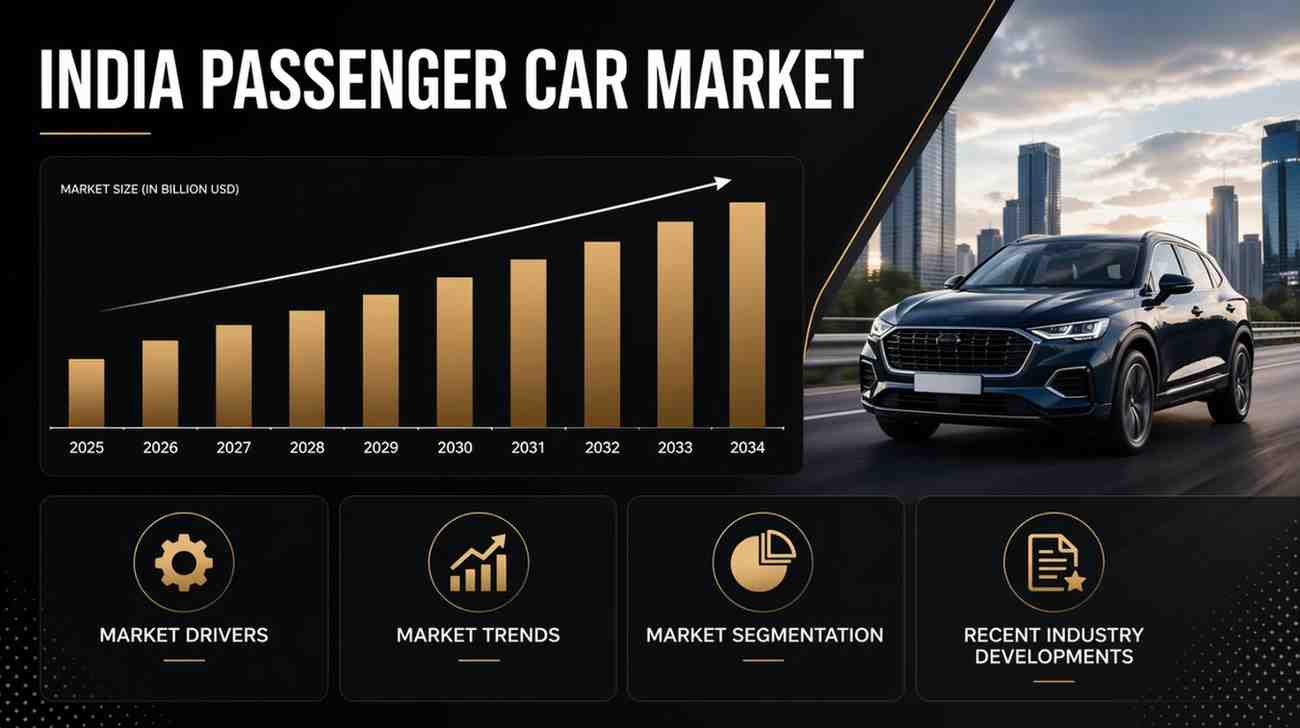
According to IMARC Group’s report titled “India Passenger Car Market Size, Share, Trends and Forecast by Vehicle Type, Fuel Type, Transmission Type, Price Segment, and Region, 2026-2034“, The report offers a comprehensive analysis of the industry, including India passenger car market analysis, trends, share, and regional insights.
The India passenger car market size was valued USD 63.01 Billion in 2025. By 2034, this figure is projected to reach around USD 111.33 Billion, with a compound annual growth rate (CAGR) of 6.53% over the forecast period (2026-2034).
The India Passenger Car Market is undergoing a rapid, volume-driven expansion, fueled by massive urbanization and an expanding middle class demanding feature-rich personal mobility. For automotive OEMs and institutional investors, aligning manufacturing pipelines with this demographic shift is critical to securing long-term profitability.
Robust Market Valuation: The market was valued at USD 63.01 Billion in 2025 and is aggressively scaling toward a projected USD 111.33 Billion by 2034.
Steady Growth Trajectory: Expanding at a 6.53% CAGR (2026-2034), underpinned by favorable demographic trends and continued economic expansion.
Segment Dominance: Hatchbacks control 48% of the market, and manual transmissions hold a massive 78% share, driven by their suitability for congested urban environments and lower acquisition costs.
The Economy Driver: Vehicles priced below ten lakh rupees (the economy segment) command a 54% market share, representing the core volume driver for the industry.
A critical hidden risk for automotive executives is the failure to recognize the rapid technological premiumization occurring within the dominant economy segment. While manual transmissions and sub-ten lakh rupee vehicles heavily dominate sales volumes due to acquisition and maintenance costs, consumers are no longer accepting stripped-down utilitarian models. Buyers are increasingly prioritizing connected car technology, enhanced safety features, and improved fuel economy, fundamentally shifting the baseline requirements for entry-level vehicles.
Ignoring this structural shift in consumer expectations creates a severe ripple effect that erodes brand loyalty and compresses operational margins across the Indian automotive sector. As the young demographic and expanding middle class pivot toward feature-rich hatchbacks and agile compact SUVs, OEMs trapped in legacy, low-tech production cycles will face rapid market share attrition. This operational bottleneck delays critical inventory turnover and ultimately isolates manufacturers from the high-volume urban mobility demands.
➤ Access Industry-Focused Insights and Future Forecasts – Request Sample Report: https://www.imarcgroup.com/india-passenger-car-market/requestsample
Capitalizing on Urbanization Corridors: With over 40% of India’s population projected to reside in cities by 2030, the strategic focus is on deploying compact, highly maneuverable mobility solutions tailored for congested metropolitan environments.
Leveraging Enhanced Road Infrastructure: Massive developments in road connectivity and national infrastructure are expanding personal vehicle demand beyond traditional urban centers, particularly strengthening high-density regions like North India, which currently holds a 31% market share.
Modernizing the Economy Fleet: The macro-level vision involves transitioning the dominant economy and hatchback segments toward technologically advanced platforms, integrating critical safety and connectivity features without compromising the affordability necessary for the middle class.
Massive Consumption Base and Demographics: India’s young demographic profile and rising disposable incomes among the expanding middle class create sustained, high-volume demand for first-time car ownership, offering investors highly predictable revenue streams.
Urbanization-Driven Scalability: Rapid migration to cities necessitates convenient personal mobility. Investors can achieve robust ROI by scaling compact hatchbacks and SUVs that specifically address the space constraints and navigational challenges of Indian urban environments.
Premiumization and Tech Upgrades: While 54% of the market is value-oriented, the demand for connected car technology and advanced safety features within this tier allows OEMs to strategically upsell and improve profit margins on high-volume models.
Supply Chain Efficiencies via Fuel Networks: Petrol-powered vehicles command a 72% market share, supported by an extensively established fuel distribution infrastructure spanning both urban and rural areas, drastically reducing consumer friction and ensuring steady, immediate market adoption.
Surging Dominance of Sport Utility Vehicles: Compact SUVs have emerged as the fastest-growing segment in the market, fundamentally reshaping OEM production priorities to meet the demand for higher ground clearance and aggressive styling.
Evolution of the Feature-Rich Hatchback: The dominant 48% hatchback segment is rapidly evolving; consumers are now demanding superior fuel efficiency seamlessly integrated with advanced digital infotainment and safety ecosystems.
Persistence of Manual Transmissions: Despite broader technological upgrades, manual vehicles maintain a 78% share, driven by strict price sensitivity and a strong preference for reduced maintenance expenses, particularly in semi-urban markets.
Geographic Consolidation: North India continues to lead the market (31% share), heavily supported by strong dealership networks across Delhi-NCR and surrounding states, indicating critical zones for localized retail expansion.
➤ Explore the Complete TOC and Data Coverage – Get Full Brochure: https://www.imarcgroup.com/request?type=report&id=31392&flag=A
Market Segmentation Breakdown:
Vehicle Type Insights:
The hatchback dominates with a market share of 48% of the total India passenger car market in 2025.
Fuel Type Insights:
The petrol leads with a share of 72% of the total India passenger car market in 2025.
Transmission Type Insights:
The manual holds the largest share with 78% of the total India passenger car market in 2025.
Price Segment Insights:
The economy holds the highest share with a 54% share of the total India passenger car market in 2025.
Regional Analysis:
North India dominates with a market share of 31% of the total India passenger car market in 2025.
By the IMARC Group, the Top Competitive Landscape & their Positioning:
Covering an in-depth analysis of the competitive landscape, market structure, key player positioning, competitive dashboards, top winning strategies, and detailed profiles of all major industry participants you will gain access to all these exclusive insights within the full research report.
Recent News & Developments
Note: If you need specific information that is not currently within the scope of the report, we can provide it to you as a part of the customization.
➤ Tailor the Research to Your Exact Business Needs – Request Customization: https://www.imarcgroup.com/request?type=report&id=31392&flag=E
Frequently Asked Questions (FAQs):
Q1. How big is the India passenger car market?
The India passenger car market was valued at USD 63.01 billion in 2025 and is projected to reach USD 111.33 billion by 2034, growing at a CAGR of 6.53% during 2026–2034.
Q2. What are the key drivers of the India passenger car market?
Key drivers include rising urbanization, increasing disposable incomes, growing middle-class population, government incentives for EVs, and rapid adoption of connected car technologies.
Q3. Which vehicle type dominates the market?
Hatchbacks dominate the market with a 48% share due to affordability, compact design, and suitability for urban commuting.
Q4. Which fuel type leads the market?
Petrol vehicles dominate with a 72% share, supported by widespread fuel availability, lower upfront costs, and established infrastructure.
Q5. What trends are shaping the future of the passenger car market?
Key trends include the rise of software-defined vehicles, increasing EV adoption, connected car ecosystems, and growing demand for SUVs and premium features.
Strategic Insight & Verdict
Having analyzed the convergence of digital cockpit innovation, EV ecosystem expansion, and strong domestic demand fundamentals, we at IMARC Group observe that the India passenger car market is transitioning into a software-defined, technology-centric mobility ecosystem. The projected growth from USD 63.01 Billion in 2025 to USD 111.33 Billion by 2034 reflects a structurally robust trajectory driven by SUV premiumization, AI-powered infotainment systems, and policy-backed EV adoption. Strategic collaborations involving Qualcomm and Google are accelerating the shift toward intelligent in-car experiences, while domestic OEMs continue to scale localized manufacturing. Stakeholders who align with connected vehicle platforms, EV infrastructure, and advanced driver assistance technologies will secure long-term value in this rapidly evolving automotive landscape.
Tarang, Digital Insights Specialist at IMARC Group: https://www.linkedin.com/in/tarang-chauhan-31a82b265/
Verified Data Source: IMARC Group
Contact Us:
IMARC Group
134 N 4th St. Brooklyn, NY 11249, USA
Email: [email protected]
Tel No:(D) +91 120 433 0800
United States: +1-202071-6302

© 2025 Crivva - Hosted by Airy Hosting Managed Website Hosting.