


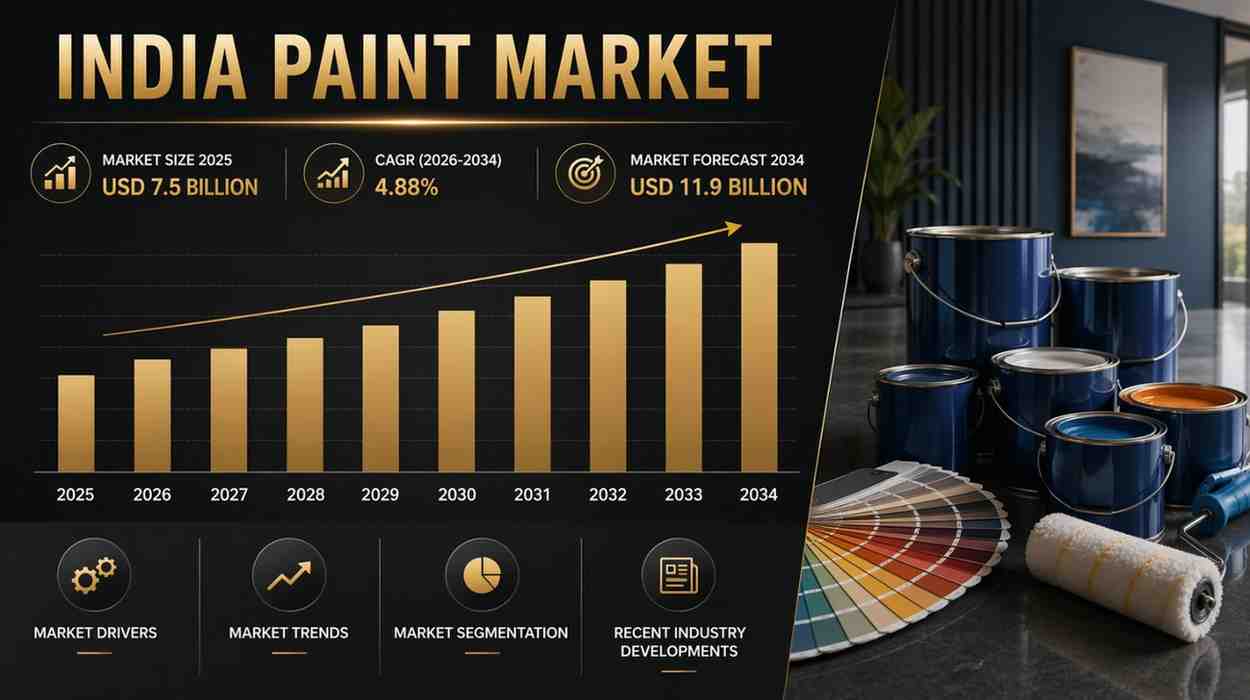
According to IMARC Group’s report titled “India Paint Market Size, Share, Trends and Forecast by Technology, Type of Paint, Resin, End User, and Region, 2026-2034“, The report offers a comprehensive analysis of the industry, including paint industry growth in india, trends, share, and regional insights.
The India paint market size was valued at USD 7.5 Billion in 2025 and is projected to reach USD 11.9 Billion by 2034, growing at a compound annual growth rate of 4.88% from 2026-2034.
India’s transition toward advanced manufacturing and sustained urban infrastructure development is driving continuous expansion within the domestic chemical and materials sector. Stakeholders entering the architectural and industrial coatings segments face a robust growth environment supported by demographic shifts and targeted structural reforms.
The domestic paint market reached a valuation of USD 7.5 Billion in 2025 and is projected to expand to USD 11.9 Billion by 2034.
The sector is projected to register a steady compound annual growth rate (CAGR) of 4.88% throughout the 2026-2034 forecast period.
According to United Nations-backed estimates, the national urban population will hit 600 million by 2031, directly expanding the architectural and decorative paint consumer base.
Rural consumption expenditure, growing at an estimated 10% annually based on National Sample Survey Office (NSSO) data, is opening high-volume distribution channels.
Industrial coating demand remains strong, aligned with the manufacturing sector, which historically generates 16-17% of the national gross domestic product (GDP).
A primary structural friction within the Indian paint sector revolves around raw material price volatility, particularly for crude oil derivatives essential for solvent-based resins and titanium dioxide. As global supply chains encounter logistical bottlenecks, domestic manufacturers face compressed operating margins. This dependency necessitates heavy capital allocation toward continuous supply chain optimization and advanced inventory forecasting. Consequently, the ecosystem is accelerating its transition toward localized raw material sourcing and water-based, eco-friendly formulations to mitigate external macroeconomic shocks.
➤ Access Industry-Focused Insights and Future Forecasts – Request Sample Report: https://www.imarcgroup.com/india-paint-market/requestsample
Affordable Housing and Urbanization Targets: Government housing subsidies under the Pradhan Mantri Awas Yojana aim to bridge the residential real estate deficit, establishing a predictable volume pipeline for architectural emulsions and wood finishes.
Manufacturing Sector Self-Reliance: The “Make in India” policy framework targets an increase in domestic production capabilities, directly stimulating the consumption of high-performance industrial paints across automotive, marine, and heavy equipment verticals.
Rural Infrastructure Modernization: Broad-scale initiatives, including the Swachh Bharat Abhiyan, focus on rural sanitation and structural upgrades, expanding the penetration rate of protective coatings and distemper beyond metropolitan centers.
Sustainability and Green Chemistry Goals: National directives are systematically shifting the chemical sector toward decarbonization, incentivizing manufacturers that adopt water recycling, renewable energy usage, and lower volatile organic compound (VOC) material formulations.
Driven by structural demographic shifts, India’s urban population is definitively projected to reach 600 million by 2031. This rapid densification directly fuels consistent market demand for premium architectural and decorative coatings across high-rise residential and commercial real estate developments.
The National Sample Survey Office (NSSO) estimates rural consumption expenditure is growing at 10% annually. Government programs improving rural sanitation and road networks directly increase regional accessibility, generating substantial volume growth for affordable, durable protective paints and industrial finishes.
According to the India Brand Equity Foundation (IBEF), the manufacturing industry’s contribution to the national GDP drives intensive capital expenditure. High-performance industrial coatings, particularly anti-corrosive and marine segments, benefit directly from increased localized automotive production and heavy engineering projects.
Stringent environmental norms are accelerating capital allocation toward low-volatile organic compound (VOC) and water-based emulsions. Investors gain long-term ROI by backing facilities that integrate renewable energy and water recycling to align with global environmental, social, and governance (ESG) regulatory criteria.
Expansion of Water-Based Formulations: Environmental compliance and consumer health awareness are systematically replacing traditional solvent-based enamels with advanced water-based acrylics and polyurethanes.
Integration of Smart Coatings: Industrial segments are actively adopting self-healing and anti-corrosive smart coatings designed to extend the lifecycle of automotive components and marine infrastructure.
E-Commerce Penetration in Tier-3 Cities: Digital distribution networks and optimized logistics are allowing legacy brands to supply smaller, cost-effective paint packaging directly to rural and semi-urban retail points.
Operational Margin Optimization: Manufacturers are strategically targeting operating margins in the 15-18% range by localizing supply chains and adopting energy-efficient production methodologies.
DIY Renovation Segment Growth: A measurable shift toward domestic home improvement and do-it-yourself (DIY) repainting projects is driving retail demand for accessible, easy-to-apply decorative textures and interior finishes.
Ministry of Housing and Urban Affairs (MoHUA): The Pradhan Mantri Awas Yojana (PMAY) initiative directly subsidizes affordable housing construction, creating a localized surge in demand for cost-effective distemper and emulsion decorative paints.
Bureau of Indian Standards (BIS): The regulatory body enforces strict quality compliance, explicitly mandating that lead content in household decorative paints must remain below the 90 parts per million (ppm) threshold to protect consumer health.
Central Pollution Control Board (CPCB): Environmental mandates enforced by the CPCB actively pressure chemical manufacturers to reduce volatile organic compounds (VOC) emissions, driving a structural shift from solvent-based to water-based resin technologies.
Reserve Bank of India (RBI) & Invest India: The RBI’s optimized credit deployment frameworks for the MSME manufacturing sector, combined with Invest India’s foreign direct investment facilitation, provide crucial capital liquidity for regional paint formulators expanding their operational capacities.
Ministry of Rural Development: Implementation of the Pradhan Mantri Gram Sadak Yojana (PMGSY) has modernized rural infrastructure, facilitating efficient logistics distribution for paint suppliers and opening high-volume Tier-3 and Tier-4 market segments.
➤ Explore the Exact Chapters and Data Scope – Get Full Brochure: https://www.imarcgroup.com/request?type=report&id=24362&flag=A
Market Segmentation Breakdown:
Analysis by Technology:
Analysis by Type of Paint:
Analysis by Resin:
Analysis by End User:
Regional Insights:
By the IMARC Group, the Top Competitive Landscape & their Positioning:
Covering an in-depth analysis of the competitive landscape, market structure, key player positioning, competitive dashboards, top winning strategies, and detailed profiles of all major industry participants you will gain access to all these exclusive insights within the full research report.
Note: If you need specific information that is not currently within the scope of the report, we can provide it to you as a part of the customization.
➤ Tailor the Research to Your Exact Business Needs – Request Customization: https://www.imarcgroup.com/request?type=report&id=24362&flag=E
Frequently Asked Questions (FAQs):
Q1: What is the current value and projected growth of the India Paint Market?
According to IMARC Group, the market reached USD 7.5 Billion in 2025 and is projected to scale to USD 11.9 Billion by 2034, registering a CAGR of 4.88% during the forecast period.
Q2: Which consumer demographic is driving the architectural segment?
The architectural segment is expanding primarily due to the rising middle class and rapid urban densification, with United Nations projections indicating India’s urban demographic will reach 600 million by 2031.
Q3: How are rural consumption patterns affecting paint sales?
Rural consumption, expanding at approximately 10% annually, is creating substantial demand for affordable protective paints, supported by federal infrastructure projects and improved regional supply chains.
Q4: What technological shifts are occurring within the industrial coatings sector?
The industrial sector is migrating toward high-performance, weather-resistant smart coatings that offer self-healing properties and superior chemical resistance for the automotive, aerospace, and marine industries.
Q5: How do environmental regulations influence product development?
Strict regulatory mandates regarding volatile organic compounds (VOC) emissions are forcing a systematic shift away from solvent-based resins toward eco-friendly, water-based formulations like acrylics and epoxies.
Strategic Insight & Verdict
Analyzing the macroeconomic fundamentals and shifting regulatory frameworks, we at IMARC Group have observed that the sector offers highly stable returns anchored by domestic consumption. Investors should direct capital toward manufacturers prioritizing water-based technologies, rural distribution networks, and decarbonized production facilities. As urbanization accelerates and industrial manufacturing expands, companies possessing agile supply chains and eco-compliant portfolios will capture the majority of the projected USD 11.9 Billion valuation by 2034.
Tarang, Digital Insights Specialist at IMARC Group: https://www.linkedin.com/in/tarang-chauhan-31a82b265/
Verified Data Source: IMARC Group
Contact Us:
IMARC Group
134 N 4th St. Brooklyn, NY 11249, USA
Email: [email protected]
Tel No:(D) +91 120 433 0800
United States: +1-202071-6302

© 2025 Crivva - Hosted by Airy Hosting Managed Website Hosting.