According to IMARC Group’s report titled “India Healthy Food Market Size, Share, Trends and Forecast by Product, Distribution Channel, and Region, 2026-2034“, The report offers a comprehensive analysis of the industry, market growth, trends, share, and regional insights.
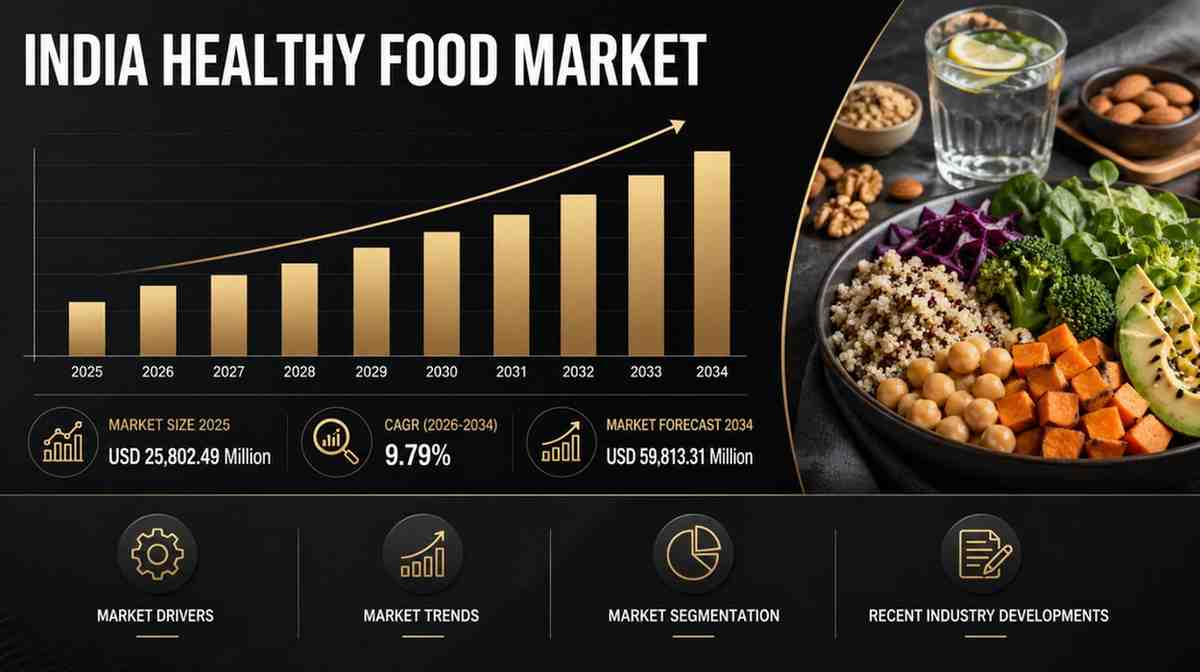
The India healthy food market size was valued at USD 25,802.49 Million in 2025 and is projected to reach USD 59,813.31 Million by 2034, growing at a compound annual growth rate of 9.79% from 2026-2034.
India’s healthy food market is experiencing a structural transformation, with valuation expanding from USD 25,802.49 million in 2025 to a projected USD 59,813.31 million by 2034 at a CAGR of 9.79%. This trajectory reflects critical shifts for corporate stakeholders:
- North India commands 33.8% market share, driven by concentrated urban populations, robust retail infrastructure, and elevated per-capita health expenditure in metropolitan corridors.
- Organic foods dominate product segmentation, validated by parallel growth in India’s organic food sector (USD 2,303.31 million in 2025, projected USD 11,296.09 million by 2034 at 19.32% CAGR).
- Supermarkets and hypermarkets control 36.7% distribution share, leveraging scale advantages in product assortment, quality verification systems, and consumer trust mechanisms.
- E-commerce infrastructure is accelerating penetration, with India’s online market expanding from USD 129.72 billion (2025) to USD 651.10 billion (2034) at 19.63% CAGR, fundamentally reshaping accessibility.
- Urbanization trajectory projects 600 million urban residents by 2036 (40% of population), with urban centers contributing nearly 70% of GDP—a structural demand catalyst.
The Strategic Market Challenge: Navigating the India Healthy Food Market
Supply chain integrity and certification authenticity represent critical operational vulnerabilities that corporate leaders consistently underestimate. The absence of standardized traceability protocols across organic certification bodies creates quality variance, eroding institutional buyer confidence and complicating enterprise procurement strategies. Inadequate cold chain infrastructure—particularly in tier-2 and tier-3 distribution networks—compromises product integrity during transit, resulting in inventory write-offs that directly impact margin structures. This systemic fragmentation forces vertical integration considerations and necessitates partnership models with agritech platforms implementing QR-code verification systems to ensure end-to-end transparency.
India’s Strategic Vision for the Healthy Food Market:
- Regulatory standardization through National Programme for Organic Production: January 2025 revisions aligned Indian organic standards with European Union grades, establishing transparent oversight mechanisms and facilitating international trade compliance—critical for export-oriented growth strategies.
- Agricultural transformation via Paramparagat Krishi Vikas Yojana: Government-backed organic farming expansion reduces input costs for certified growers, improving raw material supply economics and supporting backward integration opportunities for food processors.
- Certification infrastructure under Jaivik Bharat initiative: Scaling certification capacity for organic products addresses authentication challenges, reducing compliance friction for new market entrants and supporting brand differentiation strategies.
- Supply chain visibility mandates from December 2024 policy announcements: Union Home Minister Amit Shah’s launch of NCOL-Amul organic food distribution under the Bharat brand aims to integrate tribal farmer networks, introducing certified organic grains across markets within four years—expanding sourcing optionality for corporate buyers.
Why Invest in the India Healthy Food Market: Key Growth Drivers & ROI
- Preventive healthcare adoption is restructuring consumption patterns: Urban millennials and Gen Z demographics are prioritizing functional foods targeting immunity, digestive wellness, and metabolic health management. This demographic shift creates sustained demand for fortified products, translating lifestyle awareness into predictable revenue streams with premium pricing resilience across economic cycles.
- Digital commerce penetration unlocks underserved geographies: E-commerce growth at 19.63% CAGR is democratizing access beyond metro markets, with tier-2 and tier-3 cities demonstrating accelerated adoption rates. Direct-to-consumer channels reduce distribution friction, improve margin capture, and enable data-driven personalization—strategic advantages that justify digital infrastructure investments.
- Organized retail expansion drives visibility and trial conversion: Supermarket proliferation in urban clusters provides controlled merchandising environments, sampling opportunities, and point-of-purchase education that accelerate brand adoption. In-store health food sections with dedicated shelf space create category legitimacy, lowering consumer acquisition costs for established players.
- Income growth trajectory supports premiumization: Rising disposable incomes, particularly in northern and western urban clusters, are reducing price elasticity for health-positioned products. Willingness to pay premium prices (15-30% above conventional alternatives) among metropolitan consumers validates margin-accretive product innovation and justifies R&D allocation toward functional ingredient development.
India Healthy Food Market Trends & Future Outlook:
- Functional nutrition targeting specific wellness outcomes (immunity support, gut microbiome health, cardiovascular markers) is fragmenting the market into specialized subsegments with distinct buyer personas and consumption occasions.
- Clean-label transparency and non-GMO positioning are becoming table-stakes requirements in tier-1 markets, with ingredient scrutiny extending beyond organic certification to include sourcing ethics and processing methods.
- Technology-enabled traceability systems (blockchain integration, QR-code verification) are emerging as competitive differentiators, particularly for institutional buyers requiring supply chain audit trails and ESG compliance documentation.
- Strategic M&A activity consolidating market leadership: Tata Consumer Products’ January 2024 acquisition of Organic India exemplifies vertical integration strategies leveraging distribution synergies and premiumization capabilities across domestic and export channels.
- Personalized nutrition platforms utilizing AI-driven recommendations are creating direct consumer relationships, bypassing traditional retail gatekeepers and enabling subscription-based revenue models with superior lifetime value economics.
Regulatory Landscape & Policy Catalysts in India:
- Food Safety and Standards Authority of India (FSSAI) is intensifying labeling enforcement, requiring precise nutritional information disclosure and health claim substantiation. This regulatory tightening raises compliance costs but establishes quality floors that protect incumbents from low-cost, low-quality competition.
- Revised organic certification standards (January 2025) under the National Programme for Organic Production harmonize domestic frameworks with EU equivalency, eliminating export market friction for certified producers and expanding addressable international demand.
- Production-Linked Incentive (PLI) schemes for food processing industries are incentivizing capacity expansion in health-focused categories, with capital subsidies reducing fixed-cost barriers for greenfield investments in fortification and functional food manufacturing.
- Jaivik Bharat certification initiative is scaling authentication infrastructure, processing thousands of organic product certifications and reducing approval timelines—critical for fast-moving consumer goods companies requiring rapid SKU launches.
- December 2024 tribal farmer integration policy establishes direct procurement channels for organic grains under NCOL-Amul partnership, introducing government-backed supply stability and pricing transparency for institutional buyers managing commodity cost volatility.
- State-level agricultural reforms supporting organic farming transitions provide input subsidies and technical assistance, improving raw material availability and reducing procurement costs for companies with backward integration strategies.
Market Segmentation Breakdown and Share Analysis:
Analysis by Product Type:
- Naturally Healthy Foods
- Functional Foods
- Better-for-You (BFY) Foods
- Organic Foods
- Others
Organic foods represent the largest segment in 2025, driven by rising awareness of chemical-free products and increasing preference for sustainably sourced food among urban consumers.
Analysis by Distribution Channel:
- Supermarkets and Hypermarkets
- Convenience Stores
- Specialty Stores
- Online Retail/E-Commerce
- Others
Supermarkets and hypermarkets lead with a 36.7% market share in 2025, supported by wide product availability, easy comparison, and growing demand for convenient one-stop shopping experiences.
Regional Insights:
- North India
- South India (Major hub for organic and plant-based startups)
- West India
- East India
North India holds a 33.8% share in 2025, driven by higher disposable incomes, strong retail infrastructure, and dense urban populations in key metropolitan regions such as Delhi-NCR.
By the IMARC Group, the Top Competitive Landscape & their Positioning:
Covering an in-depth analysis of the competitive landscape, market structure, key player positioning, competitive dashboards, top winning strategies, and detailed profiles of all major industry participants you will gain access to all these exclusive insights within the full research report.
Note: If you need specific information that is not currently within the scope of the report, we can provide it to you as a part of the customization.
Frequently Asked Questions (FAQs):
Q1: What is the current value and projected growth of the India Healthy Food Market?
According to IMARC Group, the India healthy food market was valued at USD 25,802.49 million in 2025 and is projected to reach USD 59,813.31 million by 2034, expanding at a compound annual growth rate of 9.79% from 2026-2034. This growth trajectory reflects fundamental shifts in consumer health priorities, urbanization patterns, and disposable income expansion across India’s demographic pyramid.
Q2: Which product segment leads the India healthy food market?
Organic foods represent the dominant product segment in 2025, driven by heightened consumer awareness regarding pesticide residues and chemical additives. The organic food subsector alone is growing at 19.32% CAGR (from USD 2,303.31 million in 2025 to USD 11,296.09 million by 2034), significantly outpacing overall market expansion and signaling sustained premiumization opportunities.
Q3: Which distribution channel holds the largest market share?
Supermarkets and hypermarkets command 36.7% distribution share in 2025, benefiting from comprehensive product assortments, quality verification systems, and consumer preference for physical inspection before purchase. These organized retail formats provide controlled merchandising environments that facilitate brand discovery and trial conversion—particularly important for premium-positioned healthy food products.
Q4: What are the primary growth drivers for investors?
Key investment catalysts include structural urbanization (600 million urban residents projected by 2036 contributing 70% of GDP), preventive healthcare adoption among younger demographics, e-commerce infrastructure expansion (19.63% CAGR), and regulatory support through organic certification reforms. These macro trends create sustained demand visibility with limited cyclicality compared to discretionary consumer categories.
Q5: Which region demonstrates the strongest market penetration?
North India accounts for 33.8% of market share in 2025, attributable to concentrated disposable income in Delhi-NCR metropolitan region, established cold chain infrastructure, and density of organized retail formats. This geographic concentration enables efficient market entry strategies with focused distribution investments before expanding to tier-2 cities in other regions.
Strategic Insight & Verdict
From our analytical vantage point, we at IMARC Group have observed that India’s healthy food market presents compelling risk-adjusted returns for strategically positioned investors. The convergence of regulatory standardization (January 2025 organic certification reforms), digital commerce acceleration (19.63% CAGR e-commerce growth), and structural urbanization (70% urban GDP contribution by 2036) creates a multi-decade runway supported by irreversible demographic shifts. Corporate investors should prioritize vertical integration strategies securing organic supply chains, digital-first brand architectures capturing direct consumer relationships, and product innovation emphasizing functional nutrition with clinical validation—these positioning choices will differentiate market leaders from commoditized followers as the sector matures toward USD 60 billion valuation by 2034.
Tarang, Digital Insights Specialist at IMARC Group: https://www.linkedin.com/in/tarang-chauhan-31a82b265/
Verified Data Source: IMARC Group
Contact Us:
IMARC Group
134 N 4th St. Brooklyn, NY 11249, USA
Email: [email protected]
Tel No:(D) +91 120 433 0800
United States: +1-202071-6302