India FMCG Market Outlook
The India FMCG market is experiencing robust expansion driven by rising disposable incomes, rapid urbanization, and evolving consumer lifestyles seeking convenience-oriented products. The sector benefits from strong retail infrastructure development, accelerating digital transformation, and increasing brand consciousness across demographics.
Government initiatives — including Production-Linked Incentive (PLI) schemes for food processing, rural electrification programs, and digital infrastructure development — are deepening market accessibility across urban, semi-urban, and rural cohorts, collectively positioning FMCG as one of the most dynamic consumer-driven sectors in the Indian economy.
Market Snapshot
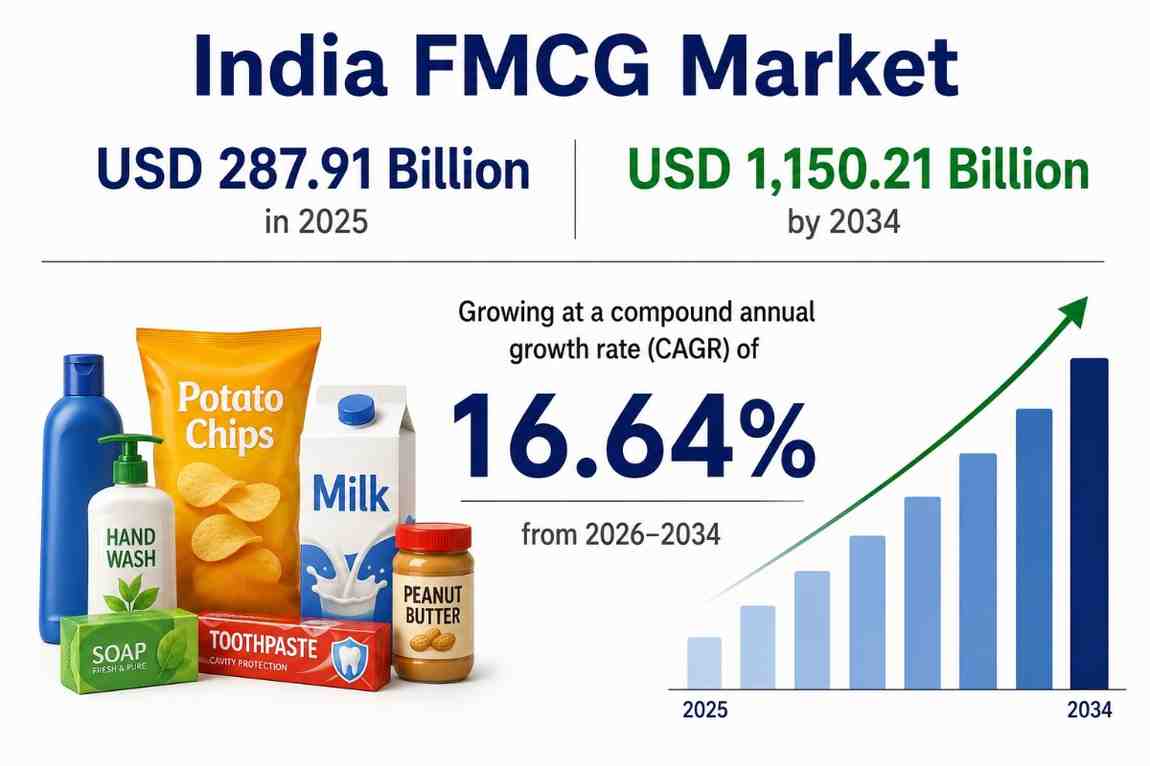
- Market Size (2025): USD 287.91 Billion
- Forecast Market Size (2034): USD 1,150.21 Billion
- CAGR (2026–2034): 16.64%
- Leading Product Type: Personal Care & Cosmetics — 48% share
- Leading Demographic: Urban — 63% share
- Leading Sales Channel: Offline — 76% share
- Leading State: Maharashtra — 12% share
- Key Drivers: Rising incomes, digital transformation, PLI schemes, rural growth
Executive Summary
India’s FMCG market is projected to grow from USD 287.91 Billion in 2025 to USD 1,150.21 Billion by 2034 at a CAGR of 16.64%, representing one of the world’s largest consumer-goods growth opportunities. The market represents a highly competitive landscape with multinational corporations and domestic giants vying for market share through product innovation, strategic acquisitions, and digital transformation. Personal care and cosmetics dominate at 48% share, supported by grooming awareness, premiumization, and the rapid rise of D2C beauty brands.
Urban markets account for 63% of total demand, although rural cohorts are emerging as the fastest-growing engine, with average basket sizes rising as connectivity and agricultural incomes improve. The sector witnessed notable consolidation activity — Hindustan Unilever’s acquisition of Minimalist demonstrates strategic moves by legacy players to capture digital-first consumer segments. Quick commerce platforms are now a dominant share of e-grocery orders in metros, fundamentally reshaping last-mile distribution economics.
Evaluate Market Opportunity with the Business Sample Report
Key Market Drivers
- Rising Disposable Incomes and Expanding Middle Class: India’s sustained economic growth has elevated per capita income, enabling greater consumer spending on quality FMCG products. The expanding middle class — now among the world’s largest by population — is reshaping consumption patterns with growing preferences for branded, premium, and convenience-oriented products across all FMCG categories.
- Digital Transformation and E-Commerce Expansion: Internet users are projected to exceed 900 million, with rural areas accounting for the majority of new digital adopters. E-commerce platforms have democratized product access, enabling consumers in smaller towns to access diverse FMCG portfolios. Quick commerce has revolutionized fulfillment expectations, with platforms delivering within minutes in urban areas.
- Government Initiatives and Policy Support: The PLI scheme for food processing has attracted substantial investments while creating employment across the value chain. Rural electrification programs have expanded refrigeration and storage capabilities, enabling distribution of temperature-sensitive products to previously inaccessible markets. GST implementation has streamlined interstate commerce and improved supply chain efficiency.
- Premiumization and Health-Conscious Consumption: Indian consumers are increasingly gravitating toward premium and wellness-oriented products, demonstrating willingness to pay higher prices for superior quality, functional ingredients, organic formulations, and clean-label certifications — particularly in personal care and packaged food categories.
Emerging Trends
- Quick Commerce Revolution and AI Integration: Quick commerce platforms offering ultra-fast delivery within minutes have captured a dominant portion of e-grocery orders in metro cities. This is prompting FMCG manufacturers to recalibrate distribution strategies, with quick commerce applications now representing significant revenue contributors for leading firms. AI technologies powered approximately half of new FMCG product launches in recent periods while influencing pricing decisions across majority of market segments.
- Rural Premiumization: Rural India overtook cities in affordable premium FMCG consumption in 2025, demonstrating the geographic expansion of premiumization beyond traditional metropolitan concentrations into emerging semi-urban and prosperous rural markets. Rising agricultural incomes and digital access are creating powerful new consumer cohorts.
- Strategic M&A and D2C Acquisitions: Strategic acquisitions are intensifying as legacy players seek to capture digital-first consumer segments. Emami Limited acquired 100% of The Man Company (Helios Lifestyle) in August 2024. Such M&A signals a structural shift toward building D2C capabilities within established FMCG portfolios.
- Technology-Driven Go-to-Market Platforms: Tata Consumer Products launched MAVIC — an AI-powered Go-to-Market (GTM) platform — in partnership with Salesforce in October 2024, demonstrating how leading FMCG companies are embedding AI across sales, distribution, and demand forecasting functions to gain competitive advantage.
Market Challenges
Despite strong momentum, the India FMCG market faces several structural headwinds:
- Escalating raw material costs — palm oil, packaging materials, and agricultural commodities — are pressuring manufacturer margins, while currency volatility amplifies costs for companies dependent on imported inputs
- India’s diverse geography and fragmented retail landscape present significant distribution challenges; logistics inefficiencies in rural areas increase operational costs while cold chain infrastructure gaps constrain temperature-sensitive product distribution
- Intense competition among multinationals, domestic giants, regional players, and emerging digital-native D2C startups limits pricing flexibility and compresses profitability, particularly in the mass-market segment
- Quick commerce disruption is intensifying pressure on traditional distributors and kirana stores, requiring rapid adaptation to evolving channel dynamics and changing fulfillment economics
Segment Insights
By Product Type
- Personal Care and Cosmetics — 48% (Body Care, Hair Care, Oral Care, Skin Care, Baby Care)
- Food and Beverages (Juices & Drinks, Tea & Coffee, Fresh Food, Others)
- Health Care (Feminine Care, Over-the-Counter, Others)
- Home Care (Cleaning Products, Fragrance, Others)
- Others
By Demographics
- Urban — 63% (Higher purchasing power, modern retail access, digital engagement)
- Rural — 37% (Fastest-growing cohort; rising agricultural incomes; improving digital connectivity)
By Sales Channel
- Offline — 76% (Kirana stores, supermarkets, hypermarkets, organized retail)
- Online — 24% (E-commerce platforms, quick commerce, D2C channels; fastest-growing segment)
Top Regional Markets (2025)
- Maharashtra
- Tamil Nadu
- Uttar Pradesh
- Gujarat
- Karnataka
- West Bengal
- Rajasthan
- Andhra Pradesh
- Telangana
- Madhya Pradesh
- Delhi NCR
- Punjab
- Haryana
- Others
Maharashtra dominates with a market share of 12% of the total India FMCG market in 2025.
Government Initiatives Supporting the Market
- Production-Linked Incentive (PLI) Scheme for Food Processing — substantial budget outlay incentivizing capacity expansion, technology adoption, and value addition across the food processing value chain
- GST Implementation — streamlining interstate commerce, reducing logistics complexity, and improving supply chain efficiency, benefiting FMCG distribution across the country
- Rural Electrification Programs — expanding refrigeration and storage capabilities, enabling distribution of temperature-sensitive products to previously inaccessible rural markets
- Digital India Initiative — expanding internet and mobile connectivity to underserved populations, enabling digital commerce access and direct FMCG purchasing in rural areas
- Make in India — attracting investments in domestic FMCG manufacturing and reducing import dependence for key product categories across food, personal care, and home care
Competitive Landscape
The India FMCG market exhibits a highly competitive landscape characterized by multinational corporations, established domestic giants, and emerging digital-native brands. Market leaders leverage extensive distribution networks, strong brand equity, and substantial marketing investments. Key companies include:
- AB InBev India (Anheuser-Busch InBev SA/NV)
- Amul
- Asian Paints Ltd
- Britannia Industries Limited
- Coca-Cola India (The Coca-Cola Company)
- Colgate Palmolive (India) Ltd (Colgate-Palmolive Company)
- Dabur Ltd
- Godrej Consumer Products Limited
- Hindustan Unilever Limited (Unilever Plc)
- ITC Limited
- Marico Limited
- Nestlé India Limited (Nestlé S.A.)
- Patanjali Ayurved Limited
- PepsiCo (India) Holdings Pvt. Ltd. (PepsiCo Inc.)
- Procter & Gamble Hygiene and Health Care Limited (The Procter &Gamble Company)
Investment Opportunities
- High-Growth Segments: Personal care premium variants, functional foods, and organic/clean-label formulations are growing faster than mass-market equivalents and command significant pricing premiums, creating high-margin opportunities for manufacturers and investors.
- Geographic Expansion: Tier-2/3 cities and rural India represent the fastest-growing consumer cohort, with multi-decade demand expansion as agricultural incomes rise, digital access broadens, and brand awareness grows across underserved markets.
- Venture & Strategic Investment: D2C beauty, wellness, and specialty food brands attracting substantial PE/VC capital. AI-driven supply chain optimization, predictive demand planning, and quick commerce infrastructure partnerships represent high-return strategic investment themes.
Discuss Your Requirements With an Analyst and Get Your Customized Market Report
Recent Developments
- October 2024 — Tata Consumer Products Limited and Salesforce announced a strategic partnership, launching MAVIC, an AI-powered Go-to-Market platform aimed at significantly accelerating and improving TCPL sales and distribution processes
- August 2024 — Emami Limited signed a binding agreement to acquire 100% of Helios Lifestyle Pvt Ltd (The Man Company) by purchasing the remaining 49.60% stake, making it a wholly-owned subsidiary
- By April 2025 — Household FMCG spending increased by 8% to ₹17,792 Crore (USD 2.07 Billion), with strong contributions from both staples and non-staples (per IBEF data)
- Hindustan Unilever’s acquisition of Minimalist demonstrates legacy players’ growing commitment to capturing digital-first consumer segments, signaling ongoing M&A consolidation in the premium skincare and D2C beauty space
Frequently Asked Questions (FAQ)
- What is the size of the India FMCG market in 2025?
The India FMCG market was valued at USD 287.91 Billion in 2025.
- What is the CAGR of the India FMCG market?
The market is expected to grow at a CAGR of 16.64% during 2026–2034, supported by digital transformation, premiumization, rural consumption expansion, and favorable government policies.
- Which product segment leads the India FMCG market?
Personal Care and Cosmetics leads with a 48% share in 2025, driven by rising grooming awareness, premiumization, and the rapid growth of D2C beauty brands.
- Which distribution channel dominates?
Offline channels — kirana stores, supermarkets, and hypermarkets — dominate with 76% share, although online channels including quick commerce are growing at materially faster rates.
- Who are the top FMCG companies in India?
Key players include Hindustan Unilever, ITC, Nestlé India, Britannia, Dabur, Marico, Godrej Consumer Products, Patanjali, Amul, Coca-Cola India, PepsiCo India, P&G, Colgate-Palmolive, Asian Paints, and AB InBev India.
Conclusion
India’s FMCG market is poised for one of the largest consumer-goods expansions globally over the next decade, underpinned by demographic tailwinds, digital infrastructure maturity, and aggressive policy support. Quick commerce, AI integration, and rural premiumization are reshaping competitive dynamics, while strategic M&A activity is consolidating digital-first capabilities within legacy portfolios. Companies that invest in omnichannel distribution, AI-driven supply chains, sustainable formulation, and Tier-2/3 market reach will be best positioned to capture disproportionate value through 2034.