According to IMARC Group’s report titled “India Electric Scooter Market Size, Share, Trends and Forecast by Drive, Battery, Product, Battery Fitting, End Use, and Region, 2026-2034“, The report offers a comprehensive analysis of the industry, including market forecast, growth, share, and regional insights.
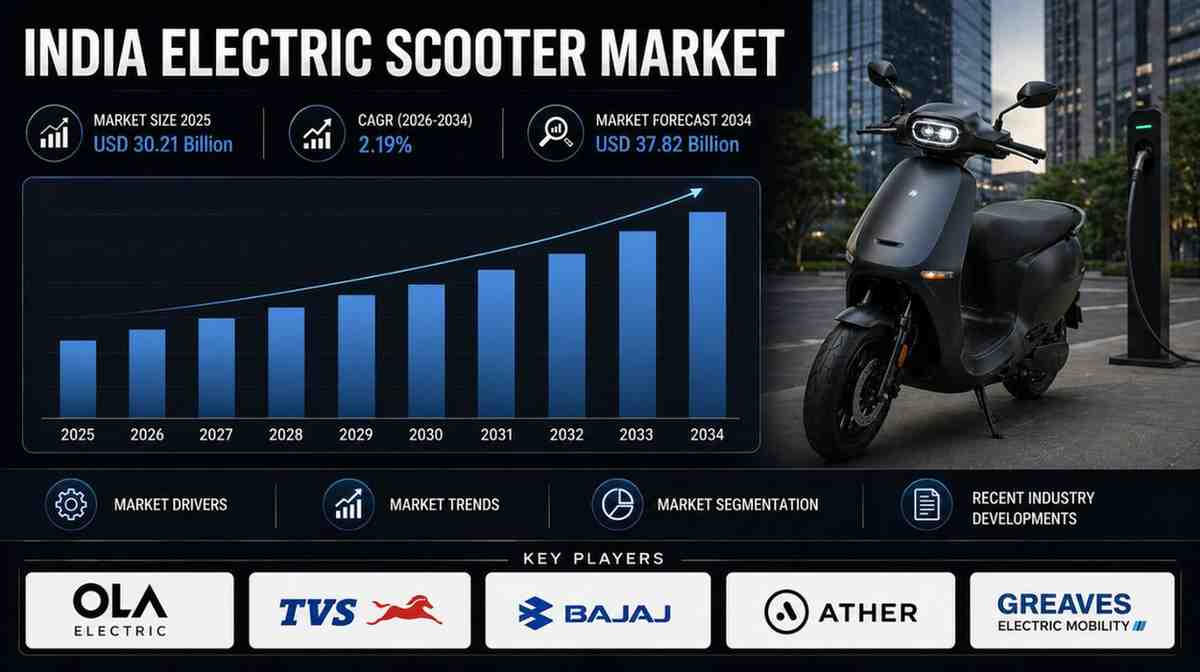
India’s electric scooter sector has moved well past the pilot phase it is now a commercially scaled, policy-backed market where consumer adoption, manufacturing investment, and infrastructure deployment are all accelerating in parallel. According to IMARC Group, the India electric scooter market was valued at USD 1.46 Billion in 2025 and is projected to reach USD 3.22 Billion by 2034, growing at a CAGR of 9.22% during 2026–2034.
For automotive investors, OEM strategists, and mobility infrastructure stakeholders, this trajectory presents several concrete and near-term opportunities:
- Hub motors dominate with 68% drive share in 2025, reflecting their cost-effectiveness, simplified drivetrain design, and seamless integration across mass-market and mid-range electric scooter models suited for urban commuting conditions.
- Lithium-ion batteries command an 85% share of the battery segment in 2025, supported by superior energy density, declining pack costs, and government subsidy eligibility requirements that mandate advanced battery technology adoption.
- Personal end use accounts for 83% of market demand in 2025, driven by individual commuters seeking fuel cost savings, lower maintenance overhead, and government purchase incentives that reduce total cost of ownership relative to petrol alternatives.
- In 2024, the Ministry of Heavy Industries launched the Electric Mobility Promotion Scheme (EMPS) 2024 with an initial outlay of ₹500 crore to incentivize electric two-wheelers and fund charging infrastructure development providing a direct, quantified policy catalyst for market expansion.
The Strategic Market Challenge: Navigating the India Electric Scooter Market in India
The most consequential and consistently underweighted structural challenge in India’s electric scooter market is the geographic concentration of charging infrastructure, which creates a two-tier adoption reality that constrains national market potential. Metropolitan cities receive the overwhelming majority of public charging investment, while tier-2 cities, rural corridors, and intercity routes remain critically underserved. This disparity generates persistent range anxiety among prospective buyers without access to home charging limiting electric scooter penetration precisely in the mid-income, geographically distributed consumer segments that represent the largest volume opportunity through 2034.
India’s Strategic Vision for the India Electric Scooter Market
India’s policy framework for electric two-wheelers is coordinated across demand-side incentives, supply-side manufacturing support, and infrastructure investment providing a multi-layered foundation for sustained market expansion.
- PM E-DRIVE Scheme (Ministry of Heavy Industries, 2024): The Ministry of Heavy Industries launched the PM E-DRIVE scheme in 2024 to accelerate electric mobility adoption, providing direct purchase incentives for electric two-wheelers and dedicated funding for charging infrastructure development. This scheme succeeded the earlier FAME frameworks and signals continued central government commitment to sustaining demand-side stimulus through the forecast period.
- Electric Mobility Promotion Scheme (EMPS) 2024: Launched with an initial outlay of ₹500 crore, EMPS 2024 directly incentivizes electric two-wheeler purchases while simultaneously strengthening the domestic manufacturing ecosystem through production-linked support mechanisms addressing both the demand shortfall and the supply-chain localization imperative in a single policy instrument.
- Production-Linked Incentive (PLI) Scheme for Automobiles and Auto Components: The PLI scheme for the automotive sector supports domestic manufacturing of electric vehicles and their critical components, including battery cells and power electronics. This encourages OEMs and component suppliers to invest in India-based EV manufacturing capacity, progressively reducing import dependence and supporting competitive domestic pricing.
Why Invest in the India Electric Scooter Market: Key Growth Drivers & ROI
- Government Purchase Incentives Compressing the ICE-to-EV Price Gap: Central and state-level subsidy programs, road tax exemptions, reduced registration fees, and GST concessions substantially lower the upfront purchase cost of electric scooters relative to petrol equivalents. Bajaj Auto’s January 2026 launch of the Chetak C25 at ₹91,399 its most affordable electric variant demonstrates how policy-supported economics are enabling manufacturers to target price-sensitive urban and emerging-market consumers who were previously outside the addressable range of organized EV brands.
- Persistent Fuel Cost Increases Strengthening the Long-Term TCO Case: Rising petrol prices create a compounding per-kilometer operating cost advantage for electric scooters that resonates with cost-sensitive buyers across income segments. Lower maintenance requirements fewer moving parts, reduced servicing frequency, and no engine oil changes further widen the total cost-of-ownership differential over the vehicle’s operational life. In September 2025, Ecofy Finance partnered with Motovolt Mobility to provide end-to-end EV financing for individual buyers, logistics operators, and fleet customers reducing the capital barrier that previously prevented cost-conscious buyers from converting intent into purchase.
- Lithium-Ion Battery Cost Reduction and Domestic Manufacturing Expansion: Continuous improvements in lithium iron phosphate and nickel manganese cobalt cell chemistry are delivering higher energy densities and longer operational lifespans at declining unit costs. In June 2024, Amara Raja Energy and Mobility signed a licensing agreement with Gotion to manufacture lithium-ion batteries in India using advanced LFP technology enabling domestic production that strengthens India’s EV battery supply chain and supports competitive pricing for manufacturers dependent on localized cell sourcing.
India Electric Scooter Market Trends & Future Outlook
- Affordable Entry-Level Models Accelerating Tier-2 and Tier-3 Penetration: The market is shifting strategically toward budget-friendly variants with simplified feature sets designed for price-sensitive consumers in emerging urban centers. Bajaj Auto’s Chetak C25, launched at ₹91,399 in January 2026, exemplifies how established OEMs are engineering cost-downward product architectures specifically to convert the next wave of semi-urban buyers who represent the largest untapped volume in the forecast period.
- Battery Swapping Gaining Commercial Traction in Delivery and Fleet Applications: Battery swapping is proving particularly viable in commercial and last-mile delivery segments where vehicle downtime directly reduces revenue. The SUN Mobility-IndianOil deployment of 10,000-plus swapping stations across 40 cities creates a nationwide infrastructure layer that enables fleet operators to maintain operational continuity without extended charging stops a critical operational requirement that plug-in models cannot currently meet at scale.
- Fixed Battery Design Maintaining Dominance at 76% Share: Fixed battery configurations retain their leadership due to structural rigidity, lower manufacturing complexity, optimized frame geometry, and compatibility with home charging the most common charging method for personal users. Ather Energy’s Rizta, featuring a fixed lithium-ion pack integrated into the chassis for improved structural strength and riding stability, illustrates how premium brands are refining fixed-battery architecture rather than pivoting to detachable alternatives.
Regulatory Landscape & Policy Catalysts in India
India’s automotive regulatory framework for electric two-wheelers spans purchase incentives, manufacturing support, safety standards, and infrastructure mandates each dimension reinforcing the commercial viability of the electric scooter sector.
- PM E-DRIVE Scheme (Ministry of Heavy Industries, 2024): According to the Ministry of Heavy Industries, the PM E-DRIVE scheme provides purchase incentives for electric two-wheelers and dedicated funding for public charging infrastructure. It represents the current phase of India’s sustained demand-side EV policy and directly supports consumer affordability across the mid-segment electric scooter category.
- Electric Mobility Promotion Scheme (EMPS) 2024 ₹500 Crore Outlay: EMPS 2024, launched by the Ministry of Heavy Industries with a ₹500 crore initial allocation, incentivizes electric two-wheeler purchases while simultaneously supporting domestic EV manufacturing ecosystem development. The scheme is designed to bridge the demand gap during the period between subsidy frameworks, ensuring continuity of consumer incentives and market momentum without policy discontinuity.
- PLI Scheme for Automobiles and Auto Components (Ministry of Heavy Industries): The production-linked incentive scheme for automobiles supports domestic manufacturing investment in electric vehicles and critical components including battery cells, motors, and power electronics. Manufacturers qualifying for PLI benefits gain a structural cost advantage over import-dependent competitors reinforcing the viability of India-based EV production at scale.
By the IMARC Group, the Top Competitive Landscape & their Positioning:
- Ola Electric Mobility Ltd.
- TVS Motor Company
- Bajaj Auto Ltd.
- Ather Energy
- Greaves Electric Mobility Limited
Covering an in-depth analysis of the competitive landscape, market structure, key player positioning, competitive dashboards, top winning strategies, and detailed profiles of all major industry participants you will gain access to all these exclusive insights within the full research report.
Market Segmentation Breakdown and Share Analysis:
Analysis by Drive:
- Hub Motors (42.8% market share dominate due to low cost, minimal maintenance, and suitability for urban commuters)
- Belt Drive (34.6% Market share serves the premium segment with better performance and brand appeal)
- Chain Drive (22.6% market share remains relevant in budget and rural markets due to easy repairability and low cost
Analysis by Battery:
- Lithium-Ion (leads at 86.5%, driven by FAME II subsidies, longer range, and falling prices)
- Lead Acid (10.8% survives in ultra-budget segments with limited range needs)
- Others (2.7%) include emerging technologies like sodium-ion and solid-state batteries)
Analysis by Product:
- Standard (Most popular for daily commuting)
- Folding
- Self-Balancing
- Maxi
- Three Wheeled
Analysis by Battery Fitting:
- Fixed (Common in high-speed scooters)
- Detachable (Gaining popularity for convenience and swapping)
Analysis by End Use:
- Personal (Dominant segment driven by individual commuters)
- Commercial (Last-mile delivery fleets)
Regional Insights:
- North India (26.4%) growth is policy-driven, especially in Delhi NCR.
- West India (22.1%) benefits from Maharashtra’s subsidies
- East India (19.0%) gains from existing electric mobility adoption trends.
- South India (32.5%) leads due to strong EV manufacturing clusters
Note: If you need specific information that is not currently within the scope of the report, we can provide it to you as a part of the customization.
Frequently Asked Questions (FAQs):
Q1: What is the current value and projected growth of the India Electric Scooter Market?
According to IMARC Group, the India electric scooter market was valued at USD 1.46 Billion in 2025 and is projected to reach USD 3.22 Billion by 2034, growing at a CAGR of 9.22% during 2026–2034. Growth is driven by favorable government purchase incentives, rising fuel costs, advancements in lithium-ion battery technology, expanding charging and swapping infrastructure, and increasing consumer preference for cost-effective electric urban mobility. The full report is available at https://www.imarcgroup.com/india-electric-scooters-market.
Q2: Which drive technology dominates the India electric scooter market, and why?
Hub motors lead with a 68% drive share in 2025. Their dominance reflects a combination of cost-effectiveness, compact integrated design that eliminates the need for separate transmission components, and low maintenance requirements all of which align with the economics of mass-market urban commuting.
Q3: Why do lithium-ion batteries account for such a high share of the market?
Lithium-ion batteries hold an 85% share in 2025 because they deliver the combination of energy density, weight efficiency, charging speed, and lifespan that electric scooter use cases require. Government subsidy frameworks mandate advanced battery technology for eligibility effectively setting lithium-ion as the compliance baseline.
Q4: What is driving the commercial segment’s growth, and what role does battery swapping play?
The commercial segment at 17% of end use (mirroring the 83% personal, 17% commercial split) is expanding primarily through last-mile delivery, logistics fleet operators, and shared mobility applications all of which require minimal vehicle downtime. Battery swapping directly addresses this need: the SUN Mobility-IndianOil deployment of 10,000-plus stations across 40 cities provides a practical operational model where vehicles can resume service within minutes of a battery exchange rather than waiting through multi-hour plug-in charging cycles.
Q5: What are the primary risks investors and OEMs should monitor in this market?
Three risks warrant active monitoring. First, charging infrastructure remains unevenly distributed metropolitan concentration limits rural and intercity addressability and creates adoption ceilings in geographies that represent substantial long-term volume. Second, the upfront price premium of electric scooters over comparable petrol models persists despite subsidies, particularly in lower-income segments where subsidy awareness and accessibility are inconsistent. Third, consumer uncertainty around after-sales service availability and battery degradation timelines affects resale value perceptions and purchase confidence outside established EV dealer networks constraining conversion rates among risk-averse, first-time EV buyers.
Strategic Insight & Verdict
Based on the segment data and policy trajectory, we at IMARC Group have observed that investors and manufacturers prioritizing localized battery manufacturing, dealer network depth in tier-2 cities, and Battery-as-a-Service commercial partnerships are best positioned to capture both the volume growth in the personal segment and the margin opportunities in the premium connected and commercial fleet categories through 2034.
Tarang, Digital Insights Specialist at IMARC Group: https://www.linkedin.com/in/tarang-chauhan-31a82b265/
Verified Data Source: IMARC Group