


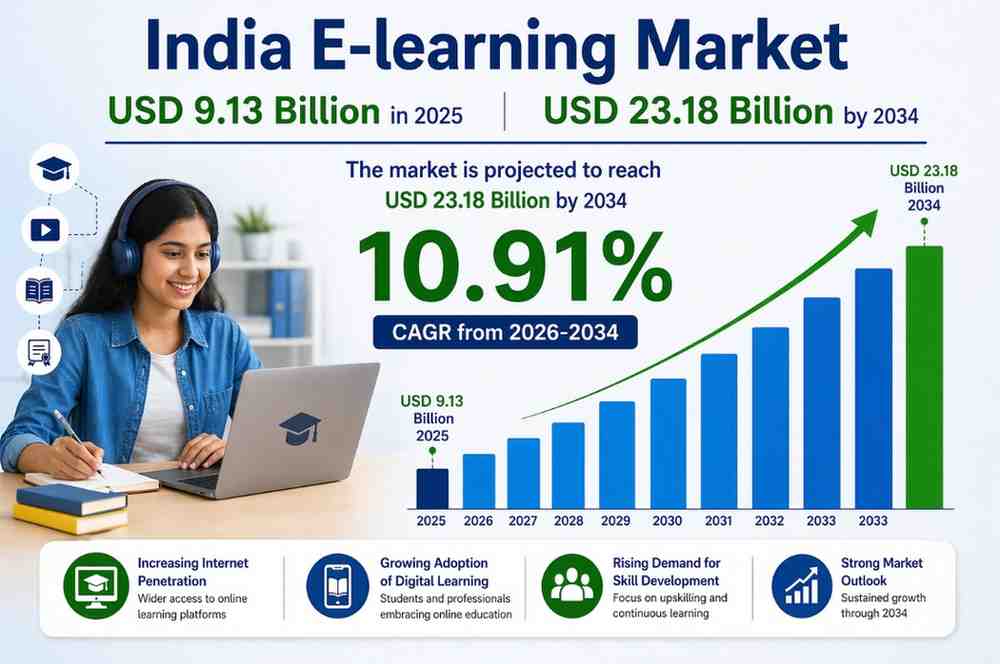
According to the latest research report titled “India E-Learning Market Size, Share, Trends and Forecast by Technology, Provider, Application, and Region, 2026-2034” the report offers a comprehensive analysis of the industry, including market share, growth, trends, and regional insights.
How India’s E-learning Market Performing?
The India e-learning market size was valued at USD 9.13 Billion in 2025 and is projected to reach USD 23.18 Billion by 2034, growing at a compound annual growth rate (CAGR) of 10.91% during the forecast period 2026-2034. The market’s rapid expansion is driven by digital infrastructure development, increased internet penetration, smartphone usage, and demand for flexible learning. Important drivers include government digital literacy initiatives, corporate training needs, and AI and gamification adoption in learning platforms.
What Growth Factors are Driving the India E-learning Market?
One of the greatest enablers of e-learning implementation in India is rapid digital infrastructure growth, a key driver highlighted in e-learning industry trends India 2026. As of December 2025, over 2.18 lakh gram panchayats have been given access to high-speed broadband connectivity. This shift has considerably reduced the urban-rural digital divide, resulting in a solid infrastructure for quality digital education for students who were previously not part of the formal online learning ecosystem, with the potential for sustained growth across all market segments.
With the increasing penetration of inexpensive smartphones and mobile internet packs in India‚ the mobile-first approach for learning solutions has gained momentum in tier-2 and tier-3 cities‚ where students can access learning material on their smartphones without needing to invest in expensive hardware or a fixed broadband connection for learning solutions․ This will considerably expand the addressable market for edtech platforms and create new growth corridors beyond the core metro-centric user community that currently exists․
Advancements in technology across industries have generated long-term demand for upskilling and reskilling of the workforce․ Corporates are investing more in online skilling programs across sectors like generative AI‚ data analytics‚ cloud computing‚ and cybersecurity where demand is growing rapidly․ With firms viewing continuous learning as a calculated rather than a discretionary investment‚ the enterprise e-learning segment of the market has become structurally larger‚ with platform and content providers benefiting from long-duration revenue visibility․
The centrality of government policy is evidenced by the fast-tracking of digital learning in India through platforms such as SWAYAM and SAMARTH‚ which are institutionalizing online courses within a national academic framework with a focus on access to university learning․ It is helpful that the government’s acceptance of internet-based learning into the mainstream‚ or its inaugural Online Education Day on October 25‚ 2025‚ signals an increasingly positive policy environment for the growth of e-learning‚ and thus provides further encouragement for the investment of public and private edtech companies in creating digital content and platforms․
The centrality of government policy is evidenced by the fast-tracking of digital learning in India through platforms such as SWAYAM and SAMARTH‚ which are institutionalizing online courses within a national academic framework with a focus on access to university learning․ It is helpful that the government’s acceptance of internet-based learning into the mainstream‚ or its inaugural Online Education Day on October 25‚ 2025‚ signals an increasingly positive policy environment for the growth of e-learning‚ and thus provides further encouragement for the investment of public and private edtech companies in creating digital content and platforms․
What are the Latest Emerging Trends in the India E-learning Market?
In India’s fast growing e-learning market‚ AI is likely to considerably impact learner experience․ E-learning platforms are now deploying AI capabilities to adapt the learning content‚ pace and assessments in real-time based on learner profiles․ By providing real-time feedback and customized learning pathways‚ AI-powered recommendation systems can strengthen learning outcomes․ For instance‚ in January 2026‚ Google launched AI-powered JEE Main practice tests on its Gemini platform in India for students preparing to take competitive examinations utilizing adaptive learning technologies․ As AI capabilities continue to grow‚ hyper-personalization will shift from being a unique offering to an industry-wide standard in the future․
Developing knowledge content in vernacular languages (Hindi‚ Tamil‚ Telugu‚ Bengali) opens the opportunity to address the untapped segment of learners in tier 2 and tier 3 cities․ IGNOU programs‚ IIT Bombay’s Project Udaan are examples of large scale content development in vernacular languages‚ through which more learners are benefitting from high-quality culturally sensitive relevant content․ This trend will rapidly increase the audience for edtech platforms meant to be used by students outside of the bigger metro areas‚ since the language barrier has historically been an issue․
Due to the proliferation of low-cost smartphones‚ which serve as the primary computer for most of the Indian population‚ mobile-first has become the primary architectural strategy for success․ Offline content and bite-sized learning are becoming table stakes rather than differentiators for e-learning platforms․ The trajectory of edtech unicorn PhysicsWallah‚ whose mobile-first learning app gained millions before an anticipated 2025 initial public offering (IPO)‚ illustrates the reach of such platforms designed around India’s varied learner needs and behaviors․
Gamification and virtual classroom experiences along with outcome-based curriculum are changing the way digital learning is perceived in India․ Such gamification features as leaderboards‚ badges‚ assessment through simulation and peer learning tools are gradually growing in appeal among the service providers as a means of increasing student engagement over a longer duration․ The rise of outcome-based learning‚ which stresses mastery of skills rather than course completion‚ is improving platform retention rates and making online credentials more valuable in the eyes of employers‚ improving the viability of online education․
Evaluate Market Potential Before You Invest – Get the Report Sample
What Opportunities Lie Ahead for the India E-learning Market in the Coming Years?
With the growth in internet infrastructure‚ a young‚ aspirational population base and rising corporate spend on reskilling and upskilling employees‚ the India e-learning opportunity is well set to grow in the coming years․ Further expansion in high-speed internet coverage into tier II/III․ cities and rural areas and falling smartphone prices will bring hundreds of millions of new learners into the e-learning fold‚ creating opportunities for volume-led play across pricing and content segments․
Within future opportunities‚ large-scale adoption of AI‚ AR‚ and advanced analytics in learning platforms can create engaging and measurable learning experiences․ Other opportunities include the demand for industry-recognized certifications‚ credit-bearing online degrees‚ and employer-mapped curriculum design and delivery for enterprises‚ especially in the premium learning offerings segment‚ where monetization opportunities are expected to grow․ Edtech companies embracing vernacular‚ mobile-first strategies‚ strong institutional product-market fit‚ and measuring success in terms of student learning outcomes and job placement will capture disproportionate value as the digital education opportunity in India matures towards its long-run potential․
India E-learning Market Segmentation
Technology
Provider
Application
Regional Insights
North India exhibits clear dominance with a 30% market share in 2025. This region benefits from a substantial student base, premier educational institutions, strong digital infrastructure, and government support, contributing to its leadership in the India e-learning market, which grows at a CAGR of 10.91%.
India E-learning Market Key Players
The report offers an in-depth examination of the competitive landscape, including market structure, key player positioning, leading strategies for success, a competitive dashboard, and a company evaluation quadrant.
India E-learning Market Recent Developments & News
India E-learning Market Key Highlights of the Report
About Us
IMARC Group is a global management consulting firm that helps ambitious changemakers create a lasting impact. The company offers comprehensive market assessment, feasibility studies, incorporation support, regulatory assistance, branding and strategy services, and procurement research.
Contact Us
IMARC Group
134 N 4th St. Brooklyn, NY 11249, USA
Email: [email protected]
Tel: (D) +91 120 433 0800
United States: +1-201971-6302

© 2025 Crivva - Hosted by Airy Hosting Managed Website Hosting.