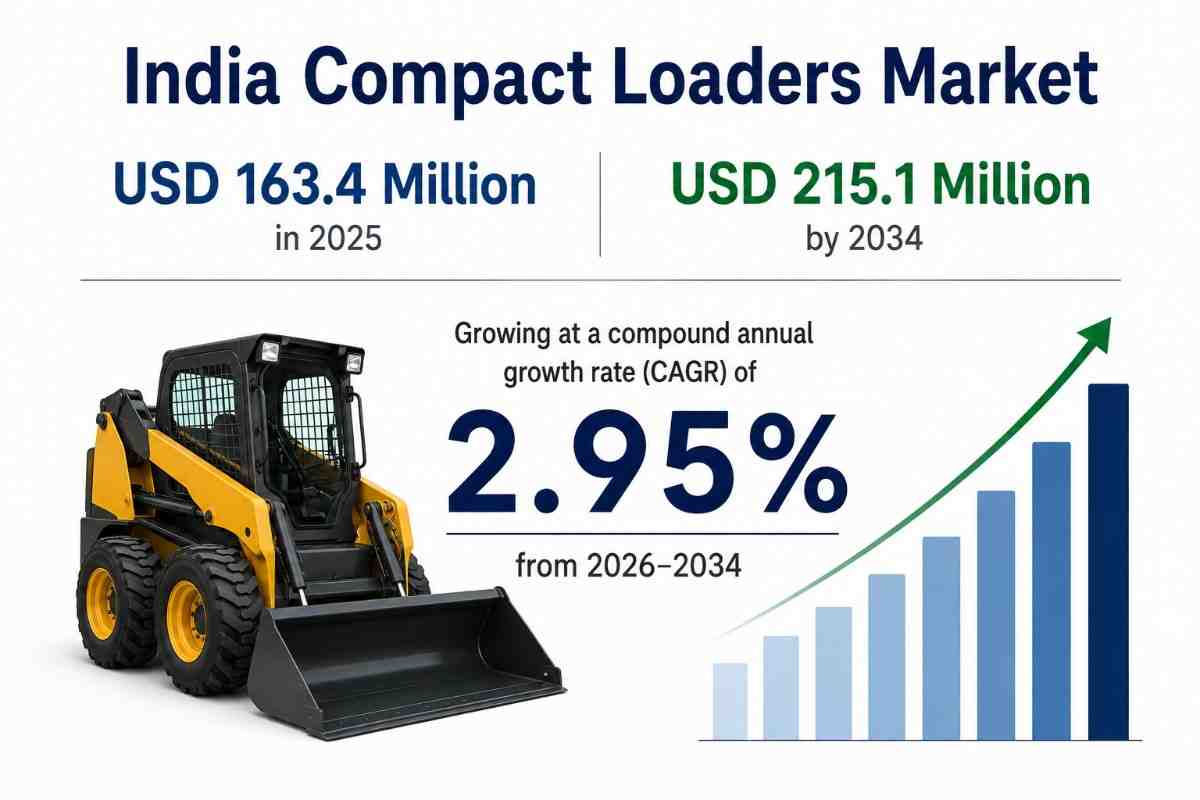
India Compact Loaders Market Outlook
The market is experiencing robust expansion driven by accelerating infrastructure development, rapid urbanization, and growing construction activities across residential, commercial, and industrial sectors. The versatility of compact loaders in performing multiple tasks including excavation, material handling, and site preparation makes them indispensable in modern construction operations.
As India pursues its ambitious infrastructure modernization agenda, the compact loaders market in India is positioned for sustained growth, with rising agricultural mechanization and industrial modernization initiatives further propelling demand across diverse end-use applications. The expanding compact loaders market share in India is further supported by increasing adoption across construction, farming, and material handling applications.
Market Snapshot
Key Market Drivers
The PM Gati Shakti National Master Plan, integrating multimodal connectivity across sixteen ministries with substantial planned investments, is generating robust and sustained demand for versatile compact loading equipment across highway, railway, and urban infrastructure construction sites. The coordinated infrastructure approach provides exceptional demand visibility across the entire forecast period, distinguishing it from historically cyclical policy-driven demand spikes.
By encompassing an extraordinarily broad range of project categories — from national logistics parks and freight corridors to last-mile rural road connectivity — the initiative ensures that compact loader demand remains geographically and sectorally diversified. For manufacturers and distributors, this multi-year forward visibility is encouraging meaningful fleet expansion among contractors and strategic production capacity planning among OEMs, reinforcing market stability.
India’s rapidly expanding urban population is driving intensive residential and commercial construction activity, creating consistent and growing demand for compact loaders capable of operating efficiently within the severely space-constrained environments typical of urban construction projects. Construction segment dominance at 54.3% reflects the primacy of this demand driver and underscores how deeply urbanization trends are reshaping equipment procurement preferences.
As vertical construction proliferates and developable site footprints shrink across high-density tier-one and tier-two cities, the operational versatility and maneuverability of compact loaders in confined job-site conditions is becoming an increasingly decisive factor for developers and civil contractors when selecting loading equipment over larger conventional alternatives.
Government-supported agricultural mechanization programs provide subsidies that actively encourage equipment adoption in farming applications, expanding compact loader demand well beyond traditional construction into agri-related material handling, farm earthwork, and rural infrastructure projects. This application diversification meaningfully strengthens market resilience across economic cycles, insulating overall demand from the boom-bust patterns that have historically characterized purely construction-dependent equipment segments.
As rural incomes gradually rise and awareness of the productivity benefits of mechanization deepens among farming communities, the agricultural demand channel is positioned to become a structurally significant and self-sustaining contributor to overall market growth across the forecast horizon.
The rental and leasing segment is experiencing substantial and accelerating growth as contractors across scales increasingly prefer flexible equipment access over outright ownership, particularly for project-specific and time-bound requirements. This democratization of modern compact loader access for small and medium enterprises — previously constrained by prohibitive capital costs, financing challenges, and ownership-related maintenance obligations — is meaningfully expanding the total addressable market.
Rental companies, incentivized by strong fleet utilization rates and a rapidly growing contractor customer base, are actively scaling their compact loader inventories, creating a compounding secondary demand layer that amplifies organic end-user growth and broadens the market’s overall commercial foundation.
Evaluate Market Opportunity with the Business Sample Report
Emerging Trends
The mandatory transition to CEV Stage V emission norms is compelling manufacturers to accelerate the development of cleaner, more fuel-efficient equipment architectures suited to India’s demanding operational environments. This sustainability imperative is driving significant investment in next-generation engine technologies, with manufacturers achieving measurable improvements in fuel efficiency and emissions performance while fully preserving the torque output and operational reliability essential for heavy-duty construction applications.
Importantly, these efficiency gains are increasingly being recognized by fleet operators for their direct commercial value — reducing fuel expenditure across large equipment inventories — making Stage V-compliant machines compelling on total cost of ownership grounds, not merely as a regulatory compliance exercise.
The emergence of electric and hybrid compact loaders is presenting substantial long-term opportunities for forward-looking manufacturers as environmental sustainability becomes an increasingly prioritized consideration across both public and private infrastructure development projects. India’s Ministry of Road Transport and Highways proposed comprehensive new safety standards specifically for electric-powered construction equipment in October 2024, signaling meaningful maturation of the regulatory framework governing clean energy machinery.
While large-scale commercial deployment remains in early developmental stages, manufacturers investing strategically in electric compact loader platforms today are establishing competitive positioning for what is broadly anticipated to evolve into a significant and high-growth market segment as battery technology costs continue declining and charging infrastructure expands across urban and peri-urban construction zones.
Fleet operators are increasingly demanding telematics-equipped compact loaders that deliver real-time machine health monitoring, geofencing capabilities, fuel consumption analytics, utilization tracking, and predictive maintenance alerts directly to fleet managers. These integrated digital capabilities substantially improve fleet-wide productivity, reduce costly unplanned equipment downtime, and enable data-driven maintenance scheduling that lowers total operating costs.
For rental companies managing large mixed-equipment fleets across geographically dispersed job sites, the operational intelligence provided by connected compact loaders directly enhances asset utilization rates and fleet profitability, creating compelling and readily quantifiable return-on-investment justification that is rapidly elevating telematics from a premium differentiator to a baseline procurement expectation.
International equipment manufacturers are strategically expanding India-specific production capacity in direct response to the country’s accelerating demand growth and favorable manufacturing policy environment. Prominent players including SDLG inaugurated a new dedicated Bengaluru manufacturing facility in April 2024 to produce wheel loaders locally, exemplifying the broader localization trend reshaping competitive dynamics across the segment.
Domestic production meaningfully reduces landed equipment costs by eliminating import duties and logistics expenses, while simultaneously improving spare parts availability and enabling far more responsive after-sales support networks across the country. Local manufacturing also empowers international OEMs to customize product specifications, duty cycles, and ergonomic configurations specifically for India’s unique application requirements and regulatory conditions, strengthening their long-term competitive positioning against both established domestic players and emerging rivals.
Market Challenges
Despite positive market fundamentals, the India compact loaders market faces persistent structural and operational headwinds.
Segment Insights
Application Insights:
Construction dominates with a market share of 54.3% of the total India compact loaders market in 2025.
Product Type Insights:
Backhoe loaders lead with a share of 38.6% of the total India compact loaders market in 2025.
Regional Insights:
West India exhibits a clear dominance with a 34.1% share of the total India compact loaders market in 2025.
Competitive Landscape
The report offers an in-depth examination of the competitive landscape, including market structure, key player positioning, leading strategies for success, a competitive dashboard, and a company evaluation quadrant.
Conclusion
The India compact loaders market presents a steady, infrastructure-anchored growth opportunity for equipment manufacturers, dealers, and rental fleet operators. Sustained government infrastructure investments, agricultural mechanization programs, and the democratizing effect of rental market expansion are creating durable demand foundations for compact loader adoption across India’s diverse construction and material handling applications.
Organizations investing in emission-compliant product development, flexible financing and rental solutions, and expanded dealer networks in emerging markets will be best positioned to capture sustainable competitive advantages as India’s compact loader market matures through 2034.
Source: IMARC Group

© 2025 Crivva - Hosted by Airy Hosting Managed Website Hosting.