


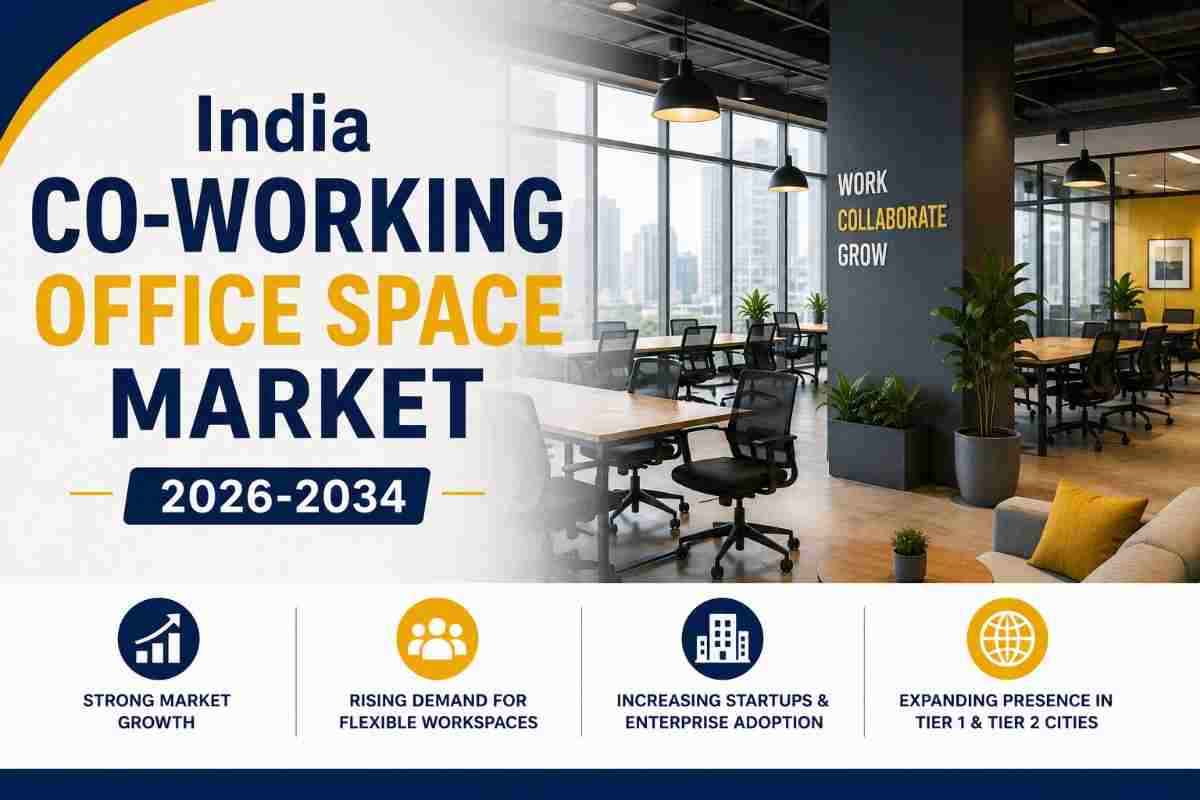
How Is the India Co-Working Office Space Market Performing?
The co working space market size India is undergoing a steady expansion, driven by rising demand for flexible workspaces, cost-efficiency for startups, hybrid work adoption, increased focus on employee well-being, expansion of tech hubs beyond metros, corporate demand for managed offices, a growing freelancer and SME base, real estate optimization by enterprises, short-term lease preferences, and continued infrastructure development.
Utilities, enterprises, and individual professionals are increasingly turning to flexible managed offices and serviced spaces as an alternative to long-term leases, supported by improving digital infrastructure, technology integration, and a wave of new center launches across metro and Tier-2 cities. The market was valued at USD 307.5 Million in 2025 and is projected to reach USD 890.5 Million by 2034, growing at a CAGR of 12.16% during 2026-2034.
Growth is being driven by enterprise adoption of hybrid work models, IT and ITES sector demand for satellite offices, and rapid expansion into Tier-2 cities such as Jaipur, Indore, Kochi, and Lucknow — alongside rising integration of IoT and AI-based building technologies and a growing emphasis on green-certified, sustainable workspace design.
Market Snapshot
What Growth Factors Are Driving the India Co-Working Office Space Market?
The co-working office space market in India is seeing strong momentum in Tier 2 cities such as Jaipur, Indore, Kochi, Lucknow, and Coimbatore. With improved infrastructure, lower real estate costs, and rising talent pools, these cities are becoming attractive hubs for startups, remote teams, and large enterprises. In May 2025, IWG, the UK-based coworking leader, announced plans to launch its premium brand Signature in India, targeting Tier II and III cities with 40–50 new centers by 2025, particularly in Bengaluru and other key locations.
Large companies are increasingly choosing co-working spaces to support hybrid work models, decentralize operations, and provide regional access points for employees. According to the India Brand Equity Foundation (IBEF), India’s co-working office space is projected to expand to 125 million sq. ft by March 2027, up from 80 million sq. ft in December 2024, at a CAGR of 21–22%, with the share of co-working spaces in the commercial office market potentially doubling to 12.5–13.5% by FY27.
Operators are leveraging flexible pricing models — pay-per-use, dedicated desks, and private cabins — to cater to startups, SMEs, and large enterprises. Seat pricing in Tier-I cities like Mumbai and Bengaluru has shown moderate inflation amid rising demand, while occupancy rates in top-performing centers have rebounded to pre-pandemic levels, supported by long-term leases and managed office solutions that reduce financial volatility.
Bengaluru has emerged as one of the most important centers of the market, offering a strong base of startups, IT firms, and global capability centers. NCR and Mumbai benefit from their roles as corporate and financial hubs, while Tier-II metros such as Pune, Hyderabad, and Chennai are seeing a surge in premium co-working development due to cost advantages and growing talent pools.
What Are the Latest Emerging Trends in the India Co-Working Office Space Market?
Providers are rapidly adopting IoT solutions for real-time monitoring of occupancy, energy consumption, and maintenance needs, alongside AI for automated visitor management and predictive maintenance. Sustainability has become a critical focus, with rising preference for IGBC or LEED-certified buildings, renewable energy sources, and waste management systems.
What Opportunities Lie Ahead for the India Co-Working Office Space Market in the Coming Years?
The India co-working office space market is positioned for sustained expansion through 2034, as remote and hybrid work arrangements continue to create demand for well-equipped, flexible work environments. Large corporations are using co-working spaces to support satellite teams and project-based work, while rapid urbanization, rising real estate costs, and the need for shorter lease commitments make co-working options attractive across metropolitan cities.
Companies positioning themselves across Tier-2 city expansion, enterprise-grade managed offices, and technology-enabled sustainable workspace design are well placed to capture above-market returns as competition intensifies.
Evaluate Market Opportunity with the Business Sample Report
How Is the India Co-Working Office Space Market Segmented?
By Type:
By Application:
By End User:
By Region:
West and Central India leads the market as the largest region in 2025, anchored by Mumbai and Pune’s fintech, entertainment, and retail sector demand, while North India benefits from NCR’s corporate hub status and South India from Bengaluru and Hyderabad’s technology ecosystem.
Competitive Landscape
The market research report has provided a comprehensive analysis of the competitive landscape, covering market structure, key player positioning, top winning strategies, a competitive dashboard, and a company evaluation quadrant, along with detailed profiles of all major companies.
Challenges in the Market
The rise of permanent remote work policies and hybrid models, particularly among IT and tech firms, has tempered long-term demand in certain urban pockets, while resistance from traditional corporate hierarchies hinders adoption in sectors prioritizing centralized management. Market saturation in core metros has also intensified competition, pressuring margins for smaller operators, prompting a pivot toward managed office solutions, enterprise-focused centers, and wellness-enhanced environments.
Investment & Growth Opportunities
India Co-Working Office Space Market Recent Developments & News
Source: IMARC Group

© 2025 Crivva - Hosted by Airy Hosting Managed Website Hosting.