

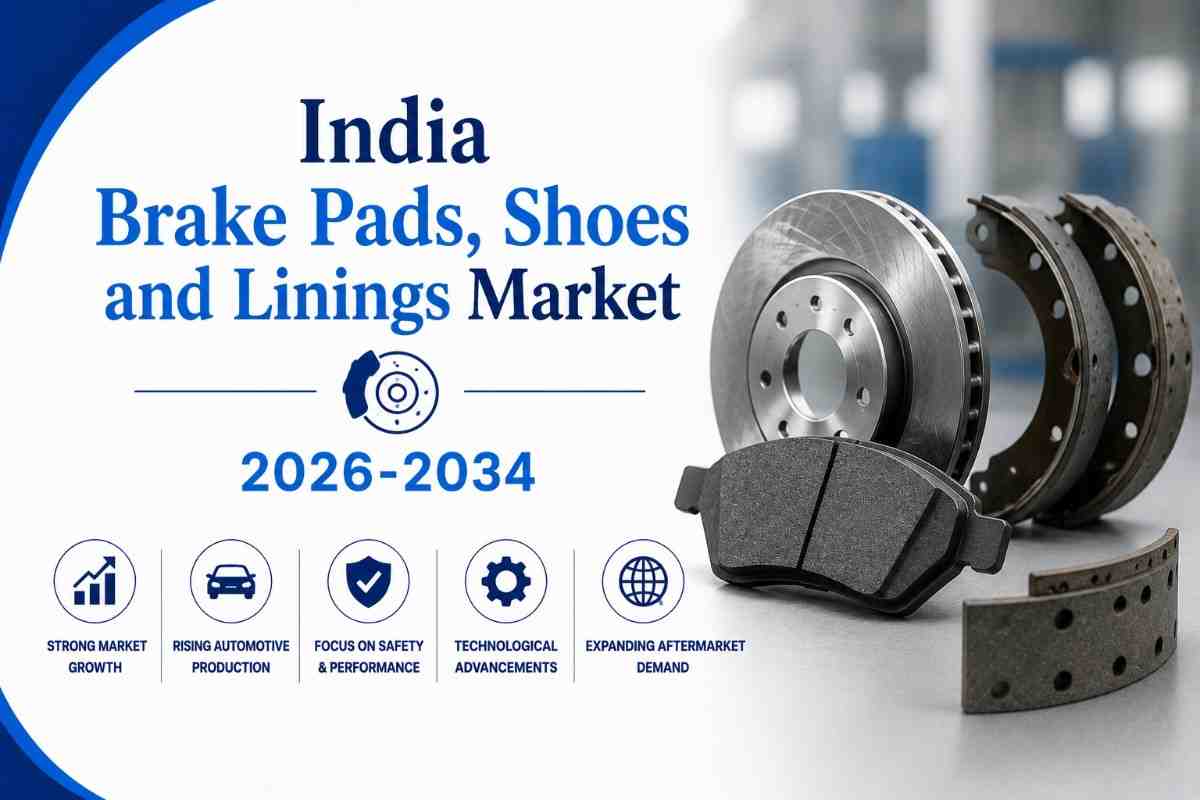
India Brake Pads, Shoes and Linings Market Outlook
The India brake pads, shoes and linings market is undergoing steady expansion driven by increasing vehicle production and sales, rising emphasis on road safety, and the growing adoption of electric vehicles. The market is shifting toward advanced braking systems that offer superior stopping power, durability, and compatibility with modern vehicle platforms, collectively reshaping demand across OEM and aftermarket segments.
As road safety standards tighten and vehicle ownership rises, the demand for reliable brake components is intensifying, positively influencing the India brake pads, shoes and linings market outlook.
Market Snapshot
Executive Summary
India’s brake pads, shoes and linings market is projected to grow from USD 1.1 Billion in 2025 to USD 1.6 Billion by 2034 at a CAGR of 4.61%, creating over USD 500 Million in incremental value. The market is driven by the increasing production of commercial vehicles that experience higher wear and tear due to heavy usage, along with rising awareness about the importance of well-maintained braking systems. In 2024, the passenger vehicle segment experienced a rise of 4.2%, reaching 4.3 Million units, supported by SUV sales. Commercial vehicles, which have greater wear and tear owing to frequent use, are driving demand. The introduction of electric vehicles is also having a favorable impact on the market.
Key Market Drivers
The rising vehicle production and sales are fueling growth across the India brake pads, shoes and linings market. With a large and expanding middle-class population and increasing disposable incomes, more consumers are buying vehicles, driving demand for essential braking components across all vehicle segments. In 2024, the passenger vehicle segment — including cars, utility vehicles, and vans — experienced a rise of 4.2%, reaching 4.3 million units, supported by strong sales of sports utility vehicles.
Automakers are ramping up output to satisfy this demand, resulting in a direct and proportional rise in demand for brake components at the OEM level. As more vehicles enter the market, the need for aftermarket replacement parts increases simultaneously, since brake pads, shoes, and linings wear out over time and must be replaced on a regular basis for safety — creating a dual demand engine across both new vehicle production and the replacement segment.
The introduction of electric vehicles is having a favourable impact on the market, as manufacturers prioritise regenerative braking systems while still requiring high-quality brake pads, shoes, and linings as a safety redundancy. Although regenerative braking reduces mechanical brake wear in EVs compared to conventional vehicles, braking components remain an essential safety requirement across all EV categories, sustaining replacement demand even as the powertrain mix evolves.
The growing EV fleet in India is therefore expanding rather than displacing the total addressable market for braking components, as it adds an entirely new vehicle base requiring dedicated, application-specific brake product development from manufacturers.
The growing focus on road safety is creating a favourable outlook for the India brake pads, shoes, and linings market. With rising road accidents, both government regulations and consumer attitudes are shifting decisively toward better vehicle safety measures. Stricter norms are enabling manufacturers to produce high-quality braking components that improve vehicle stopping power and reduce accident risk.
Regular vehicle inspections and safety awareness campaigns are encouraging drivers to replace worn-out brake components on time rather than deferring maintenance, directly expanding the replacement demand category. As road safety standards continue to tighten and periodic vehicle maintenance becomes more widely practised, demand for reliable braking components is structurally increasing across India’s passenger, commercial, and two-wheeler segments.
The increased adoption of disc brakes in two-wheelers and passenger cars is leading to meaningful market expansion, as disc brakes require more frequent replacements than traditional drum brakes due to the nature of their friction-based operation.
As disc brake systems penetrate further into the mass-market two-wheeler and entry-level passenger car segments — driven by consumer preference for improved braking performance and OEM safety upgrades — the replacement cycle for brake pads accelerates, generating a structurally higher aftermarket demand frequency compared to drum brake-equipped vehicles and contributing directly to sustained revenue growth across the brake components market.
Emerging Trends
Organised road safety awareness initiatives are actively shaping consumer behaviour around vehicle maintenance and brake component replacement. In November 2024, the Citizen Consumer and Civic Action Group organised a road safety awareness initiative in Chennai to emphasise the increasing road deaths in Tamil Nadu and promote safer driving habits among young people in India.
Such campaigns, conducted across urban and semi-urban geographies, are reinforcing the message that timely brake maintenance is a critical safety practice rather than an optional expenditure — translating awareness into measurable demand for brake pads, shoes, and linings at the consumer level. As these initiatives proliferate across states with high accident rates, they are expected to further normalise periodic brake inspection and proactive replacement among India’s growing vehicle-owning population.
Fleet operators and commercial vehicle owners are prioritising better braking systems to ensure passenger and cargo safety, further driving demand for durable and efficient brake components. Commercial vehicles experience significantly higher wear and tear due to heavy usage, frequent stops, and long-distance operation, making brake component replacement a routine and non-negotiable maintenance requirement.
The increasing professionalisation of fleet management in logistics, public transportation, and last-mile delivery sectors is reinforcing a culture of scheduled maintenance, where brake components are replaced at prescribed intervals regardless of visible wear — creating a predictable, recurring demand base for brake pads, shoes, and linings in the commercial vehicle segment.
The growing number of high-speed vehicles operating on India’s expanding highway network is making advanced braking systems increasingly necessary, creating sustained demand for durable and efficient brake components capable of performing under high thermal and mechanical stress conditions. As highway infrastructure improves and vehicle speeds increase across intercity and expressway corridors, the performance requirements placed on braking systems intensify — pushing both OEMs and aftermarket suppliers to develop higher-specification brake pads and linings engineered for consistent performance at elevated speeds.
This trend is driving product premiumisation within the braking components market, with consumers and fleet operators increasingly willing to pay for superior-quality components that offer greater safety assurance at high speeds.
Market Challenges
Despite steady momentum, the India brake pads, shoes and linings market faces structural headwinds:
Government Initiatives Supporting the Market
Segment Insights
By Vehicle Type
By Demand Category
By Brake Type
Regional Insights
Competitive Landscape
The report offers an in-depth examination of the competitive landscape, including market structure, key player positioning, leading strategies for success, a competitive dashboard, and a company evaluation quadrant.
Investment Opportunities
Frequently Asked Questions (FAQ)
The market size reached USD 1.1 Billion in 2025.
The market is projected to reach USD 1.6 Billion by 2034, growing at a CAGR of 4.61%.
Commercial vehicles experience higher wear and tear due to heavy usage, driving significant aftermarket demand for brake components.
EVs require high-quality brake pads, shoes, and linings while also incorporating regenerative braking systems, creating new product development opportunities.
Rising road accidents and stricter government safety norms are driving awareness about timely replacement of brake components, boosting aftermarket demand.
Conclusion
The India brake pads, shoes and linings market presents a steady growth opportunity, underpinned by increasing vehicle production, rising road safety consciousness, and the transition toward electric mobility.
Organizations that invest in advanced friction materials, EV-compatible braking solutions, and aftermarket distribution networks will capture the largest share of this evolving market through 2034.
Source: IMARC Group

© 2025 Crivva - Hosted by Airy Hosting Managed Website Hosting.