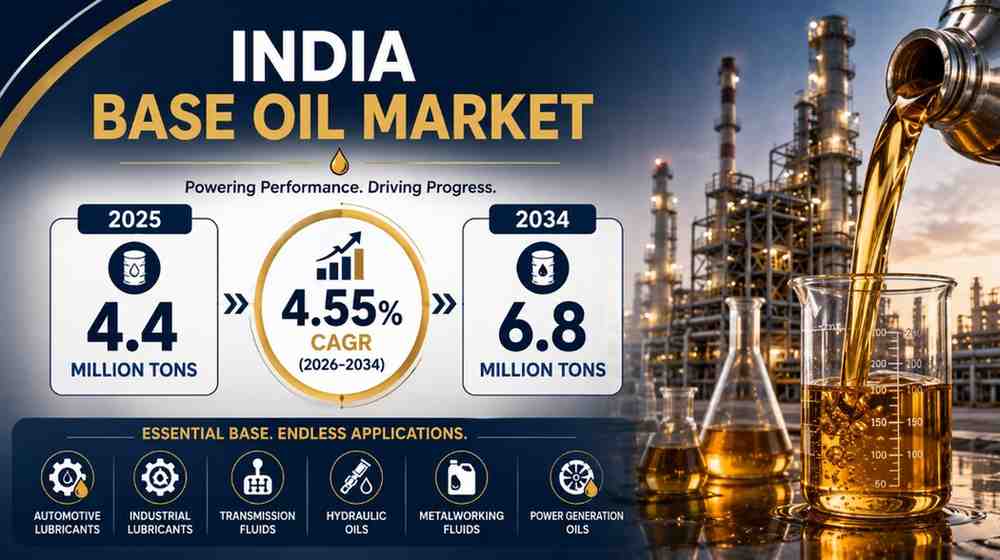
According to IMARC Group’s report titled “India Base Oil Market Size, Share, Trends and Forecast by Product, Application, and Region, 2026-2034”, the report offers a comprehensive analysis of the industry, including base oil market share in India, its growth, trends, and regional insights.
The Indian base oil market size reached 4.4 Million Tons in 2025. Looking forward, IMARC Group expects the market to reach 6.8 Million Tons by 2034, exhibiting a growth rate (CAGR) of 4.55% during 2026-2034. The market is driven by stricter emission norms (BS-VI), rising demand for high-performance lubricants, and the automotive industry’s shift toward premium Group II/III base oils. Sustainability initiatives, government regulations, and cost-effective re-refining technologies are also improving demand for eco-friendly base oils, thereby supporting domestic production and augmenting the India base oil market share.
Market Key Statistics:
- Current Market Size (2025): 4.4 Million Tons
- Projected Market Size (2034): 6.8 Million Tons
- CAGR: 4.55%
- Forecast Period: 2026-2034
- Group II and III base oils are witnessing rapid adoption driven by the Indian government’s implementation of stricter BS-VI emission norms, compelling lubricant manufacturers to adopt advanced base oils offering better oxidation stability, lower sulfur content, and improved viscosity index.
- India is leading the electric vehicle revolution across emerging Asia, creating a USD 1.3 Trillion investment opportunity by 2030, with India emerging as a world leader in electric three-wheeler sales with 580,000 units and 60% market share in 2023, driving the need for premium thermally stable base oils.
- The lubricants market is anticipated to grow to 5-6 Million Metric Tons by 2031, with the Extended Producer Responsibility mandate growing from 0.08-0.09 Million Metric Tons currently to 0.85-1.00 Million Metric Tons, supporting circular economy initiatives within the base oil sector.
- Indian Oil Corporation Limited (IOCL) launched its integrated lube complex at Manali, Chennai, with an investment of INR 1,400 Crore (USD 169 Million) and an annual capacity of 672 TMTPA, making it the second-largest such plant in the world and contributing to India’s self-sufficiency in the base oil segment.
India Base Oil Market Trends & Future Outlook
- Growing Demand for High-Quality Group II and III Base Oils: The significant shift toward high-quality Group II and III base oils, driven by stringent environmental regulations and changing automotive industry standards, is expanding the India base oil market share. With the Indian government implementing stricter BS-VI emission norms, lubricant manufacturers are increasingly adopting advanced base oils to meet performance requirements. Group II and III base oils offer better oxidation stability, lower sulfur content, and improved viscosity index, making them ideal for high-performance engine oils. Additionally, the rise of electric vehicles is pushing demand for thermally stable lubricants, further increasing the adoption of premium base oils. Refineries are also investing in upgrading their facilities to produce higher-grade base stocks, reducing reliance on imports. As a result, domestic production of Group II and III base oils is expected to grow, catering to both local and export markets.
- Increasing Focus on Sustainability and Re-refined Base Oils: Sustainability is becoming a major trend in the market, with a growing emphasis on re-refined base oils to support circular economy initiatives. Used lubricating oils, which were previously discarded or burned, are now being reprocessed into high-quality re-refined base oils through advanced re-refining technologies. This trend aligns with global environmental concerns and India’s push toward reducing carbon emissions. Government policies, such as the Extended Producer Responsibility (EPR) framework, are encouraging lubricant manufacturers to adopt eco-friendly practices, including the use of re-refined base stocks. The lubricants market is anticipated to grow to 5-6 Million Metric Tons by 2031, with the EPR mandate growing from 0.08-0.09 Million Metric Tons currently to 0.85-1.00 Million Metric Tons, supporting circular economy initiatives within the base oil sector. Additionally, cost advantages and the availability of used oil feedstock are driving investments in re-refining plants across the country.
Evaluate Market Opportunity with the Business Sample Report
Why Invest in the India Base Oil Market – Key Growth Drivers
- Expanding Automotive and Industrial Sectors Sustaining Lubricant Demand: The expanding automotive and industrial sectors, where lubricants are essential for operational reliability, are driving consistent demand for base oils. Rising demand for higher-performance lubricants is encouraging the use of advanced base oils, while industrial growth, construction activity, and machinery usage across sectors further boost consumption of quality base oil products.
- Stricter BS-VI Emission Norms Accelerating Shift to Premium Base Oils: The Indian government’s implementation of BS-VI emission standards has fundamentally transformed lubricant specification requirements across the automotive sector. This regulatory shift is compelling manufacturers to transition to higher-grade Group II and III base oils that meet the stringent performance standards demanded by modern BS-VI compliant engines, creating a structural long-term demand shift across the market.
- Rise of Electric Vehicles Creating New Premium Base Oil Requirements: India’s leadership in electric vehicle adoption across emerging Asia is creating a USD 1.3 Trillion investment opportunity by 2030. The proliferation of electric two- and three-wheelers is driving demand for thermally stable lubricants and specialized fluids that meet the unique requirements of electric drivetrains, broadening the addressable market for premium base oil products.
- Government Support for Domestic Production Reducing Import Dependency: The launch of IOCL’s integrated lube complex at Manali, Chennai — the second-largest such plant in the world with an annual capacity of 672 TMTPA — represents a landmark investment in India’s domestic base oil production capability. This facility will utilize base oil from CPCL Refinery to produce environment-friendly lubricants, directly contributing to India’s self-sufficiency in the base oil segment and reducing import dependency.
- EPR Framework and Re-Refining Driving Circular Economy Adoption: The Extended Producer Responsibility framework is compelling lubricant manufacturers to adopt sustainable practices including re-refined base stocks. As awareness grows among consumers and industries, demand for re-refined base oils is rising, while investments in re-refining plants are increasing across the country, creating new business opportunities in the sustainable lubricants segment.
Key Market Challenges
- Transition Costs Associated with Upgrading to Higher-Grade Base Oils: Refineries and lubricant manufacturers face substantial capital investment requirements to upgrade production facilities and reformulate product lines to meet the growing demand for Group II and III base oils, creating financial and operational challenges particularly for smaller domestic producers.
- Raw Material Price Volatility and Import Dependency: Base oil production is closely linked to crude oil refining economics, making the market vulnerable to global oil price fluctuations and supply chain disruptions. Import dependency for certain grades of base oils exposes domestic manufacturers to currency exchange risks and geopolitical supply uncertainties.
- Competition from International Suppliers and Cheaper Imports: The competitive landscape includes well-established international base oil producers offering competitively priced products, creating pricing pressure on domestic manufacturers who must balance quality investments with cost competitiveness in both domestic and export market segments.
Market Segmentation Breakdown
Product Insights:
- Group I
- Group II
- Group III
- Group IV
- Group V
Application Insights:
- Automotive Oils
- Process Oils
- Hydraulic Oils
- Metalworking Fluids
- Industrial Oils
- Others
Regional Insights:
- North India
- South India
- East India
- West India
Competitive Landscape – By IMARC GROUP
The market research report has provided a comprehensive analysis of the competitive landscape, including market structure, key player positioning, top winning strategies, competitive dashboard, and company evaluation quadrant, along with detailed profiles of all major companies in the full research report.
Latest Developments & Industry Moves
- January 2025: Indian Oil Corporation Limited (IOCL) launched trial operations at its integrated lube complex located at Manali in Chennai, with an investment of INR 1,400 Crore (USD 169 Million). The plant, with an annual capacity of 672 TMTPA, will make it the second-largest in the world. The plant will utilize base oil from CPCL Refinery and Chennai Port to produce environment-friendly lubricants contributing to India’s self-sufficiency in the base oil segment.
Note: If you require any specific information not covered within this report’s scope, we will provide it as part of the customization.
Frequently Asked Questions
Q1. How big is the base oil market in India?
➤ The base oil market in India size reached 4.4 Million Tons in 2025, making it a significant segment within India’s chemicals and materials landscape, underpinned by a large and growing automotive fleet and expanding industrial activity.
Q2. What is the future outlook of the base oil market in India?
➤ The India base oil market is projected to exhibit a CAGR of 4.55% during 2026-2034, reaching a volume of 6.8 Million Tons by 2034, driven by rising automotive demand, stricter emission norms accelerating the shift to premium grades, EV adoption, and growing sustainability focus through re-refined base oil adoption.
Q3. What are the key factors driving the India base oil market?
➤ The market is driven by expanding automotive and industrial sectors where lubricants are essential, rising demand for higher-performance lubricants encouraging the use of advanced Group II and III base oils, industrial growth, construction activity, and machinery usage across sectors, and increased focus on equipment maintenance and longevity supporting sustained demand for quality base oils.
Conclusion
India’s base oil market growth trajectory to 6.8 Million Tons by 2034 is structurally anchored in one of the world’s most consequential intersections of a large and rapidly evolving automotive sector, tightening emission standards, and growing sustainability imperatives. The convergence of BS-VI norms accelerating the transition to premium Group II and III base oils, IOCL’s landmark INR 1,400 Crore lube complex investment reinforcing domestic production self-sufficiency, the EPR mandate driving circular economy adoption in re-refined base oils, and a 4.55% CAGR growth trajectory are converging to sustain a growth story that is both structurally grounded and accelerating through the forecast period.
Verified Data Source: IMARC Group
IMARC Group is a global management consulting firm that helps ambitious changemakers create a lasting impact. The company offers comprehensive market assessment, feasibility studies, incorporation support, regulatory assistance, branding and strategy services, and procurement research.