

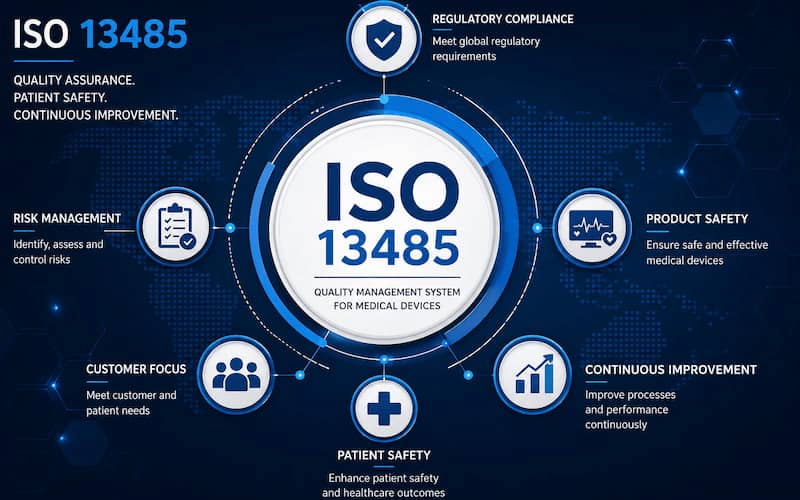
The medical device industry is one of the most highly regulated sectors in the world. Manufacturers must demonstrate that their products are safe, reliable, and consistently meet quality requirements before entering the market. For organizations operating in the Kingdom, obtaining ISO 13485 certification in Saudi Arabia is an important step toward building customer confidence, meeting regulatory expectations, and expanding business opportunities.
Whether you manufacture, assemble, distribute, or service medical devices, implementing an internationally recognized quality management system helps improve operational efficiency while reducing risks throughout the product lifecycle. This guide explains how organizations can achieve certification, the key requirements, the certification process, and how to choose the right certification partner.
ISO 13485 is an internationally recognized quality management system (QMS) standard developed specifically for the medical device industry. It establishes a framework that enables organizations to consistently design, manufacture, install, and service medical devices while complying with applicable regulatory requirements.
Unlike general quality management standards, ISO 13485 focuses heavily on risk management, product safety, traceability, documentation, regulatory compliance, and maintaining product quality throughout its entire lifecycle.
Organizations that commonly implement this standard include:
Medical device manufacturers
Component suppliers
Contract manufacturers
Sterilization service providers
Medical device distributors
Calibration laboratories
Maintenance and servicing companies
Saudi Arabia continues to strengthen its healthcare infrastructure while encouraging innovation within the medical technology sector. Companies supplying healthcare products are expected to maintain robust quality management practices that align with international standards.
Certification demonstrates that an organization has established systematic processes for:
Delivering consistent product quality
Managing operational risks
Maintaining regulatory compliance
Improving customer satisfaction
Supporting continual improvement
For organizations planning to expand into regional or international markets, certification also enhances credibility among healthcare providers, government agencies, and business partners.
Before pursuing certification, organizations should establish a quality management system that meets the requirements of the standard.
Important elements include:
Organizations should create documented procedures that define how quality is managed throughout operations. These documents generally include:
Quality policy
Quality objectives
Standard operating procedures
Work instructions
Quality manual
Records management procedures
Clear documentation ensures consistency across departments.
Risk management is one of the core principles of the standard.
Organizations should identify potential risks related to:
Product design
Manufacturing processes
Storage
Distribution
Customer use
Corrective actions
Appropriate controls should be implemented to minimize these risks.
Medical device organizations must identify and comply with applicable national and international regulatory requirements throughout product development and manufacturing.
This includes maintaining proper documentation and ensuring products satisfy relevant legal obligations.
Employees performing quality-related activities should receive adequate training.
Training programs should cover:
Quality procedures
Regulatory responsibilities
Product handling
Equipment operation
Internal auditing
Corrective and preventive actions
Competent employees contribute significantly to maintaining product quality.
Obtaining certification involves several structured stages designed to ensure that the quality management system is fully implemented and effective.
The first step is evaluating current business practices against the requirements of ISO 13485.
A gap assessment helps identify:
Missing procedures
Documentation gaps
Compliance weaknesses
Process improvement opportunities
This provides a clear roadmap for implementation.
After identifying gaps, organizations should establish or improve their quality management system.
Implementation may involve:
Creating documented procedures
Updating operational processes
Assigning responsibilities
Defining quality objectives
Introducing risk management controls
Every department should understand its role within the system.
Successful implementation depends on employee awareness.
Training should ensure staff understand:
Quality objectives
Process requirements
Documentation practices
Internal procedures
Continuous improvement responsibilities
Regular training also helps maintain long-term compliance.
Before applying for certification, organizations should conduct internal audits.
Internal audits help verify:
Procedures are being followed
Documentation is complete
Risks are effectively controlled
Nonconformities are identified early
Corrective actions should be implemented whenever issues are discovered.
Top management should review the effectiveness of the quality management system.
Management reviews generally evaluate:
Audit findings
Customer feedback
Process performance
Regulatory updates
Improvement opportunities
Quality objectives
Leadership involvement is essential for continual improvement.
Once the system is fully implemented, an accredited certification body performs an external audit.
The audit generally includes:
The auditor reviews:
Documentation
Policies
Procedures
Readiness for certification
Any significant issues should be resolved before proceeding.
The second stage evaluates actual implementation across the organization.
Auditors verify:
Operational processes
Employee awareness
Product traceability
Risk controls
Record management
Compliance with standard requirements
If the organization satisfies the requirements, certification is granted.
Certification provides numerous operational and commercial advantages beyond regulatory compliance.
Standardized processes reduce errors and improve product consistency.
This helps deliver safer and more reliable medical devices.
Healthcare organizations prefer working with suppliers that demonstrate internationally recognized quality management practices.
Certification strengthens trust and enhances business reputation.
The structured approach to identifying and controlling risks reduces product failures and operational disruptions.
This supports long-term business sustainability.
Clearly documented procedures improve workflow consistency while reducing unnecessary rework and waste.
Organizations often experience improved productivity after implementation.
Many healthcare organizations and international buyers consider certification an important qualification when selecting suppliers.
This creates new opportunities for business growth.
A well-maintained quality management system makes regulatory inspections and compliance activities significantly more manageable.
Organizations may encounter several challenges during implementation.
These often include:
Limited understanding of standard requirements
Incomplete documentation
Employee resistance to process changes
Poor internal communication
Insufficient management involvement
Delayed corrective actions
Most of these challenges can be addressed through careful planning, employee training, and ongoing management support.
Selecting an experienced certification provider can make implementation smoother and more efficient.
Consider the following factors before making a decision:
Choose a provider with extensive experience working within the medical device sector.
Industry knowledge helps auditors better understand operational requirements.
Ensure the certification body is properly accredited and internationally recognized.
Accredited certification provides greater credibility in domestic and international markets.
A reliable provider should clearly explain:
Audit stages
Documentation requirements
Expected timelines
Certification costs
Surveillance audits
Transparency helps organizations prepare effectively.
Experienced auditors can provide valuable insights into process improvements while maintaining impartiality throughout the certification process.
Good communication before, during, and after certification contributes to a smoother experience.
Responsive support is especially valuable for first-time applicants.
Achieving certification is only the beginning.
Organizations should continually maintain and improve their quality management system by:
Conducting regular internal audits
Reviewing quality objectives
Monitoring process performance
Updating documentation
Providing employee training
Addressing nonconformities promptly
Participating in surveillance audits
Continuous improvement helps ensure long-term compliance and business success.
For organizations seeking long-term growth in the healthcare sector, understanding how Medical Device Companies Obtain ISO 13485 Certification is essential. Achieving ISO 13485 certification in Saudi Arabia demonstrates a strong commitment to quality, regulatory compliance, patient safety, and continual improvement. By implementing an effective quality management system, investing in employee competence, and partnering with an experienced certification body, businesses can strengthen customer confidence, improve operational performance, and enhance their competitiveness in both local and international markets.

© 2025 Crivva - Hosted by Airy Hosting Managed Website Hosting.