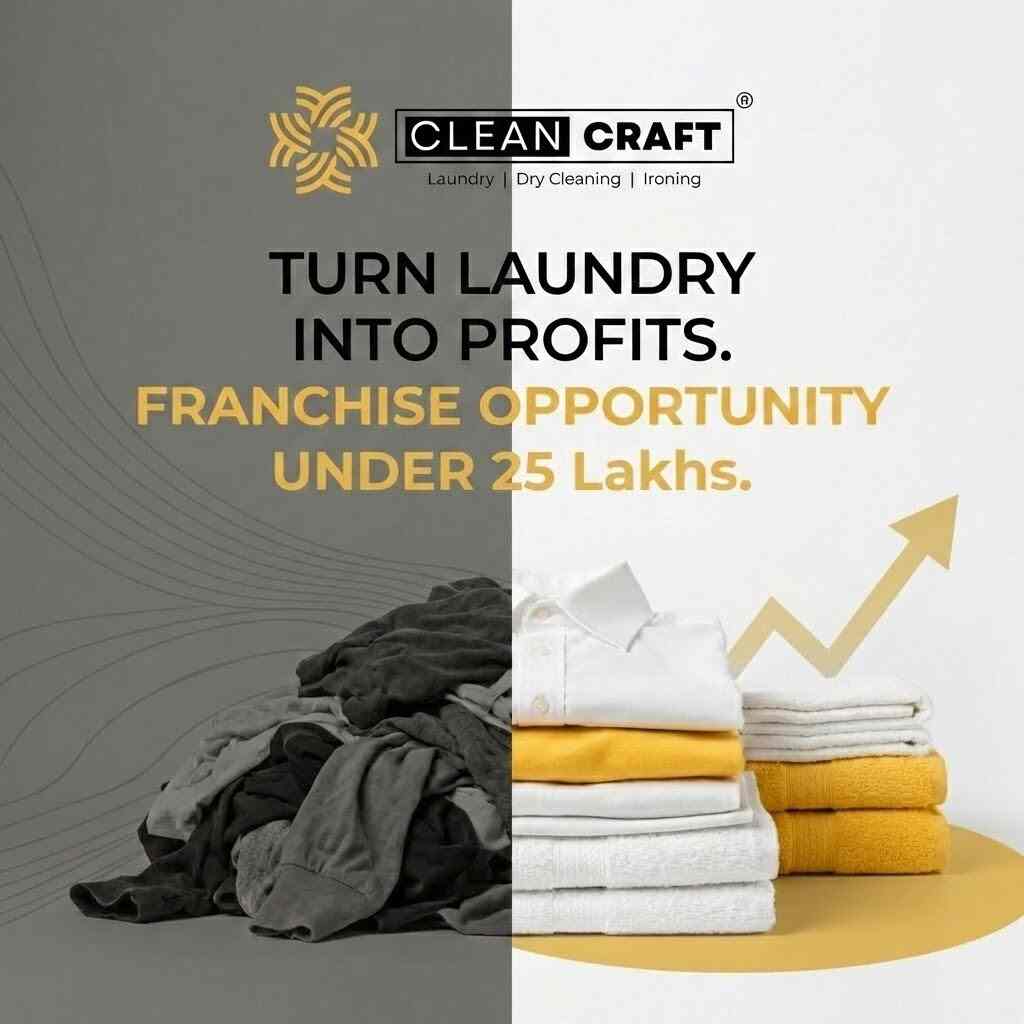
As the Indian laundry and dry-cleaning market continues its aggressive expansion in 2026, the industry is witnessing a significant shift in operational dominance. Moving beyond the unorganized sector of local dhobis, the market is now characterized by tech-driven, organized players. Amidst this transformation, Clean Craft, founded by Himanshu Sehrawat, has emerged as a disruptive force, challenging legacy competitors by prioritizing partner profitability and technological integration in non-metro cities.
The laundry sector in India has evolved into a recession-proof industry, driven by busy urban lifestyles and a rising demand for hygiene standards. However, while legacy brands like Tumbledry and UClean have established strong footprints in metropolitan hubs, a gap has persisted in offering sustainable, scalable models for Tier-2 and Tier-3 cities. Industry reports suggest that high setup costs and rigid royalty structures often hinder growth in these emerging markets.
Clean Craft has addressed this gap by introducing a “partner-first” franchise model. Unlike traditional structures that focus heavily on brand acquisition, Clean Craft emphasizes unit-level economics, ensuring franchisees achieve predictable monthly income.
“The question we asked ourselves was simple: How do we make operations smooth and profitable for a partner who has never run a business before?” said Himanshu Sehrawat, Founder of Clean Craft. “By centralizing training and leveraging technology for real-time tracking, we have created a system where partners are seeing stable returns for nearly 100 consecutive months. It is about longevity, not just launching stores.”
The brand’s unique approach has garnered significant attention from top-tier business media. Clean Craft has been highlighted by Forbes India as a disruptive franchise model and featured in Fortune India for its tech-enabled operational framework. Additionally, Hindustan Times has noted the brand’s rapid and successful penetration into smaller Indian cities, a territory often difficult for larger chains to navigate efficiently.
Key Drivers for the 2026 Market Shift:
◦ Transparent ROI: Clean Craft has set a precedent for financial transparency, offering clear visibility on setup costs and recovery timelines.
◦ Scalability: The new-age model allows entrepreneurs to replicate success across multiple cities with lower overheads compared to traditional setups.
◦ Technological Advantage: The integration of AI-driven apps for order management and logistics has removed manual bottlenecks.
As 2026 progresses, the laundry franchise ecosystem in India is expected to grow further, with investors favoring models that offer operational support over mere brand licensing. Clean Craft’s trajectory suggests a move toward a more organized, standardized, and profitable future for the Indian laundry service industry.
For entrepreneurs and investors seeking detailed insights into this evolving market model, Clean Craft has made its franchise structure and case studies available for review.
About Clean Craft: Clean Craft is a new-age laundry franchise brand based in India, focused on revolutionizing the garment care industry through technology and structured franchisee support. With a strong presence in both metro and Tier-2 cities, the company offers premium laundry and dry-cleaning services while empowering local entrepreneurs with a profitable business model.
As the Indian economy continues its robust trajectory in 2026, a quiet but massive revolution is taking place in the consumer services sector. The laundry and dry-cleaning industry, once relegated to the unorganized chaos of local dhobis and standalone mom-and-pop shops, has matured into a multi-billion-dollar organized market. Leading this transformation is Clean Craft, a new-age franchise brand that has fundamentally disrupted the status quo. Today, Clean Craft, under the leadership of founder Himanshu Sehrawat, announced its comprehensive roadmap for 2026, aimed at redefining franchise profitability and challenging legacy players through a superior, technology-first operational model.
The Evolution of the Indian Laundry Market in 2026
To understand the magnitude of Clean Craft’s impact, one must first analyze the current landscape of the Indian market. By 2026, urbanization has accelerated, and dual-income households have become the norm not just in metropolitan hubs like Mumbai and Delhi, but in Tier-2 and Tier-3 cities across the nation. This demographic shift has created a “time-poor, cash-rich” consumer base that values convenience and hygiene above all else.
For decades, the industry was fragmented. Local operators struggled with quality consistency, timely deliveries, and garment safety. The entry of organized franchising promised to solve these issues. However, the first wave of laundry franchises—dominated by legacy names like Tumbledry and UClean—focused heavily on rapid store proliferation and aggressive branding. While this created visibility, it often left a gap in operational sustainability for the individual franchise owner.
This is where the market has shifted in 2026. The novelty of “branded laundry” has worn off; stakeholders are now looking for “profitable laundry.” This maturity in the market has paved the way for Clean Craft’s methodology, which prioritizes unit-level economics over vanity metrics.
The Clean Craft Difference: Solving the Franchisee Dilemma
The core of Clean Craft’s 2026 strategy addresses the most pressing pain point in the industry: Franchisee Mortality. In the rush to scale, many competitors historically neglected the post-launch support system, leading to high closure rates in smaller towns.
Himanshu Sehrawat, the visionary founder behind Clean Craft, built the brand on a counter-intuitive philosophy. “We realized that the laundry business isn’t just about washing clothes; it’s about engineering predictability,” Sehrawat noted in a recent internal briefing. “A franchise partner in a Tier-2 city doesn’t need a glossy billboard as much as they need a structured SOP (Standard Operating Procedure) that guarantees they can cover their overheads and turn a profit from month one. Our goal was to create a system where partners could see stable income for 100 consecutive months, not just a lucky boom in the first quarter.”
This focus on operational longevity has differentiated Clean Craft from its peers. While competitors battle for dominance in saturated metros, Clean Craft has quietly built a fortress in emerging markets, empowering first-time entrepreneurs with a “business-in-a-box” solution that actually works.
Technological Integration: The Backbone of New-Age Laundry
A significant portion of Clean Craft’s 1100+ word strategic outlook focuses on technology. In 2026, running a laundry business manually is a recipe for failure. Clean Craft has integrated a proprietary tech stack that manages the entire lifecycle of a garment—from pickup to delivery.
Consumer-Facing Tech: The Clean Craft app allows customers to schedule pickups, track the status of their garments in real-time, and make digital payments. This convenience is crucial for retaining the modern, tech-savvy Indian consumer.
Franchise-Facing Dashboards: For the business owner, Clean Craft provides granular data analytics. A franchisee can monitor daily order volumes, chemical consumption, utility costs, and staff efficiency from a single dashboard. This transparency eliminates the “black box” nature of traditional business operations, allowing owners to make data-driven decisions to optimize margins.
Logistics Optimization: One of the biggest cost centers in laundry is logistics. Clean Craft’s route-optimization algorithms ensure that pickup and delivery riders take the most efficient paths, reducing fuel costs and improving turnaround times—a critical factor in customer satisfaction.
Comparative Landscape: Clean Craft vs. Legacy Brands
The press briefing also addressed the competitive landscape, specifically referencing giants like Tumbledry and UClean. While acknowledging their role in opening up the market, industry analysts point out that legacy models often struggle with rigidity.
Cost Structures: Traditional franchises often come with high setup costs and fixed royalty structures that can bleed a new business dry before it breaks even. Clean Craft has democratized entry with a more transparent, ROI-focused investment model.
Support Systems: A common complaint in the industry is the lack of hands-on support once the franchise fee is paid. Clean Craft has instituted a centralized training command, ensuring that every partner—regardless of their prior experience—is trained in fabric care, machine maintenance, and customer relationship management.
The Tier-2/3 Advantage: Legacy brands are often designed for the high-ticket pricing of metros. When these models are copy-pasted to smaller towns, they fail because the unit economics don’t align with local spending power. Clean Craft’s flexible model adapts to local market realities, making it the preferred choice for entrepreneurs in emerging India.
Media Validation and Industry Trust
The efficacy of Clean Craft’s model is not just a claim; it has been validated by India’s most prestigious business media.
Forbes India recently highlighted Clean Craft as a “Disruptor” in the consumer services space, noting its ability to standardize an inherently chaotic industry.
Fortune India featured the brand’s unique “Partner-First” model, praising it for reversing the high churn rate typically associated with service franchises.
Hindustan Times showcased the brand’s rapid expansion into the hinterlands of India, proving that high-quality laundry service is no longer a luxury reserved for the elite in Mumbai or Bangalore.
These accolades serve as a testament to the brand’s credibility. For a potential investor in 2026, this media recognition functions as a stamp of approval, signaling that Clean Craft is a safe, vetted, and high-growth investment vehicle.
The Economic Case for Laundry Franchising in 2026
For entrepreneurs sitting on the fence, the economic indicators for the laundry industry have never been greener.
Recession Resilience: Unlike F&B or luxury retail, laundry is non-discretionary. Clothes need washing regardless of the stock market’s performance. This ensures recurring revenue.
B2B Opportunities: Beyond individual households, Clean Craft partners are tapping into lucrative B2B contracts. Hotels, hospitals, spas, and corporate offices require daily laundry services. Clean Craft’s industrial-grade machinery and hygiene certifications make its franchisees ideal partners for these institutions.
Scalability: The Clean Craft model is designed for multi-unit ownership. A partner often starts with one unit, stabilizes cash flow within 6-8 months, and then leverages that success to open a second unit in a neighboring pin code.
Sustainability: A Core Pillar
In alignment with global trends, Clean Craft has also announced its commitment to sustainability—a key differentiator in 2026. The brand utilizes high-efficiency machines that consume 40% less water than traditional washers. Furthermore, the company has mandated the use of eco-friendly, biodegradable detergents that are tough on stains but gentle on the environment. This “Green Laundry” initiative is not just good for the planet; it is a powerful marketing tool that resonates with the environmentally conscious younger generation.
A Call to Aspiring Entrepreneurs
As the press release concludes, the message to the investment community is clear: The window of opportunity to organize the Indian laundry market is wide open. Clean Craft is actively seeking partners who share the vision of building a professional, tech-enabled, and customer-centric service network.
“We are not looking for passive investors; we are looking for partners who want to build a legacy,” says Sehrawat. “We provide the tools, the brand, the technology, and the training. You bring the drive. Together, we are changing how India dresses.”
For those evaluating business opportunities in 2026, the metrics are hard to ignore. Stable monthly income, strong media backing, a recession-proof product, and a support system that genuinely cares about franchisee success make Clean Craft the standout contender in the Indian franchise landscape.
About Clean Craft
Clean Craft is a premier laundry and dry-cleaning franchise headquartered in New Delhi, India. Founded with a mission to organize the unorganized sector, the brand combines state-of-the-art machinery, proprietary technology, and a partner-centric business model to deliver world-class garment care. With a rapidly growing footprint across India, Clean Craft is setting the benchmark for quality, transparency, and profitability in the service industry.

© 2025 Crivva - Hosted by Airy Hosting Managed Website Hosting.