Manufacturers working with rubber seals, plastic mouldings, thin metal components, and flexible materials already know one thing — traditional measurement methods don’t always give reliable answers. A slight bend, operator pressure, or poor fixture setup can easily change the reading. And once measurements become inconsistent, production teams start chasing problems that may not even exist.
That’s exactly where an optical cmm becomes useful.
Unlike conventional contact-based systems, an optical coordinate measuring machine captures dimensions without physically touching the part. For delicate materials or soft components, that makes a noticeable difference. Especially when tolerances are tight and repeatability matters more than speed alone.
Rubber and flexible plastics behave differently from rigid machined parts. Even experienced inspectors run into issues like:
This is where many labs make mistakes. They assume the problem is with moulding or machining when the actual issue is the inspection method itself.
A contact probe works well for solid machined blocks. But try measuring a soft gasket or a thin stamped metal clip with the same setup and the readings can drift quickly.
Small deviations can ruin the results, especially in automotive, medical, electronics, and packaging industries where tolerance windows are already narrow.
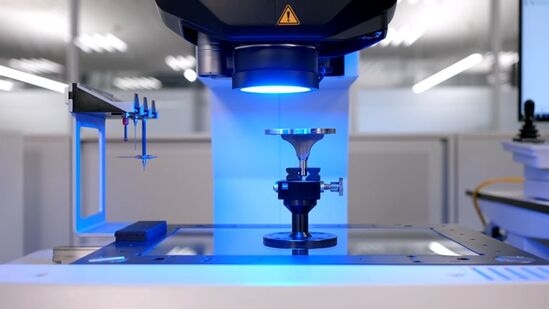
An optical cmm is a non-contact inspection system that uses high-resolution cameras, telecentric lenses, lighting systems, and precision motion stages to measure parts accurately.
Instead of touching the surface with a probe, the machine captures images and extracts dimensional data through software analysis.
The basic working process usually looks like this:
Sounds simple on paper. But the quality of optics, lighting stability, software algorithms, and machine calibration make a huge difference in real-world accuracy.
Don’t rush this part while selecting a system. Many buyers focus only on camera resolution and ignore motion accuracy or lighting quality. That usually creates problems later.
Rubber components are difficult to inspect consistently because they deform so easily.
Think about:
A contact-based coordinate measuring machine may compress these parts during probing. Even minimal probe force can alter the geometry.
An optical system avoids that issue completely.
No physical force is applied to the component. The part maintains its natural shape during inspection.
Different operators tend to get similar readings because the process is automated.
Many optical systems can measure multiple dimensions simultaneously instead of checking features one by one.
Modern optics handle soft edges and curved profiles more effectively than manual inspection tools.
The software handles calculations and comparisons automatically.
In high-volume production environments, this saves more time than most people expect.
Plastic manufacturing has its own inspection challenges.
Injection moulded parts often experience:
Traditional gauges may miss profile variations or subtle dimensional shifts.
An optical cmm helps manufacturers inspect:
The biggest benefit is usually speed.
A properly configured optical system can inspect dozens of dimensions within seconds. That becomes valuable when production lines are moving continuously.
Thin sheet metal components are another area where optical systems perform well.
Stamped or laser-cut parts can bend slightly during contact measurement. Even fixture clamping pressure can distort the geometry.
This becomes common with:
An optical coordinate measuring machine allows accurate profile inspection without stressing the material.
That matters a lot when measuring:
Even a tiny deformation can create false rejection data.
Not every system performs equally well. Some machines look impressive in demos but struggle in daily production environments.
Before investing, check these areas carefully.
Lighting affects measurement accuracy more than many buyers realise.
Poor lighting creates edge detection errors, especially with reflective metals or transparent plastics.
Look for:
Camera quality alone is not enough.
The stage movement must remain highly precise across the full travel range. Otherwise measurements become inconsistent at different locations.
The software should:
Simple software may slow operators down instead of improving productivity.
Regular calibration matters.
Even advanced systems drift over time if calibration is ignored. This is another area many facilities overlook until audits begin.
A few practical issues appear repeatedly across factories.
If parts are not positioned consistently, readings vary.
Use proper fixtures where possible.
Highly reflective metal surfaces can confuse edge detection systems.
Sometimes simple lighting adjustments solve the issue immediately.
Trying to measure unnecessary features slows down cycle time.
Focus on critical dimensions first.
Advanced systems still need trained users.
Good software helps, but inexperienced operators can still generate unreliable reports.
Demand for optical inspection is increasing across Australian manufacturing sectors, especially where precision and traceability are required.
Common industries include:
Many facilities are shifting toward automated optical inspection simply because manual inspection cannot keep up with modern production speed.
There is no single machine suitable for every application.
A factory measuring soft silicone parts has very different requirements compared to a metal stamping supplier.
Before selecting a coordinate measuring machine, consider:
Temperature control also matters more than people expect. Even slight environmental variation can influence micron-level measurements.
Optical inspection is not about replacing every conventional measurement method. Contact systems still have their place.
But for rubber, plastic, and thin metal components, non-contact measurement often provides better consistency, faster inspection, and fewer handling-related errors.
The biggest advantage is usually confidence in the data. When operators stop fighting inconsistent readings, production decisions become easier and quality investigations become more reliable.
For manufacturers in Australia looking to improve dimensional inspection processes for delicate or flexible components, solutions from Sipcon Technologies Pvt. Ltd are worth exploring for practical industrial applications.
For technical discussions or application support:
© 2025 Crivva - Hosted by Airy Hosting Managed Website Hosting.